At noon in France, something shifts. It doesn’t matter if you’re in Paris, in a market town in Burgundy, or in a village of 200 people. The streets go quieter. The brasseries fill up. The smell of something warm drifts from an open kitchen. And for the next hour or two, almost nothing else matters.
The French midday meal — le déjeuner — is not a refuelling stop. It is a ritual. And it follows rules that nobody has to write down because everyone already knows them.
Lunch Is the Main Event
The French don’t save themselves for dinner the way many cultures do. Lunch is the centrepiece of the day — bigger, slower, and more communal than the evening meal, which is often something lighter. Soup. Leftovers. A plate of charcuterie and bread.
This surprises visitors. They expect France’s legendary food culture to play out at dinner, in candlelit bistros with starched tablecloths. But the real action happens at midday, when the blackboard goes up, the carafe comes out, and the whole neighbourhood sits down together.
There is a logic to it. A proper midday meal means you go back to work fed and calm. You don’t need a heavy dinner. You sleep better. You wake hungry enough to enjoy breakfast. The French approach to food isn’t indulgent — it’s considered. The meal has a purpose beyond eating, and that purpose is the rhythm of the entire day.
Working from home has changed some of this. But millions of French people still sit down for a real lunch every single day. The habit runs too deep to shift with a global trend. It is baked into the structure of French time itself.
What Goes on the Plate
A French lunch has structure. Not a rigid formula, but a rhythm — something small to start, a warm main with vegetables, something to finish. Cheese before dessert, not after. Coffee at the end, never during the meal.
Most restaurants offer a formule at lunchtime — a fixed menu, usually two or three courses, priced for everyday eating. This is not fine dining. It is the everyday standard. The starter might be a simple salad with walnuts and lardons. The main a braised chicken with lentils. The dessert a crème brûlée or a wedge of fruit tart.
Portions are calibrated. Not large, not small. Enough. The French believe that eating a little of several things is better than eating a lot of one. The meal ends before you feel full. Twenty minutes later, you realise you are completely satisfied — and that this was the point all along.
Wine is ordered by the carafe, not the bottle. A small glass at lunch is normal, even on a Tuesday, even for the woman with an afternoon of meetings ahead. Nobody blinks. Nobody lectures. It is simply part of the meal.
The Brasserie at the Heart of Every Town
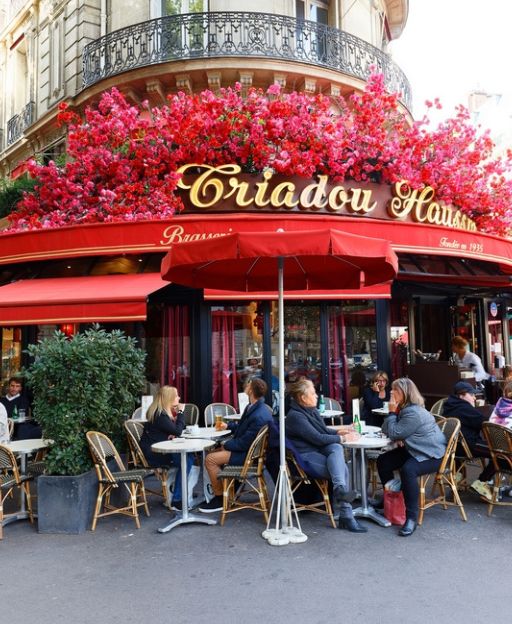
Every French town has at least one brasserie. In cities, there are dozens. These are not fancy restaurants — they are the workhorses of daily life. They open early, serve until late, and fill completely between noon and two.
The brasserie is where the plumber sits next to the bank manager. Where the same table of retired men appears three afternoons a week. Where the waiter knows your order, your name, and whether your mother is still recovering from her operation. It is community infrastructure, dressed as a restaurant.
The menu changes daily. The price is modest. The chairs are usually wicker, the tables small, the awning red or striped. Inside: slightly foxed mirrors, a well-worn bar, and a coffee machine that occupies its own corner with quiet authority. The whole atmosphere says: this place has been here before you were born, and it will be here long after.
The brasserie exists not to impress, but to anchor. It is where a neighbourhood becomes itself — a place where people who might never otherwise meet share a table, a carafe, and an hour of their ordinary day. If you want to understand what French market towns are really like, sit in a brasserie at noon. The whole town will come to you.
Enjoying this? 7,000 France lovers get stories like this every week. Subscribe free →
Children Learn It at the Table
French children eat a three-course hot lunch at school. Not sandwiches. Not reheated nuggets. Proper food — a starter, a warm main with seasonal vegetables, cheese, and dessert. The menus are drawn up weeks in advance and published so parents can see exactly what their children will eat each day.
La cantine — the school canteen — is taken seriously. Dietitians consult on the menus. Local and seasonal produce is prioritised where budgets allow. Children are required to sit at the table, to take some of everything, and to taste before deciding they don’t like it.
The rule is not about forcing children to eat. It is about teaching them that a meal deserves attention. This is food education, but not in the way most countries understand it. There are no worksheets, no food pyramids on classroom walls. The lesson happens at the table, five days a week, from the age of three. By the time French children are adults, they don’t need to be told to slow down. Slowing down is simply what lunch means.
The Unwritten Rules Everyone Follows
There are rules about lunch in France that no one explains because no one needs to. You sit down. You don’t eat standing up — not even a quick snack. You don’t check your phone at the table, and if you do, you apologise for it. You wait until everyone is served before picking up your fork.
You don’t leave while others are still eating. You don’t rush the dessert to get back to work faster. And you certainly don’t eat at your desk when there is any possible alternative. The desk lunch is not a French invention, and France has not been enthusiastic about adopting it.
These aren’t laws. They’re habits, passed through families and reinforced in schools and brasseries every single day. Breaking them doesn’t get you arrested. It just marks you out as someone who hasn’t quite understood how things work here. The French are not precious about this. They don’t lecture. They simply eat properly, and expect others to do the same.
Why France Hasn’t Given This Up
The world has moved fast. Desk lunches, delivery apps, protein bars eaten over a keyboard — all of this has reached France. And France has, largely, declined to fully adopt it. Part of this is cultural stubbornness, which the French wear openly and without apology.
But part of it is a genuine belief — backed increasingly by research — that a proper midday break makes the afternoon better. More productive, calmer, less prone to the kind of errors that come from hunger and stress. The French have been running this experiment for generations. The results, they would say, speak for themselves.
France also treats collective eating as a civic act. Sitting down with others — even strangers — is a form of social cohesion. The brasserie is not just a place to eat. It is a place where a neighbourhood becomes itself. And the lunch hour — unhurried, communal, resolutely French — is one of the things that holds it all together.
Just as the French treat the hour before dinner as sacred, the midday table is defended with the same quiet conviction. And if you’re planning a trip to France, do yourself a favour: build your days around lunch, not dinner. Order the plat du jour, take your time, and let the afternoon find its own pace. The country will reveal itself. Just don’t rush it.
There is a moment, somewhere in the middle of a French lunch, when you stop waiting for the meal to be over. The table feels right. The conversation finds its pace. The afternoon can wait. That feeling — so specific to France, so quietly insisted upon — is not something the French intend to let go. And honestly, sitting there in the sun with a carafe of something cold, you start to understand why.
Join 7,000+ France Lovers
Three times a week, get France’s hidden gems, seasonal guides, local stories, and the art of la vie française — straight to your inbox.
Subscribe free — enter your email:
Love more? Join 65,000 Ireland lovers → · Join 43,000 Scotland lovers → · Join 30,000 Italy lovers →
Free forever · Unsubscribe anytime
🇫🇷 Want More Hidden France?
Join 7,000+ subscribers who discover France’s best-kept secrets every week.
Thinking about it seriously?
If you’ve started actually planning a move, our complete our complete Moving to France guide walks through every step, every cost, and the paperwork that catches most people out.
Free forever · Unsubscribe anytime · No spam
📥 Free Download: France Travel Planning Guide
Itineraries, insider tips, and the places you must not miss on your next trip to France.
🇫🇷 You Might Also Love
Tours & experiences you might love


Powered by Viator. Some links are affiliate links — we may earn a small commission at no extra cost to you.

Leave a Reply