You have always known your family came from somewhere in France. Perhaps your surname carried a certain weight — something old, something Norman. Maybe it was Le Blanc or Morin or Dupont. Perhaps it was a name that arrived in North America with the first French settlers, survived centuries of hardship, and still sits on the end of your pen today. If your roots trace back to Normandy, your surname is not just a label. It is a door — one that opens onto Viking longships, apple orchards, limestone farmhouses, and a coastline that shaped the world.
What’s your name in French? 🇫🇷
Your French Name — type any first name for the French equivalent, with meaning and regional notes.
Normandy — Normandie in French — is one of the most historically significant regions in all of Europe. Its surnames carry the weight of that history. They were forged by Norse settlers, shaped by the Catholic Church, and carried across oceans by Acadian colonists and Québécois pioneers. If you have been searching for the meaning behind your Norman family name, this guide is for you.
Why Normandy Surnames Are Unlike Any Other in France
To understand Norman surnames, you first need to understand where Normandy came from. In 911 AD, a Viking chief called Rollo and his Norse warriors were granted land along the Seine estuary by the Frankish king, Charles the Simple. The region took its name from these newcomers: the Norsemen, or Normands.
Over the next two centuries, these Scandinavian settlers intermarried with the local Frankish and Gallo-Roman population. They adopted the French language. They converted to Christianity. But they left a permanent mark on local names. You can still hear the Norse echoes in Norman place names today — and those place names became the foundation of many Norman family surnames.
Then came 1066. When William the Conqueror crossed the Channel and won the Battle of Hastings, Norman surnames spread into England, Scotland, and Ireland. Names like De Clare, De Warenne, and Beaumont entered the English aristocracy. The Norman Conquest was, in many ways, the first great migration of French surnames into the English-speaking world.
Later, in the 17th century, thousands of Norman families sailed for New France — what is now Canada. The Acadians of Nova Scotia, the colonists of Québec and Louisiana — many carried Norman surnames that had already survived a thousand years of European history. Today, those names are found in family trees from Halifax to New Orleans.
The Most Common French Surnames from Normandy
Norman surnames tend to fall into clear categories: surnames from place names (toponymic), surnames from occupations, surnames from physical descriptions, and surnames with Norse or Germanic roots. Here are twenty of the most significant, with their origins and meanings.
1. Le Blanc / Leblanc
Meaning: “The white one.” This surname was originally a nickname describing someone with fair hair or a pale complexion. In Norman French, blanc derives from the Old Frankish word blank, meaning shining or bright. Leblanc became one of the most widespread surnames across Normandy and the former French colonies. In Acadian communities, it is still one of the most common family names found from Nova Scotia to Louisiana.
2. Morin
Meaning: Derived from the Old French word more, meaning dark-complexioned or Moorish. It may also relate to a Germanic personal name. Morin is particularly concentrated in Seine-Maritime and Calvados — the heart of historic Normandy. Many Morins emigrated to Québec in the 1600s and 1700s, where the name remains extremely common today.
3. Dupont / Du Pont
Meaning: “Of the bridge.” A toponymic surname given to families who lived near a bridge (pont). Bridges were significant landmarks in medieval Normandy’s agricultural landscape, and families living near them often took the location as their name. Dupont spread widely through New France and remains common in French-Canadian communities.
4. Bernard
Meaning: From the Old Germanic personal name Bernhard — “bear-brave” or “bold as a bear.” Bernard was a popular given name among Norman nobles and gradually became a hereditary surname. Saint Bernard of Clairvaux helped popularise the name across France in the 12th century. In Normandy, Bernard families are particularly associated with the Eure and Manche departments.
5. Robert
Meaning: From the Old German Hrodebert — “bright fame.” Robert was an enormously popular Norman given name, largely because Robert I, Duke of Normandy, was the father of William the Conqueror. The surname Robert and its variants (Roberts, Robertson) spread through England after 1066 and across New France during colonisation.
6. Leroy / Le Roy
Meaning: “The king.” This nickname surname was given to someone who played the role of a king in pageants or festivals, or who worked in the royal household. Common across northern France, including Normandy, Leroy is one of the most recognisable French surnames in North America today.
7. Legrand / Le Grand
Meaning: “The tall one” or “the great one.” A physical description surname given to someone of notable height. Common in Upper Normandy (Seine-Maritime), Legrand appears frequently in Acadian genealogical records from the 17th century onwards.
8. Gosselin
Meaning: From the Old German given name Gautzelin or Goscelin, itself derived from a Frankish tribal name. Gosselin is one of the most distinctly Norman surnames — it is rarely found outside Normandy and French Canada, making it a strong indicator of Norman ancestry. Variants include Goslin, Gosslin, and Joselin.
9. Hamon / Hamond
Meaning: From the Norse personal name Hamundr — “high protection.” This is one of the most clearly Scandinavian of all Norman surnames, a direct link to the Viking founders of Normandy. Hamon appears in the Domesday Book of 1086 as one of the Norman surnames brought to England after the Conquest. In France, it remains associated with the Seine-Maritime area.
10. Toutain / Toustain
Meaning: From the Old Norse name Thorsteinn — “Thor’s stone.” Another unmistakably Viking name, preserved in the Norman tradition. Toutain is almost exclusively Norman in its distribution across France, and genealogists tracing Norman Acadian roots frequently encounter it in 17th-century parish records from Lower Normandy.
11. Aubert
Meaning: From the Old German Adalbert — “noble and bright.” Aubert was a widely used personal name in medieval Normandy, partly due to Saint Aubert of Avranches, the bishop credited with founding the Mont-Saint-Michel abbey in the 8th century. The name became hereditary in the Manche and Calvados departments.
12. Lefebvre / Lefevre / Lefeuvre
Meaning: “The blacksmith” — from Latin faber, meaning craftsman or smith. This occupational surname was common across all of northern France, including Normandy. The many spelling variants (Lefebvre, Lefevre, Lefeuvre, Favre, Faber) reflect regional pronunciation differences. In Québec, the Lefebvre family line is one of the most documented in the province’s genealogical archives.
13. Mallet / Malet
Meaning: From the Old French mallet, meaning a hammer or mallet. This occupational or nickname surname was associated with metalworkers and was particularly prominent among Norman nobles who followed William the Conqueror to England. The Malet family held significant lands in Suffolk and Yorkshire after 1066. In Normandy, Malet remains associated with the Seine-Maritime area.
14. Courtin / Courtine
Meaning: From the Old French cort or court, meaning a courtyard or a small enclosed farm. A toponymic surname for families living near or on such a property. Common in Lower Normandy, particularly in the Manche department, and found in Acadian genealogical records from early colonial settlements.
15. Besson
Meaning: A Norman French dialect word for “twin.” This was a nickname given to a twin or to the parent of twins, and it became a hereditary surname in Normandy and the surrounding regions. Besson is found across northern France and in French-Canadian communities where Norman emigrants settled.
Enjoying this? 7,000 France lovers get stories like this every week.
Thinking about it for retirement? If you’ve started thinking seriously about retiring there, our complete our full Retire in France guide covers the visa, healthcare, cost-of-living, and the regions worth shortlisting.
Where Norman Surnames Went: Migration and the Diaspora
Norman surnames did not stay in Normandy. From the moment William the Conqueror sailed for England in 1066, Norman family names began their extraordinary journey around the world.
Norman Surnames in England
After 1066, Norman nobles brought their surnames into English aristocracy. Names like De Beaumont, De Vere, and Malet became English family names. Over centuries, many Norman French names were anglicised — De Clare became Clare, De la Mare became Delamare, and Hamon became Hammond. If your English surname has a French feel to it, Norman ancestry is quite possible.
Norman Surnames in Quebec and French Canada
The largest concentration of Norman surnames outside France is in the province of Québec. Between 1608 and 1760, thousands of settlers — the majority from Normandy, Perche, and the Paris Basin — crossed the Atlantic to build New France. Names like Morin, Gosselin, Dupont, Aubert, and Besson appear constantly in the Registre de la population du Québec ancien, the comprehensive database of early French-Canadian settlers.
If your French-Canadian surname traces back to 17th-century Normandy, the departmental archives of Seine-Maritime, Calvados, Manche, Eure, and Orne are the places to search. Many records are now digitised. You can read about how to begin that search in our guide on how to trace your French ancestry.
Norman Surnames in Acadia (Nova Scotia and New Brunswick)
The Acadians — French settlers of Atlantic Canada, particularly Nova Scotia and New Brunswick — were largely of Norman and Poitevin descent. Before the British deportation of 1755, known as the Grand Dérangement, Acadian communities carried surnames like Leblanc, Thibodeau, Robichaud, and Arsenault. Many of these names trace directly to Normandy and the Loire region. After the deportation, scattered Acadian families ended up in Louisiana (where they became the Cajuns), in France, and eventually some returned to Maritime Canada.
If your family carries an Acadian surname, Normandy is a likely point of origin — and the village of origin may still be identifiable through the Archives nationales d’outre-mer in Aix-en-Provence.
Regional Variations: Upper Normandy vs Lower Normandy
Normandy is historically divided into two broad regions: Upper Normandy (Haute-Normandie), centred on Rouen and the Seine valley, and Lower Normandy (Basse-Normandie), centred on Caen and the Cotentin Peninsula.
Surnames in Upper Normandy — particularly in the Seine-Maritime department — tend to reflect the region’s industrial and maritime history. The port city of Rouen was one of medieval Europe’s great trading centres, and its surnames include many Germanic and Norse variants carried by merchant families. Names like Grisel, Lainé, and Varin are characteristic of Upper Normandy.
Lower Normandy, by contrast, has a stronger Celtic and rural character. The Cotentin Peninsula — where Coutances and Cherbourg stand today — has surnames that reflect the bocage landscape and the old agricultural communities: names like Lebreton (meaning “the Breton,” suggesting a family of Breton origin), Cauvin, and Lemonnier.
Understanding which part of Normandy your ancestors came from can significantly narrow your genealogical search. Departmental archives are organised by the five modern departments: Seine-Maritime, Eure, Calvados, Manche, and Orne.
Visiting Normandy to Trace Your Heritage
There is nothing quite like standing in the village your ancestors left behind. Normandy is one of the most rewarding regions in France for heritage travel — not just for its World War II history, but for its deep medieval roots and extraordinary landscape.
The Normandy harbour at Honfleur, for example, was a major embarkation point for colonists sailing to New France in the 17th century. Many Norman families who became French Canadians left from ports along this coast. Walking those cobblestone quays today, you can feel the weight of that departure. Read more about the Normandy harbour that comes alive before the rest of France wakes up.
Key heritage sites in Normandy for family researchers include:
- Archives departementales de Seine-Maritime (Rouen) — holds parish records from as far back as the 16th century, now largely digitised on their website.
- Archives departementales du Calvados (Caen) — extensive records for Lower Normandy, including the Cotentin.
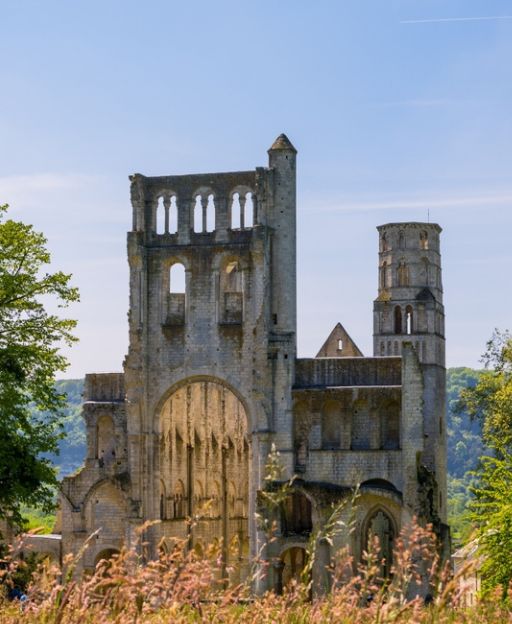
- Jumieges Abbey — one of the great Benedictine monasteries of medieval Normandy. Founded in the 7th century, it held vast records of local families before the Revolution.
- Rouen Cathedral — the seat of the Norman archbishopric. Its treasury holds extraordinary medieval records, and the city’s archives contain genealogical gold for families from Upper Normandy.
- Coutances — the episcopal centre of Lower Normandy. The surrounding Manche countryside is where many Acadian and Québécois family names originated.
For a broader guide to planning a heritage trip around France, including how to work with local archives and hire a professional genealogist, see our France trip planning guide.
How to Research Your Norman Surname
Researching a Norman surname requires combining multiple sources. Here is a practical approach for anyone working from Canada, the United States, or the UK.
Step 1: Identify the Earliest Known Record
Start with what you know. Birth certificates, marriage records, and death records in your home country will usually give you a place of origin — or at least the name of an ancestor’s parents. French-Canadian civil registration began in 1760 in Québec (church records go back to the early 1600s). Acadian records are more fragmentary but not impossible to trace.
Step 2: Use the PRDH Database for Quebec Ancestry
If your family is French-Canadian, the Programme de recherche en démographie historique (PRDH) at the Université de Montréal is your most powerful tool. It contains records of over 700,000 individuals who lived in Québec before 1800, including their places of origin in France. A subscription is required, but the information is extraordinarily detailed.
Step 3: Search FamilySearch and Ancestry
FamilySearch (free) and Ancestry (subscription) both hold large collections of digitised French civil and parish records. FamilySearch’s collection of French civil registration records covers much of the 19th century and is searchable by department. The parish records — registres paroissiaux — go back considerably further and are now being digitised by the departmental archives of France.
Step 4: Contact the Departmental Archives Directly
Each of Normandy’s five departments maintains its own archive. Most now have searchable online portals. If you cannot find what you need online, archivists can often help with written enquiries — particularly if you can provide a full name and approximate dates. The Archives de Normandie website serves as a regional portal linking all five departmental archives.
For a full step-by-step guide to researching French ancestry — including how to use civil records, notarial records, and departmental archives — read our detailed guide: How to Trace Your French Ancestry.
The Emotional Pull of a Norman Surname
There is something profoundly moving about knowing that a name you have carried your entire life was first spoken in a Norman village eight or nine centuries ago. That the person who first bore your surname — a miller, perhaps, or a blacksmith, or a tall fair-haired farmer — walked along the same chalk cliffs and apple orchards you can still visit today.
France has a way of making the past feel present. Normandy, more than most regions, carries this quality. Its ancient abbeys, its hedgerow landscapes, its grey stone farmhouses — these are not museum pieces. They are living places that have been inhabited continuously for over a thousand years. Your ancestors’ world is still there, largely intact, waiting to be rediscovered.
If you have ever read about France’s ancient pilgrimage villages, you will understand this feeling — the sense that the stones remember what the documents have forgotten. Normandy gives that feeling to anyone who comes looking.
Frequently Asked Questions About French Surnames of Normandy
What makes a surname specifically Norman rather than generally French?
Norman surnames often show one or more of three features: Norse or Old Scandinavian roots (Hamon, Toutain, Gosselin), a concentration in the five departments of historic Normandy (Seine-Maritime, Eure, Calvados, Manche, Orne), and a strong presence in French-Canadian genealogical records from the colonial period. Surnames with the prefix Le- are especially characteristic of northern French regions, including Normandy — Le Blanc, Le Roy, Le Grand — reflecting the Norman French dialect.
Are Norman and Breton surnames similar?
They are quite distinct. Breton surnames often reflect the Celtic Breton language — you will see names ending in -ec, -oc, -ez, and many names beginning with Ker- (meaning “village of”). Norman surnames, by contrast, show Germanic, Norse, and Old French roots. The name Lebreton (“the Breton”) actually appears in Normandy as a surname given to families known to have come from Brittany, which illustrates just how different the two traditions were perceived to be.
How do I know if my French-Canadian surname comes from Normandy specifically?
The PRDH database at the Université de Montréal records the French province of origin for thousands of early settlers in New France. If your ancestor arrived before 1760, there is a good chance their origin is documented. Additionally, certain surnames — Gosselin, Morin, Toutain, Hamon — are so strongly associated with Normandy that they are reliable indicators. A professional genealogist based in Rouen or Caen can also search local records on your behalf.
Can I visit the village my Norman ancestors came from?
In most cases, yes. Normandy’s villages are largely intact and many are still small agricultural communities that have changed very little over centuries. Once you have identified a commune through genealogical research, you can visit the local church (which often predates the Revolution), the mairie (town hall), and in many cases the site of the original family farmstead. Local historical societies are often very welcoming to descendants from abroad.
Are Norman surnames found in the United States?
Yes — both directly and indirectly. Some Norman surnames arrived via England after the Conquest (Hammond, Delamare, Clare). Others came through French Canada — Cajun communities in Louisiana carry many Norman surnames that arrived via Acadia in the 17th century, including Leblanc, Thibodeau, and Melanson. There were also direct French Huguenot migrations to the American colonies in the late 1600s, some from Normandy, which introduced names like Lefevre and Besson into the mid-Atlantic states.
You Might Also Enjoy
- How to Trace Your French Ancestry – A Step-by-Step Guide
- The Normandy Harbour That Comes Alive Before the Rest of France Wakes Up
- The French Village Clinging to a Cliff That Pilgrims Have Climbed for 900 Years
Plan Your France Trip
Ready to stand in the region your ancestors called home? Whether you are planning a heritage tour of Normandy’s villages and abbeys or a broader journey through the French countryside, our France trip planning guide covers everything you need — from the best times to visit to how to hire a local guide who speaks to the history your family carries.
Join 7,000+ France Lovers
Three times a week, get France’s hidden gems, seasonal guides, local stories, and the art of la vie française — straight to your inbox.
Subscribe free — enter your email:
Love more? Join 65,000 Ireland lovers · Join 43,000 Scotland lovers · Join 30,000 Italy lovers
Free forever · Unsubscribe anytime
🇫🇷 You Might Also Love
Tours & experiences you might love


Powered by Viator. Some links are affiliate links — we may earn a small commission at no extra cost to you.

Leave a Reply