
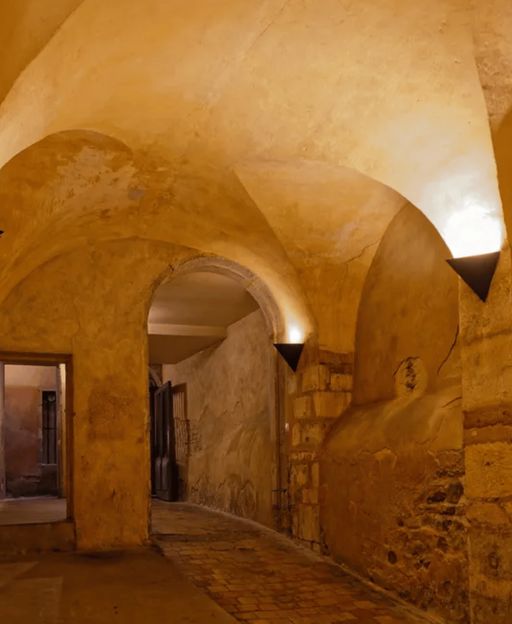
Push open a door in Lyon’s old city and you might walk straight into someone’s living room. Or so it seems. What you actually step into is a traboule — a hidden passageway that cuts clean through an entire city block. These passages are not on any tourist map. They do not announce themselves. But they have been here for over a thousand years, and they carry stories that France does not forget.
Built for Silk, Not Secrets
Lyon became the silk capital of the world in the 16th century. Thousands of weavers worked in narrow workshops on the steep slopes of the Croix-Rousse hill. The problem was rain.
Silk is destroyed by water. A sudden downpour could ruin an entire bolt of fabric. So the weavers needed a way to carry their silk from workshop to market without crossing open streets.
The solution was the traboule. Property owners cut passages straight through their buildings, linking one street to the next via interior courtyards and spiral staircases. You could cross an entire neighbourhood without stepping outside.
What a Traboule Actually Is
The word comes from the Latin trans ambulare — to walk across. And that is precisely what they allow.
You enter a doorway that looks like a private entrance. You pass through a dim corridor. Then you emerge into a sunlit courtyard, cross it, enter another passage, climb a few steps, and exit onto a completely different street.
Some traboules link four or five buildings together. Others are single corridors no wider than your shoulders. The longest ones stretch for more than 350 metres. There are around 500 of them still accessible in Lyon today.
The Croix-Rousse Quarter
Most traboules are concentrated in two areas: Old Lyon (Vieux-Lyon) and the Croix-Rousse hill. The Croix-Rousse traboules are wider and taller, built specifically for moving large bolts of fabric.
Lyonnais have a saying: Fourvière is the praying hill, Croix-Rousse is the working hill. Fourvière is where the basilica stands. Croix-Rousse is where the silk workers lived.
The buildings here still carry that atmosphere. Wide stone staircases. High ceilings designed for looms. Faded paintwork in yellows and greens that have seen two centuries of light.
Enjoying this? 7,000 France lovers get stories like this every week.
Thinking about it seriously? If you’ve started actually planning a move, our complete our complete Moving to France guide walks through every step, every cost, and the paperwork that catches most people out.
The Resistance Changed Everything
When the German army occupied Lyon in November 1942, the traboules took on a new role.
Lyon became the unofficial capital of the French Resistance. Klaus Barbie, the Gestapo chief known as the Butcher of Lyon, hunted Resistance fighters through the city’s streets. But the streets here are deceptive.
Resistance couriers used the traboules to move messages, weapons, and people without being tracked. A Gestapo officer following someone into a doorway might emerge on a completely different street, having lost the trail entirely.
Lucie Aubrac, one of the most celebrated Resistance figures in France, described how the traboules gave the Maquis an urban advantage that was impossible to replicate anywhere else. If France’s wartime courage draws you, the story of the château built by women that became a secret escape route is worth reading too.
Walking the Traboules Today
Most traboules have a small plaque beside their door. Lyon’s tourism office marks around forty of them as open to the public. The rest are residential, though many locals will let you through if you ask politely.
The best ones to seek out are on the rue du Boeuf and rue Saint-Jean in Vieux-Lyon, and the rue des Tables Claudiennes in Croix-Rousse. The latter takes you through three successive courtyards with staircases that curve up into the light like something from a film set.
Lyon is a comfortable day trip from Paris by TGV — about two hours. Or if you are planning your trip to France from scratch, Lyon deserves at least two nights on any itinerary.
Some cities wear their history on their faces. Lyon keeps its in the walls. Press a door handle on the right street, and a thousand years of silk, rain, fear, and defiance unfolds — one courtyard at a time.
Join 7,000+ France Lovers
Three times a week, get France’s hidden gems, seasonal guides, local stories, and the art of la vie française — straight to your inbox.
Subscribe free — enter your email:
Love more? Join 65,000 Ireland lovers → · Join 43,000 Scotland lovers → · Join 30,000 Italy lovers →
Free forever · Unsubscribe anytime
🇫🇷 You Might Also Love
Tours & experiences you might love


Powered by Viator. Some links are affiliate links — we may earn a small commission at no extra cost to you.

Leave a Reply