
At five in the morning, when the Atlantic mist still hangs over the marshes, a man wades into shallow water carrying nothing but a wooden rake. He moves slowly, deliberately. He has done this every day for thirty years. His grandfather did it before him. And the technique — the exact angle of the rake, the gentle dragging motion, the careful skimming of what floats on the surface — has not changed in ten centuries.
Welcome to the marais salants of Guérande.
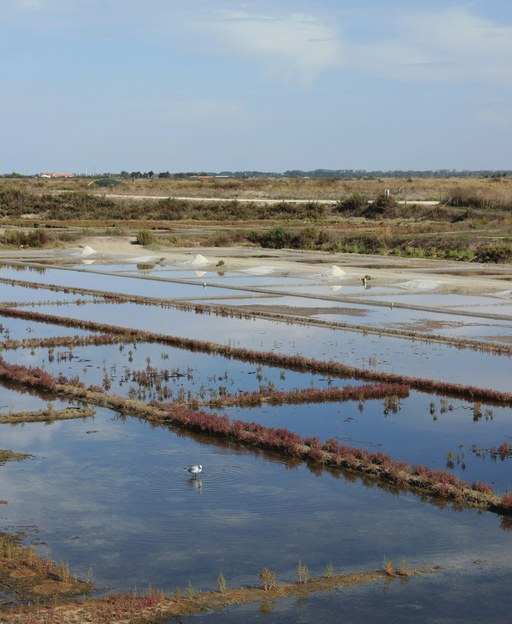
A Salt That France Has Never Forgotten
The Guérande Peninsula, tucked into Loire-Atlantique just south of Brittany, produces what many chefs call the finest salt in the world. Fleur de sel de Guérande — the “flower of salt” — is not mined or processed. It forms on the surface of shallow clay-lined pools called oeillets, and it must be skimmed by hand, in calm weather, before the sun sets.
The timing is everything. The wind must be light. The sky must be clear. On a good summer morning, a single paludier may collect four to six kilograms of fleur de sel from their beds. On a bad one, they collect nothing at all.
The Clay That Changes Everything
Most sea salt is harvested mechanically, rinsed, and processed. Guérande salt is different because of the clay beneath the ponds. The local blue-grey clay — argile bleue — gives the salt a natural mineral richness and stops it tasting bitter.
This clay formed over thousands of years. It cannot be manufactured, imported, or replicated. The paludiers protect it fiercely. Some have turned down higher-paying land deals to keep the marshes intact. They know that once you concrete over clay, you lose something you cannot get back.
What It Means to Be a Paludier
There are roughly three hundred paludiers still working the Guérande salt marshes today. Many come from families that have held the same plots for several generations. The plots — called salines — are passed down, not sold. New entrants do exist, but they must prove their commitment before being trusted with a bed.
Enjoying this? 7,000 France lovers get stories like this every week.
Thinking about it for retirement? If you’ve started thinking seriously about retiring there, our complete our full Retire in France guide covers the visa, healthcare, cost-of-living, and the regions worth shortlisting.
The work is seasonal but never simple. Spring is spent repairing the dykes. Summer is the harvest window — roughly June to September — and it demands daily attention. Autumn brings the last collection and the closing of the ponds. Winter is for maintenance, selling at markets, and planning.
A paludier rarely gets rich. But most would not swap the work. There is something about being the person who decides when the salt is ready that keeps people returning year after year.
The Villages Around the Marshes
Guérande, the medieval walled town at the heart of this region, looks out over the salt flats from its ancient ramparts. On a clear day, you can see the white shimmer of salt pans stretching to the horizon. The town has been connected to this trade since at least the 9th century, when Breton salt was traded across northern Europe.
Batz-sur-Mer and Le Croisic — two coastal villages nearby — have their own connection to the trade. Walk the paths between the salt pans in late summer and you will find paludiers loading hessian sacks, weighing out grey sel marin at small farm stalls, and moving with the unhurried precision of people who work to the rhythm of tides, not clocks.
The smell is particular: salt, mud, and something damp and mineral that you cannot quite name. When you have stood among the pans on a still August evening, you understand why families stay.
If you are planning your trip to France, the Loire-Atlantique coast is one of the most rewarding detours in the country — and one of the least crowded.
Fleur de Sel vs Sel Gris: Why It Matters
Most visitors come looking for fleur de sel, but the more honest product is sel gris — grey salt — which makes up the bulk of what Guérande produces. Sel gris is raked from the bottom of the ponds, dried in the sun, and sold in rough crystals that crunch under the teeth.
French home cooks use sel gris to finish everything from roasted vegetables to a simple fried egg. The slightly damp texture keeps it from dissolving immediately. It sits on the surface of food and releases slowly, which is the whole point.
Fleur de sel is reserved for the last moment — scattered over dark chocolate, a sliced tomato, a fillet of fish just off the grill. It is not for cooking. It is for finishing. The difference matters to anyone who has tasted both side by side.
For a broader look at the foods that define this part of France, the Brittany travel guide covers the Atlantic coast in full, from the salt marshes down to the Vendée.
Join 7,000+ France Lovers
Three times a week, get France’s hidden gems, seasonal guides, local stories, and the art of la vie française — straight to your inbox.
Subscribe free — enter your email:
Love more? Join 65,000 Ireland lovers → · Join 43,000 Scotland lovers → · Join 30,000 Italy lovers →
Free forever · Unsubscribe anytime
The paludiers do not talk much about the philosophy of what they do. Ask one why he still rakes salt by hand when machines could do it faster, and he might shrug and say the machine does not know when the salt is ready. That, in a single sentence, is everything you need to understand about Guérande — and perhaps about France itself.
🇫🇷 You Might Also Love
Tours & experiences you might love


Powered by Viator. Some links are affiliate links — we may earn a small commission at no extra cost to you.

Leave a Reply