
Drive into the Pays Basque and the road signs change. Below the French, a second language appears — older, stranger, and entirely its own. This is the corner of France that predates France itself.
A Language That Stands Completely Alone
Linguists call Euskara a language isolate. It shares no roots with French, Spanish, Latin, or any other known language, living or dead. Every European tongue descends from a common ancestor. Euskara doesn’t.
Nobody knows exactly when the Basque people began speaking it. Estimates put it at around 5,000 years at minimum. It survived Roman conquest, Frankish invasion, and centuries of French centralisation. Today, around 70,000 people speak it on the French side of the border alone.
The words resemble nothing a French speaker has heard. Eskerrik asko means thank you. Etxe means house. Borrowings from Latin are rare — native words already existed for almost everything.
The Flag on Every Balcony
Walk through Saint-Jean-de-Luz or the old quarter of Bayonne and you’ll see a flag that isn’t France’s tricolore. The Ikurriña — red, white, and green — hangs from apartment windows, decorates café awnings, and appears on stickers outside boulangeries.
France does not officially recognise it as a regional symbol. The Basque people display it anyway.
It appears on old fishing boats and new surf vans. It flies from village squares alongside the national flag. In this corner of the southwest, nobody feels the need to choose between the two.
The House Comes Before the Name
Enjoying this? 7,000 France lovers get stories like this every week. Subscribe free →
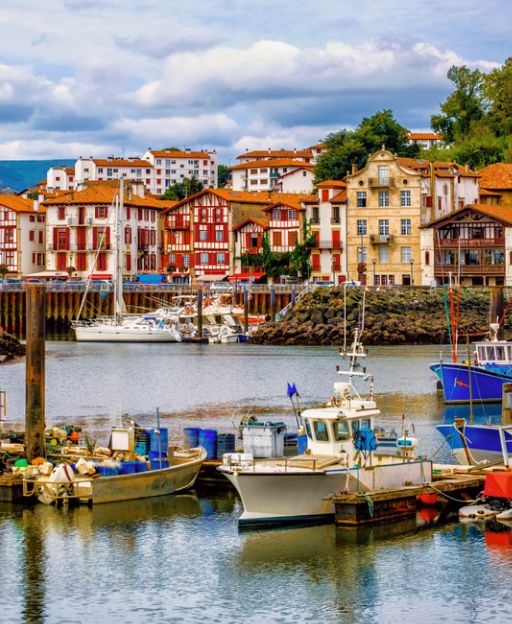
Basque farmhouses — called etxea — follow rules that predate any French building code. White-plastered walls. Heavy timber frames, painted red or green. A broad, sloping roof with deep overhangs that shelter the entrance through winter storms.
Many Basque families carry the name of their ancestral house, not the other way around. The house is not named after the family. The family takes its name from the house. That distinction tells you everything about how the Basque people see continuity and belonging.
In the Labourd region south of Bayonne, whole villages still follow this tradition. Many houses carry a carved stone inscription above the door — the name of the building and the year it stood. The stone is still there. So is the name.
The Food Belongs to No One Else
Bayonne ham is one of France’s great cured meats. Basque chefs will remind you, politely but firmly, that it belongs to no French culinary tradition. Dry-salted with Adour basin sea salt and air-dried for months, it produces something deeper and nuttier than any Italian or Spanish equivalent.
Cross south into Spain and you find pintxos lining every bar counter. They’ve started appearing on the French Basque coast too — in Bayonne, in Biarritz, in Saint-Jean-de-Luz. Small, precise pieces of food on good bread, eaten standing up with a glass of Txakoli white wine.
The morning market in Bayonne gives the clearest sense of what Basque cooking actually is: simple ingredients, handled with total confidence. If you’re already planning your trip to France, the Basque coast makes one of the most rewarding circuits in the entire country.
One Wall, One Ball, One Game
Every Basque village has a fronton — a tall stone wall for playing pelota. Villages build it beside the church and the town hall. That placement is not accidental.
Pelota is the Basque national sport. In its purest form, a player strikes a rubber ball against stone with a bare hand. Professionals use a curved wicker basket called a chistera to hurl the ball at speeds approaching 300 kilometres per hour. Both versions draw serious crowds.
The Pyrenean foothills that define the Basque hinterland hold their own stories too — including wartime escape routes through the high passes that remain walkable today. The Basques helped thousands of refugees cross to safety during the Second World War.
The region’s Atlantic coastline stretches northward into pine forests and near-empty beaches that most visitors never reach. The Basque coast is the dramatic southern end of that long, wild shore.
Why the Pays Basque Endures
France claimed sovereignty over this land in the 15th century. The Basques were already here. They had already built their houses, named their families, and played their games against stone walls.
Seven centuries of French rule and the language still endures, the flags still fly, and every etxea still wears its name above the door. Some things don’t need a nation’s permission to last.
Join 7,000+ France Lovers
Three times a week, get France’s hidden gems, seasonal guides, local stories, and the art of la vie française — straight to your inbox.
Subscribe free — enter your email:
Free forever · Unsubscribe anytime
🇫🇷 You Might Also Love
Tours & experiences you might love


Powered by Viator. Some links are affiliate links — we may earn a small commission at no extra cost to you.

Leave a Reply