
Eight hundred years ago, medieval France launched a crusade against its own people. Not against invaders. Not against pagans. Against a group of quiet, peace-loving Christians who lived in the hills of Languedoc — and simply believed differently.
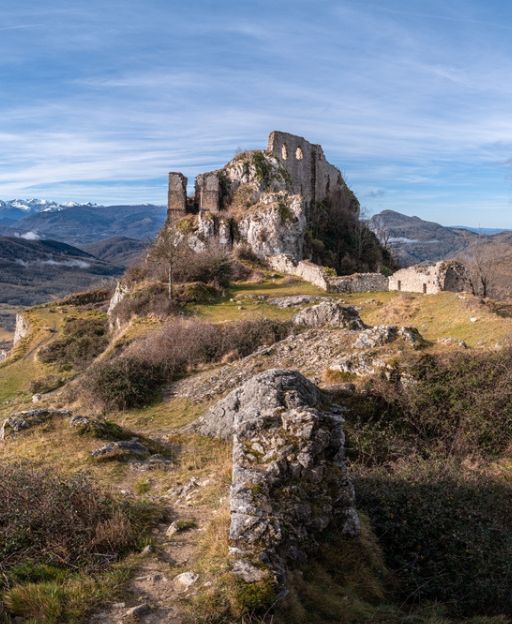
Their name was the Cathars. And though the Church tried to erase every trace of them, the south of France has never entirely let them go.
A Faith the Church Couldn’t Ignore
The Cathars — also called the “Good Men” and “Good Women” — were not violent revolutionaries. They were farmers, weavers, and scholars who followed a simple spiritual code: reject the material world, live without wealth, and treat every person with dignity.
They believed the physical world had been created not by God but by a lesser, corrupt force. The soul, they said, was the only thing worth saving. They didn’t build grand cathedrals. They didn’t demand tithes. They walked from village to village, owning almost nothing.
To the medieval Church, this was heresy of the worst kind.
The Crusade That Came From the North
In 1209, Pope Innocent III launched the Albigensian Crusade — named after the city of Albi, a Cathar stronghold. Northern French knights, promised land and absolution, rode south in enormous numbers.
The city of Béziers was among the first to fall. When a papal legate was asked how to tell the Cathars from the Catholics inside the city walls, his reported answer became one of history’s darkest lines: “Kill them all. God will know his own.”
Whether he truly said it, nobody knows. But Béziers burned. Tens of thousands died. The crusade lasted 20 years. When it ended, the Cathar way of life was broken — and the Inquisition swept in to find the survivors.
The Castles on the Hilltops
But the Cathars had one advantage: the landscape itself.
Across the rugged foothills of the Pyrenees, local lords had already built fortresses on near-impossible peaks. These became last refuges. Some held out for years after the main crusade had ended.
Montségur is the most famous. Perched at 1,207 metres, this jagged citadel above the village of the same name sheltered the final Cathar community for years. When it finally fell in 1244, over 200 men and women walked out, refused to recant, and were burned alive in the field below.
Today the path to the top takes about 45 minutes. The walls still stand. The view across the Ariège valley is extraordinary.
Peyrepertuse and Quéribus — two more Cathar castles along what is now called the Sentier Cathare — are equally dramatic. Ruined towers cling to sheer ridgelines, with the wind the only sound for miles.
Enjoying this? 7,000 France lovers get stories like this every week.
Thinking about it for retirement? If you’ve started thinking seriously about retiring there, our complete our full Retire in France guide covers the visa, healthcare, cost-of-living, and the regions worth shortlisting.
Walking the Cathar Trail Today
The Sentier Cathare is a 250-kilometre walking route that links many of the surviving castles, from the Mediterranean coast near Port-la-Nouvelle to Foix in the Ariège. Most visitors walk sections rather than the whole route.
The stretch between Quéribus and Peyrepertuse — roughly eight kilometres — is considered one of the finest walks in southern France. The nearest large city is Carcassonne, whose own medieval walls were used by crusader forces during the campaign.
If you’re planning your trip to France, building in a detour through the Aude or Ariège adds a dimension most tourists never find. It’s also worth pairing with a visit to the forgotten villages along France’s most beautiful river for a journey through some of the country’s quietest landscapes.
What the Villages Still Remember
The towns of the region hold on to this history with quiet intensity. In Albi, the enormous brick Cathedral of Saint-Cécile — built by the Church after the crusade specifically to demonstrate the power of Rome — looms over a city that still talks about the Cathars.
Museums, walking routes, and local guides treat the subject with an evenhandedness that feels respectful rather than sensational. You’ll also find the word “Cathar” on wine labels, gîte signs, and restaurant menus — a reminder that even a history of persecution can become, in time, a source of regional pride.
A Silence Worth Seeking
The Cathar castles don’t draw the crowds of the Loire Valley. There are no guided tours in a dozen languages, no gift shop queues. What there is: a narrow path through scrubland, a ruin at the top, and a view that stretches to the horizon.
And if you know what happened here — who walked these paths, what they were asked to abandon, and what they refused — it’s hard to stand in that silence and feel nothing.
Join 7,000+ France Lovers
Three times a week, get France’s hidden gems, seasonal guides, local stories, and the art of la vie française — straight to your inbox.
Subscribe free — enter your email:
🇫🇷 Discover the France Most Tourists Never Find
Get our free guide to 25 hidden villages of France — then join 7,000+ readers for weekly stories about places most guidebooks never mention.
Get Your Free Village Guide →Love more? Join 65,000 Ireland lovers → · Join 43,000 Scotland lovers → · Join 30,000 Italy lovers →
Free forever · Unsubscribe anytime
🇫🇷 You Might Also Love
Tours & experiences you might love


Powered by Viator. Some links are affiliate links — we may earn a small commission at no extra cost to you.

Leave a Reply