Walk down any street in France at seven in the morning and you will smell it before you see it. That sharp, warm scent of fresh bread drifts from a small shopfront. A queue of people stretches onto the pavement. And inside, a baker who may have started work at four in the morning is pulling another batch from the oven.
The French boulangerie is not just a shop. It is a national institution, protected by law and celebrated by tradition. In 2022, the art of the French baguette was added to UNESCO’s Intangible Cultural Heritage list — the same list as the Mediterranean diet and Mongolian falconry. A bread. Recognised by the United Nations.
To understand France, you must understand its bakeries.
What Makes a French Boulangerie Different?
Not every shop that sells bread in France is a boulangerie. The word is legally protected.
Under French law, only a baker who makes bread on the premises can use the name “boulangerie”. The dough must be mixed, shaped, and baked in the same building where it is sold. No pre-made dough. No frozen baguettes reheated in the back. A real boulangerie is defined by its baker, not its signage.
This law dates from 1998. Before it, the word was used loosely. Supermarkets sold bread labelled as artisanal. The legislation fixed that. Walk into a shop with “boulangerie” above the door and you can trust that someone woke at four in the morning to make what you are about to eat.
There are around 35,000 boulangeries in France. That is one for every two thousand people. In some villages, the boulangerie is the last remaining local shop — the heartbeat of a community that might otherwise have nothing left.
The Baguette and Its Sacred Status
The baguette is the most recognised bread in the world. You can pick it out of a silhouette. A long, thin stick of bread — pale gold on the outside, white and airy within.
It was not always this shape. Bread in France used to come in round, heavy loaves. The baguette emerged in the early twentieth century, partly from practicality. A long thin loaf cooks faster. You can eat it the same day without a knife.
French law also played a role. In 1920, a new rule banned bakers from starting work before four in the morning. The old round loaves needed hours more preparation time. The baguette could be ready by opening time. And so it became the standard.
UNESCO added the baguette to its heritage list in 2022, recognising it as part of French social life — not just French food. Families pick one up on the way home. Children snap off the crusty end on the walk back. A French meal without a baguette is somehow incomplete.
The French eat around six million baguettes every single day. Each one eaten fresh, bought that morning or that afternoon, because a baguette goes stale quickly. You do not buy it for later. You buy it for now. That urgency is part of the ritual.
The Morning Ritual That Makes France French
Go to any French town early in the morning. The boulangerie is almost always the first shop open.
By seven o’clock, the first wave of customers has already come and gone. Regulars order the same thing every day. A tradition passed from parent to child — pick up the bread on the way to school or on the way to work. The boulangerie fits into the daily rhythm in a way that feels effortless but is anything but.
This is what sets French bread culture apart from most others. Bread in France is not a product. It is a ritual. And that ritual is what the boulangerie makes possible — every single morning, without exception.
The French café is the place to sit and linger. But the boulangerie is where the day truly begins. If you have never read about why the French never eat at their desks, the boulangerie queue is a good place to start understanding it.
🇫🇷 Enjoying this? 7,000 France lovers get stories like this every week. Subscribe free →
The Meilleur Ouvrier de France
France has a national competition for bakers. The Meilleur Ouvrier de France — Best Craftsman of France — is one of the most demanding professional contests in the country.
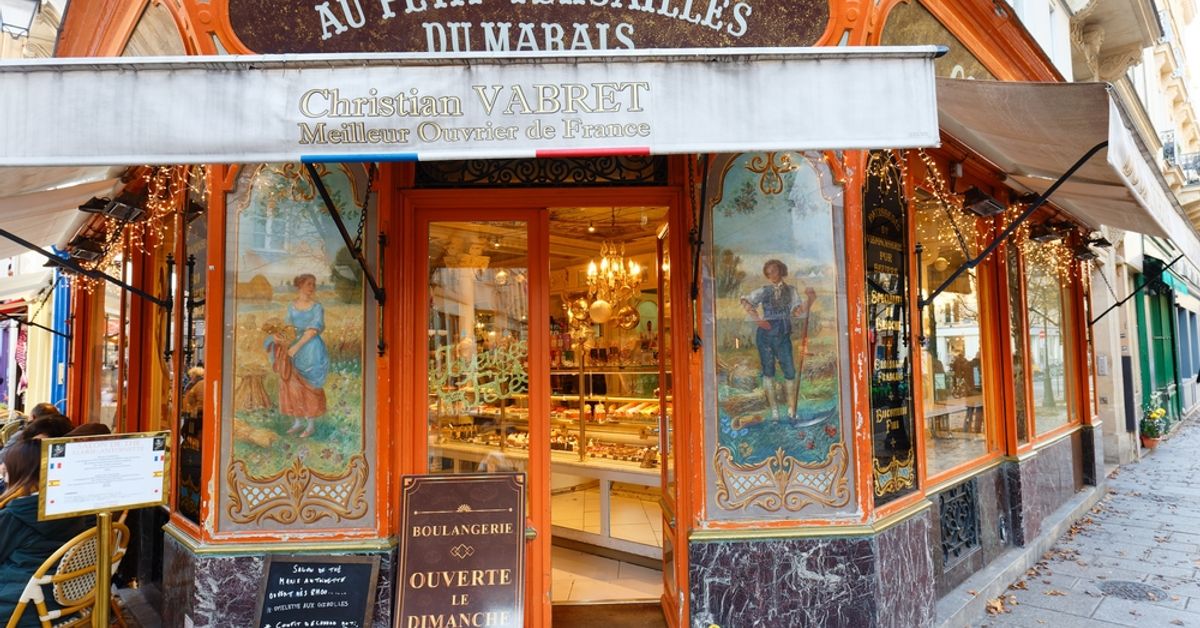
Winners earn the right to wear a collar in the colours of the French flag on their chef’s jacket. Only a handful of bakers hold the title at any one time. The baker Christian Vabret, whose shop “Au Petit Versailles du Marais” in Le Marais is pictured at the top of this article, is one of the most celebrated. His ornate shopfront with its painted pastoral panels has become a landmark in itself.
The competition does not just test bread. It tests pastry, chocolate, and confectionery. Judges include past winners and senior chefs. The standard is extremely high. A baker who wins this title has spent years treating bread as a craft rather than a commodity — which is exactly how France treats it.
Breads Beyond the Baguette
The baguette is the symbol. But the boulangerie sells much more than one kind of bread.
Pain de campagne is a round country loaf with a thick crust and a dense crumb. It lasts longer than a baguette and pairs well with soup or cheese.
Croissant — the crescent-shaped pastry you know from every breakfast menu — is made from laminated dough, closer to pastry than bread. A good croissant shatters when you bite it. A bad one is chewy and hollow.
Pain aux noix is a walnut bread, often darker in colour, served with cheese at the end of a French meal. The walnut adds a slight bitterness that works perfectly with aged varieties.
Brioche is enriched with butter and eggs, softer and richer than standard bread. French children eat it for breakfast. French adults know it is a weekend treat best eaten with jam and a good cup of coffee.
Fougasse is a flat, slit bread from Provence, sometimes flavoured with olives, herbs, or lardons. It looks like a leaf and goes stale fast — which means you eat all of it immediately. No one complains.
Each region of France has its own bread traditions. Travel from Normandy to Provence and the boulangerie will feel familiar but different. The same institution, different flavours — much like the French market, which also takes a different form in every town.
How to Find a Good Boulangerie in France
Look for a queue. In France, a line outside the door before nine in the morning is a very good sign.
Check the croissant. A straight croissant is made with margarine. A curved one uses butter. French bakers say this themselves. Order the curved one.
Listen to the sound. Good bread makes a hollow sound when you tap the base. A baguette that thunks is undercooked. This is not a trick — the baker will respect you more for checking.
Ask for it “bien cuit” if you prefer a darker, crunchier crust. Say “pas trop cuit” if you like it pale. The baker will not judge you. They want you to enjoy what they made.
And go early. The first bake of the day is always the best. A baguette fresh from the oven, still warm enough to soften the butter you put on it — that is the real reason people queue on the pavement at seven in the morning in France.
If you want to make the most of French food culture on your trip, the France planning hub has practical guides to help you get started. And while you are planning, it is worth reading about how the French spend Sunday — because Sunday and the boulangerie are inseparable in France.
Frequently Asked Questions
What is a French boulangerie?
A French boulangerie is a bakery where bread is made and baked on the premises. French law protects the name — only a baker who makes their own dough can legally use the term “boulangerie”. This means you can trust the freshness of what you buy.
Why is the baguette so important in France?
The baguette is central to French daily life. Most French households buy one every day. In 2022, UNESCO added the art of the baguette to its Intangible Cultural Heritage list — recognising it as part of French social culture and tradition, not just food.
How many boulangeries are there in France?
There are around 35,000 boulangeries in France — roughly one for every two thousand people. In many small villages, the boulangerie is the last remaining local shop. The French government actively works to protect these independent bakeries as part of rural life.
What is the Meilleur Ouvrier de France award for bakers?
The Meilleur Ouvrier de France is a national competition that awards the title of Best Craftsman of France. Winners wear a tricolour collar on their jacket. The competition covers bread, pastry, chocolate, and confectionery. Only a small number of bakers hold the title at any one time.
What other breads can you buy at a French boulangerie?
Beyond the baguette, a French boulangerie typically sells croissants, pain de campagne, brioche, pain aux noix, fougasse, and seasonal specialities. Most also sell pastries and viennoiseries — including pain au chocolat and pain aux raisins — alongside their bread.
You Might Also Enjoy
French food and daily life are inseparable. Here are a few more pieces that explore the rhythms of life in France:
- French Café Culture: Why the French Never Eat at Their Desks — the art of the two-hour lunch and sitting without guilt
- How the French Spend Sunday: A National Ritual — markets, family meals, and the sacred slow day
- The Art of the French Apéritif: How France Drinks Before Dinner — why the French always pause before eating
Plan Your France Trip
Ready to experience a French boulangerie for yourself? Start with our France travel planning hub — practical guides on where to go, what to see, and how to experience France beyond the tourist trail.
Join 7,000+ France Lovers
Every week, get France’s hidden gems, seasonal guides, local stories, and the art of la vie française — straight to your inbox.
Subscribe free — enter your email:
Love more? Join 64,000 Ireland lovers → · Join 43,000 Scotland lovers → · Join 30,000 Italy lovers →
Free forever · One email per week · Unsubscribe anytime
Tours & experiences you might love


Powered by Viator. Some links are affiliate links — we may earn a small commission at no extra cost to you.

Leave a Reply