
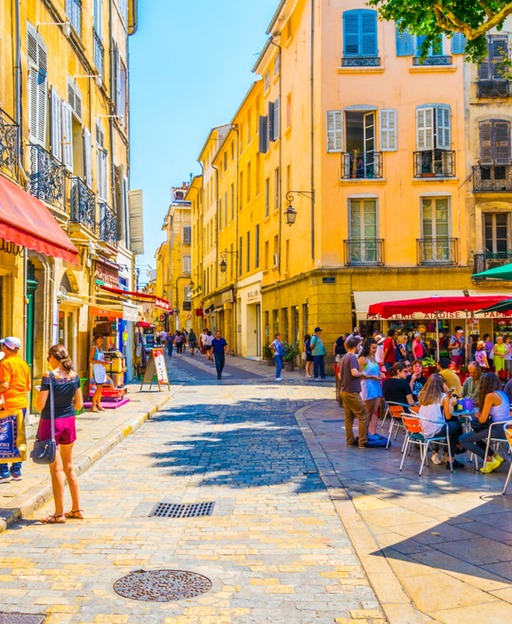
Aix-en-Provence does not announce itself loudly. There are no iconic towers, no world-famous monuments demanding your attention. What you get instead is something far more pleasurable: a city that unfolds slowly, street by narrow street, fountain by honey-coloured fountain. This is southern France at its most liveable — and for American travellers who want more than Paris, Aix-en-Provence deserves a place near the top of any France itinerary.
Love France? Join 7,000+ readers on our free newsletter → lovetovisitfrance.substack.com
What Makes Aix-en-Provence Worth the Journey
The Romans founded Aix-en-Provence in 123 BC and named it Aquae Sextiae — the waters of Sextius — after the consul who built the settlement near natural hot springs. Nearly 2,150 years later, the city still rewards those who slow down. The warm limestone lining every street turns gold in the afternoon light. The 38 fountains scattered through the old town gurgle quietly, year-round. The market stalls on Place Richelme pile high with lavender, cheese, and olives every Tuesday, Thursday, and Saturday morning.
Paul Cézanne grew up here. He spent most of his life painting the landscapes around the city — particularly the distinctive profile of Mont Sainte-Victoire, which he captured in more than 80 canvases. His former studio, the Atelier Cézanne, stands open to visitors and looks exactly as he left it on the day he died in 1906. That alone makes the trip worthwhile.
Aix is also a university city. More than 40,000 students live here, which keeps the energy lively even outside high season. The café terraces stay full on weekday mornings. The bookshops stay open late. The city never empties out the way smaller Provençal villages do in winter.
The Cours Mirabeau: The Heart of the City
Every visit starts on the Cours Mirabeau, the broad tree-lined boulevard that divides the old town from the Mazarin quarter to the south. Plane trees shade the full length of it, creating a leafy tunnel in summer. Four fountains punctuate the street. The largest, the Rotonde Fountain at the western end, dates from 1860 and marks the main arrival point for visitors walking from the train station.
The southern side of the Cours Mirabeau carries banks and upmarket shops. The northern side is all cafés — one after another, chairs facing outward so you can watch the whole city walk past. The most famous is Les Deux Garçons, open since 1792. Cézanne and his childhood friend Émile Zola drank here as students. The mirrors and gilded mouldings inside are original. The coffee is very good.
Spend an hour on the Cours Mirabeau on your first morning. Walk its full length, stop at the fountains, pick a café for breakfast. It orients you to the city quickly and gives you a feel for this place: unhurried, elegant, and serious about its pleasures.
The Old Town: Where to Get Pleasantly Lost
North of the Cours Mirabeau lies the Vieil Aix — the old town. It forms a dense grid of narrow medieval streets that takes about 20 minutes to cross on foot but several hours to properly explore. This is the best part of the city for wandering without a plan.
Wealthy noble families built most of the streets here during the 17th and 18th centuries, when Aix served as the capital of Provence. Many buildings carry elaborate doorways with carved stone figures holding up the lintels — locally known as atlantes. You find the best examples on the Rue Gaston-de-Saporta, one of the finest streets in the old town, running north from the Cours Mirabeau toward the cathedral.
The Cathédrale Saint-Sauveur at the northern end of the old town is one of the most interesting churches in southern France. Builders began work in the 5th century and continued for the next 1,300 years, so the building contains every major architectural style from early Romanesque to Gothic to Baroque. The baptistery dates from the 4th century. Craftsmen completed the carved walnut doors at the main entrance in 1508. They stand today as masterworks of Provençal woodcarving.
The morning market on Place Richelme, just south of the cathedral, is the best in the city. Farmers bring produce directly from the surrounding countryside: tomatoes still warm from the vine, almonds in their green husks, rounds of goat’s cheese wrapped in chestnut leaves. The market runs every morning except Monday, and the quality is visibly higher than most tourist-facing markets in the region.
The Cézanne Circuit: Following the Painter Through the City
The city has laid out a walking route linking the sites most associated with Paul Cézanne. You can pick up a map from the tourist office on the Cours Mirabeau, or follow the bronze medallions set into the pavement throughout the old town.
The most important stop is the Atelier Cézanne, a 10-minute walk north of the old town on the Avenue Paul Cézanne. Cézanne built his studio here in 1902, at the age of 63, specifically because the light worked — north-facing windows, high ceilings, a large skylight. He painted The Large Bathers in this room. He died in 1906 and the studio closed behind him. Curators opened it to visitors in 1954 and have kept it untouched since. His smock hangs on a hook. His pipe sits on the windowsill. His plaster skulls and pottery — the objects he painted obsessively in his still lifes — rest on a long wooden table in exactly the arrangement they appear in his canvases.
The Musée Granet on Place Saint-Jean-de-Malte houses a collection of nine Cézanne paintings alongside works by Rembrandt, Rubens, and Ingres. It is the best art museum in Aix and worth two hours of your time. Admission costs around €6.
For the full Cézanne experience, rent a car for half a day and drive the 8km to the base of Mont Sainte-Victoire. The mountain rises sharply from the flat Provençal plain, its pale limestone catching light differently at every hour. Stand at the viewpoint on the D17 road and you will immediately recognise the profiles Cézanne painted 80 times over. It is one of those rare moments where a painting and a real landscape confirm each other completely.
What to Eat and Drink in Aix-en-Provence
Aix-en-Provence produces one thing no other city in France can claim as its own: the calisson. This small diamond-shaped sweet combines a paste of ground almonds and candied melon under a coating of white royal icing. The city has made calissons since the 15th century. Every pâtisserie and confiserie in the old town sells them. The best come from Roy René, which has operated on the Cours Mirabeau since 1920. Buy a small box and eat them with coffee.
The Provençal rosé from the hills around Aix ranks among the best in France. The Coteaux d’Aix-en-Provence AOC covers around 4,000 hectares of vineyards between the city, the Luberon, and the Alpilles. The wines are dry, pale, and best drunk very cold. Most wine bars and restaurants in the old town serve them by the glass. Château Vignelaure, Château de Beaulieu, and Château Calissanne are reliable names to ask for.
For a full meal, head to the Mazarin quarter south of the Cours Mirabeau. This quieter neighbourhood has a cluster of good restaurants around the Rue du Griffon and Rue de la Fontaine. Look for menus offering daube Provençale — a slow-cooked beef stew with olives and orange zest — soupe au pistou, the Provençal version of minestrone finished with a basil and garlic paste, and salade niçoise from local farms.
Getting to Aix-en-Provence from Paris
Aix-en-Provence has its own TGV station, 8km south of the city centre. High-speed trains from Paris Gare de Lyon take approximately 3 hours and run several times daily. A shuttle bus connects the TGV station to the Rotonde bus terminal in the city centre, taking about 15 minutes and costing €4.40.
You can also reach Aix from Nice in about 2.5 hours by TGV, or from Lyon in 1 hour 45 minutes. If you drive, Aix sits at the junction of the A8 and A51 motorways, making it an easy stop between the French Riviera and the Rhône Valley.
Within the city, almost everything worth seeing is walkable from the Cours Mirabeau. The old town, the cathedral, the Granet Museum, and the morning market all sit within a 10-minute walk of the central fountain. The Atelier Cézanne requires a 20-minute walk north or a short taxi ride.
Best Time to Visit Aix-en-Provence
May, June, and September are the best months to visit. The weather is warm and reliably sunny, the markets are at their fullest, and the café terraces are busy without feeling overwhelmed. July brings the Festival International d’Art Lyrique d’Aix-en-Provence — one of the great opera festivals in Europe, running each year since 1948 — which draws a significant influx of visitors and pushes hotel prices higher.
August is the hottest month, with temperatures regularly hitting 35°C. Local residents leave and tourists arrive. If you visit in August, reach outdoor sites early and carry water.
October and November are quieter and increasingly beautiful as the plane trees on the Cours Mirabeau turn yellow and copper. Prices drop. The markets continue through autumn with mushrooms, truffles, and game. Winter in Aix is mild — frost is rare — and the city functions normally year-round, without the shuttered feeling you find in smaller Provençal villages between December and March.
What is the best time to visit Aix-en-Provence?
May, June, and September offer the best balance of warm weather, full markets, and manageable crowds. July brings the famous opera festival and higher prices. August is extremely hot at 35°C or above and very busy. October is excellent for autumn colour and lower costs.
How many days do you need in Aix-en-Provence?
Two full days covers the old town, the Cours Mirabeau, the morning market, and the Atelier Cézanne. A third day allows for a half-day excursion to Mont Sainte-Victoire or the Luberon villages. Three days is the ideal length for a first visit that takes in the city comfortably without rushing.
What is Aix-en-Provence most famous for?
Aix-en-Provence is most famous for three things: the painter Paul Cézanne, who grew up here and whose studio remains open to visitors; the calisson, the local almond sweet the city has produced since the 15th century; and its exceptional daily life — markets, fountains, café culture, and golden-stone architecture throughout the old town.
You Might Also Enjoy
- The Hidden Villages of Provence: What Most Tourists Drive Past Without Stopping
- Valensole’s Lavender Fields: A Practical Guide to Provence in Bloom
- French Riviera Travel Guide: What to Know Before You Go
Plan Your France Trip
Ready to start planning your time in France? Our complete planning guide covers when to go, how to get around, and the best regions for first-time and returning visitors: Start Here: Planning Your Trip to France.
Join 7,000+ France Lovers
Every week, get France’s hidden gems, local recipes, and travel inspiration — the kind you won’t find in any guidebook.
Subscribe free — enter your email:
Free forever · One email per week · Unsubscribe anytime
Tours & experiences you might love


Powered by Viator. Some links are affiliate links — we may earn a small commission at no extra cost to you.

Leave a Reply