
In the winter of 1943, a twenty-three-year-old Belgian woman led a group of Allied airmen through the Pyrenees in darkness. The snow lay two metres deep. Below them, German border patrols swept the foothills with torches.
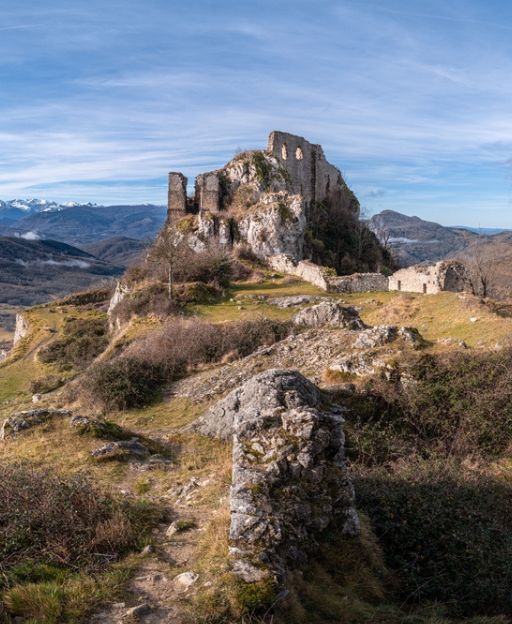
She crossed those same mountains thirty-two times. Her name was Andrée de Jongh. She was twenty-four when she made her first crossing, and the Gestapo eventually caught her. She survived three concentration camps.
The Guides Who Crossed the Mountains by Night
When Nazi forces occupied France in 1940, a network of ordinary people started doing something extraordinary.
Farmers, shepherds, and mountain guides along the Ariège foothills began moving strangers across the border into neutral Spain. They were called passeurs — crossers.
Most were Basque or Ariège locals who knew every goat track through the mountains. They charged almost nothing. Many charged nothing at all.
The German punishment for helping an Allied soldier was execution. They kept going anyway.
What the Crossing Actually Looked Like
The most famous route was the Chemin de la Liberté — the Path of Freedom. It began near Saint-Girons in the Ariège and ran south through the mountains to Spain.
The full crossing covered around 75 miles. It passed through mountain passes above 2,200 metres. In winter, snow buried the paths entirely.
Groups travelled at night and moved in single file. No fires. No talking on exposed ridgelines. No stopping for long.
Many escapees wore rope-soled shoes because leather boots were impossible to find. Some carried borrowed farmers’ coats. A few completed the crossing barefoot when their shoes gave out on the rocks.
Those caught on the French side faced arrest and deportation. Guides caught helping escapees faced execution. The risk did not stop either group.
Who Made That Journey
More than 33,000 people crossed the Pyrenees through these routes during the war.
That number included Allied airmen shot down over France, Jewish families fleeing deportation, British intelligence agents, escaped prisoners of war, and young French men avoiding forced labour in German factories.
Some were soldiers in excellent condition. Others were elderly. Some were children who had never seen snow before.
Not everyone made it. Some died on the mountain. Others were caught within sight of the Spanish border.
Enjoying this? 7,000 France lovers get stories like this every week. Subscribe free →
The Network Behind the Passeurs
The passeurs were just the final link in a long chain. Resistance networks stretched from Paris and Toulouse down to the mountain foothills.
Safe houses, forged papers, and false identities kept the chain moving — and hundreds of ordinary French people maintained them at enormous personal risk.
One network, the Comet Line, ran mostly by women. It moved over 800 Allied airmen out of France. Its co-founder, Andrée de Jongh, built it at the age of twenty-four with her own hands and her own instincts.
Other networks operated from Toulouse, Perpignan, and Pau. Local priests, pharmacists, schoolteachers, and hotel owners all played their part. Most never knew the full shape of the organisation they served.
The Route That Still Exists
Here is what makes this history different from most: you can still walk it.
The Chemin de la Liberté still runs through the Ariège. Every July, the Association Liberté organises a commemorative trek along the original route. Around two hundred walkers complete the crossing together.
Among them, every year, are descendants of people who fled — and descendants of the guides who led them. They meet on the same ridgelines, eat at the same rest points, and cross the same final pass into Spain.
Along the route, small plaques mark the places where groups rested, where some were caught, and where the last stretch into Spain finally began.
How to Walk It Yourself
The full historical route is a serious mountain hike. It crosses high-altitude terrain and requires solid fitness. July to September is the only safe season for the full crossing.
The start point is Saint-Girons, in the Ariège department of southern France. Trains run from Toulouse in around ninety minutes. The town has a small museum dedicated to the wartime escape networks of the region.
Sections of the route connect with the GR10 long-distance trail, which crosses the whole of the French Pyrenees from the Atlantic to the Mediterranean. If you are planning your time in France, the southern Ariège is one of the quietest and least-visited corners of the country.
It is also one of the most historically layered. The same valleys saw the Cathar persecutions in the thirteenth century, the mountain smuggling routes of the nineteenth, and the wartime crossings of the twentieth. History presses close in these hills.
For more hidden chapters of French history, the Roman buildings still in daily use across France tell a story that stretches back even further. And if southern France calls you deeper, the forgotten crusade that swept through these same mountains left ruins and echoes that are still visible today.
The mountains have not changed. The same wind crosses the same ridgelines. The same silence sits above the snowline. What changed is who gets to cross — and why.
Join 7,000+ France Lovers
Three times a week, get France’s hidden gems, seasonal guides, local stories, and the art of la vie française — straight to your inbox.
Subscribe free — enter your email:
Free forever · Unsubscribe anytime
🇫🇷 You Might Also Love
Tours & experiences you might love


Powered by Viator. Some links are affiliate links — we may earn a small commission at no extra cost to you.

Leave a Reply