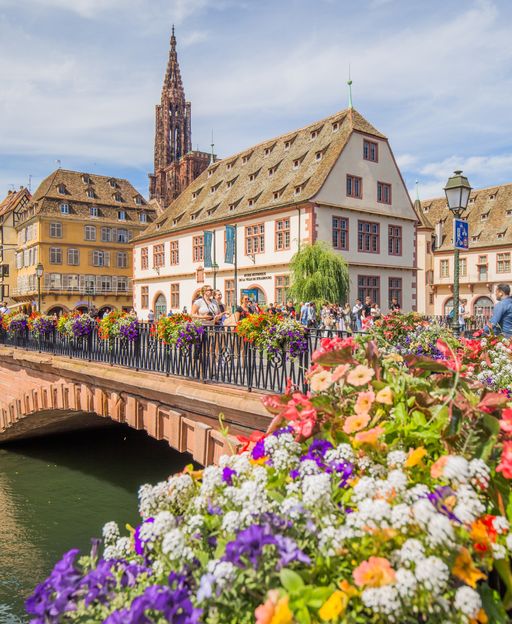
You step off the train in Strasbourg and something feels immediately strange. The street signs are in French. But the architecture looks straight out of Bavaria — steep-gabled rooftops, half-timbered walls, flower boxes overflowing at every window.
Welcome to Alsace. This is the region that France and Germany have contested, traded, annexed, and reclaimed four times in 150 years. And somehow, it came out with an identity stronger than either country gave it.
A Region That Swapped Countries Four Times
France held Alsace from 1648. Then Prussia defeated France in the Franco-Prussian War of 1870–71 and claimed the region overnight. Around 1.5 million people woke up as German citizens without moving a single step.
For 47 years, Alsace lived inside the German Empire. The administration banned French in schools. German became the official tongue of courts, offices, and classrooms. Alsatians pushed their own dialect underground — spoken at home and in market squares, passed quietly between generations.
The Armistice of 1918 returned Alsace to France. Then, in 1940, Nazi Germany annexed the region again. German administrators wiped French names off the streets. They conscripted around 130,000 Alsatian men into the Wehrmacht — the German military — against their will. These men called themselves the Malgré-nous. It means: in spite of ourselves.
France liberated Alsace in 1945 and has held it ever since. Four sovereignty changes in 74 years. No other region in Western Europe has lived through so much while standing still.
The Language That Nobody Could Erase
Alsatian — known locally as Elsässisch — is a Germanic dialect. It sounds closer to Swiss German than to standard French. Linguists classify it as an Alemannic language, related to the dialects spoken across the Rhine in Baden-Württemberg.
Successive governments tried to suppress it. After 1918, French administrators discouraged German dialects. After 1945, the association between German speech and the occupation made many Alsatians reluctant to use Alsatian in public. Schools taught French. Official life ran in French. The dialect retreated.
Roughly 900,000 people still speak Alsatian today — mostly over the age of 60. The language is declining. But it has survived every attempt to erase it, which tells you something important about what Alsatians think of anyone who tries to tell them who they are.
Walk through a village market on a Saturday morning and listen carefully. Between the French you expect, you catch the soft, guttural sounds of Alsatian — a living reminder that this region has always been more than one thing at once.
A Table That Belongs to Two Traditions
The easiest way to understand Alsace is to eat there.
Choucroute garnie arrives at your table piled high: braised sauerkraut, smoked pork, white sausage, and potatoes. German kitchens invented it. French brasseries perfected it. Today it sits on menus across Strasbourg with the confidence of a dish that has nothing left to prove.
Flammekueche tells the same story differently. A thin, crisp base spreads with crème fraîche, sliced onions, and lardons, then bakes fast in a wood-fired oven. Alsatians call it tarte flambée. Germans across the border call it Flammkuchen. Both names are correct. Both peoples claim it.
Even the wine proves the point. Alsace grows Riesling, Gewurztraminer, and Pinot Gris — varieties that Germany also produces — but bottles them under French appellations. The grapes are Germanic. The label is French. The wine itself is purely Alsatian.
Enjoying this? 7,000 France lovers get stories like this every week.
Thinking about it seriously? If you’ve started actually planning a move, our complete our complete Moving to France guide walks through every step, every cost, and the paperwork that catches most people out.
The Architecture That Tells Two Stories
Colmar shows you Alsace’s visual identity most clearly. Wander through the Tanners’ Quarter and the half-timbered houses lean over narrow cobbled streets in shades of mustard, terracotta, and faded blue. Canals thread through the old town. Geraniums spill from every window ledge. The effect is so photogenic it barely looks real.
The style is Fachwerk — the German word for the timber-frame construction that defines Alsatian villages and towns. Walk through Ribeauvillé, Eguisheim, and the hidden villages of the Alsace Wine Route and you find the same aesthetic: medieval towers, guild signs in iron, Renaissance fountains. The region’s architecture is fundamentally Germanic in form, but it carries centuries of French refinement in its details.
Strasbourg offers a more layered version of this. The medieval cathedral dominates the skyline in pale pink sandstone. Germany built the Wilhelminian district between 1871 and 1918 to mark permanent ownership — heavy imperial stone blocks intended to announce permanence. Today that same district houses the Council of Europe and the European Court of Human Rights. Germany built those buildings to assert dominance. Europe repurposed them to assert cooperation.
Only in Alsace could that transformation feel so entirely fitting.
What It Means to Be Alsatian Today
Ask an Alsatian whether they are French or German. Most will correct the question politely.
They are Alsatian. That answer is not a deflection — it is a third identity, one that neither country fully owns. The food blends both traditions. The dialect bridges both languages. The architecture negotiates between both aesthetics. Alsace has never served as a passive battlefield — it has always acted as an active participant in its own story.
Strasbourg now hosts the European Parliament for part of each year. The choice carries meaning. On the border between France and Germany — between the two nations most associated with the continent’s bloodiest wars — Europe chose to build its institutions. Alsace’s in-between position became its defining advantage.
If you want to explore Strasbourg in depth, the city rewards slow walking far more than rushed sightseeing. And if you are still planning your trip, the France travel planning guide covers the essentials from transport to timing.
What is the best time to visit Alsace?
Late spring (May–June) and autumn (September–October) offer the best balance of mild weather, green vineyards, and smaller crowds. The Alsace Christmas markets (late November through December) draw large numbers but are genuinely spectacular — book accommodation months in advance if you plan to visit then.
What food should I try in Alsace?
Start with choucroute garnie and tarte flambée (flammekueche). Then try baeckeoffe — a slow-braised casserole of meat and vegetables — and finish with kugelhopf, the region’s traditional ring cake flavoured with almonds and dried fruit. Pair everything with a local Riesling or Gewurztraminer.
How do I get to Alsace from Paris?
Strasbourg sits roughly two hours from Paris by TGV high-speed train. From Strasbourg, local trains and buses connect to Colmar, Ribeauvillé, and the villages of the Wine Route within 30–45 minutes. A hire car gives you the most flexibility for exploring smaller villages.
What language do people speak in Alsace?
French is the official and everyday language across Alsace. Older residents — particularly those over 60 in rural areas — may also speak Alsatian, a Germanic dialect. In tourist areas and larger towns like Strasbourg and Colmar, English is widely understood.
The train back through the Vosges runs past vineyards, medieval towers, and farmhouses that blur every idea of where one country ends and another begins. You arrive in France. You never left it. But Alsace gives you something no other French region can — the feeling that identity is not a line on a map, but something you build, over centuries, from the ingredients you refuse to give up.
Join 7,000+ France Lovers
Three times a week, get France’s hidden gems, seasonal guides, local stories, and the art of la vie française — straight to your inbox.
Subscribe free — enter your email:
📲 Know someone who’d love this? Share on WhatsApp →
Love more? Join 65,000 Ireland lovers → · Join 43,000 Scotland lovers → · Join 29,000+ Italy lovers →
Free forever · Unsubscribe anytime
🇫🇷 You Might Also Love
Tours & experiences you might love


Powered by Viator. Some links are affiliate links — we may earn a small commission at no extra cost to you.

Leave a Reply