
Most visitors to Alsace race between two cities. They tick off Strasbourg’s cathedral and Colmar’s canals, then head home. But the villages between them — threaded along 170 kilometres of wine road — tell a different story entirely.
The Road That Connects Them All
The Route des Vins d’Alsace runs from Marlenheim in the north to Thann in the south. Locals built it into the tourism map in the 1950s, but the villages along it are centuries older. Half-timbered houses line every lane. Storks nest on church spires. Wine caves welcome anyone who knocks.
The road never hurries you. Neither should you.
Most visitors who follow the route skip the smaller stops and make straight for Colmar or Strasbourg. That’s exactly the wrong instinct. The small villages are where Alsace shows its real character — unhurried, proud, and extraordinary.
Riquewihr — The Village That Stopped in the 16th Century
Riquewihr sits behind its medieval walls as though the rest of the world forgot to update it. The main street runs straight from the old town gate to a medieval watchtower. Every building along it dates to the 16th or 17th century.
Wine producers line both sides. Hugel & Fils, one of Alsace’s oldest estates, has made wine here since 1639. Duck into the courtyard and you’ll find barrels stacked floor to ceiling and a tasting room that welcomes drop-in visitors most days.
The tower at the top of the village — the Dolder — houses a small museum of medieval instruments. Entry costs very little. Spend the money.
Eguisheim — France’s Favourite Village
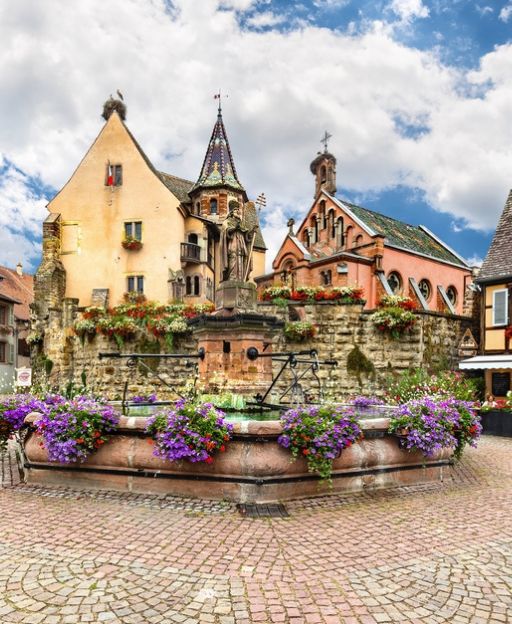
Eguisheim earned the title of France’s favourite village in 2013. It hasn’t stopped earning it since. The village spirals inward in three concentric rings, each lane narrower than the last. Geraniums cascade from every window box. The central square holds a fountain and a chapel with foundations from the 9th century.
The wine here rewards close attention. Eguisheim sits within several of Alsace’s Grand Cru vineyards. Local producers sell directly from their cellars — ask for the Gewurztraminer, which the region grows better than almost anywhere else on earth.
Kaysersberg — The Town That Gave the World Albert Schweitzer
Kaysersberg gave the world Albert Schweitzer — philosopher, organist, and Nobel Peace Prize winner — in 1875. His birthplace still stands on the main street, now a small and touching museum that traces his life from Alsace to Africa and back.
The River Weiss cuts straight through the village. A fortified medieval bridge crosses it at the centre. Above the town, the ruins of a 13th-century castle watch everything below. Climb up — the path takes 15 minutes and delivers a view that justifies every step.
Enjoying this? 7,000 France lovers get stories like this every week.
Thinking about it seriously? If you’ve started actually planning a move, our complete our complete Moving to France guide walks through every step, every cost, and the paperwork that catches most people out.
Ribeauvillé — Where the Mountains Meet the Vines
Ribeauvillé lies at the point where the Vosges foothills rise sharply behind the plain. Three ruined castles crown the ridge above the town. On clear days, the Black Forest shimmers across the Rhine in Germany.
Every September, the town hosts the Pfifferdaj — the Day of the Pipers — a festival with roots stretching back to the Middle Ages. Musicians in medieval costume parade through the cobbled streets. The atmosphere is unlike anything else in the region.
How to Drive or Cycle the Route
The Route des Vins runs fastest by car but rewards those who take two wheels. Cycling between villages takes roughly three to four days at a relaxed pace. Most villages offer bike hire, and the gradients are gentle through the plain section.
Start in Colmar — Colmar makes the ideal base for exploring the southern wine route. Work north through Eguisheim, Riquewihr, Kaysersberg, and Ribeauvillé. End in Strasbourg — Strasbourg’s old city rewards at least two full days before you leave Alsace behind.
For transport options, seasonal timing, and what to pack, our France trip planning guide covers everything you need before you go.
What is the best time to visit the Alsace Wine Route?
Late September to early November is the vendanges — harvest season — when vineyards turn gold and amber and tastings run daily across every village. Spring (April to June) offers fewer crowds and wildflowers covering the slopes.
Which villages on the Alsace Wine Route are most worth visiting?
Eguisheim, Riquewihr, and Kaysersberg are the three most rewarding stops. Each takes two to three hours to explore properly on foot. Ribeauvillé adds another strong half-day if your schedule allows.
How do you get to the Alsace Wine Route from Paris?
Take the TGV from Paris Gare de l’Est to Strasbourg or Colmar — the journey takes around two hours. From either city, hire a car or join a guided cycling tour to explore the villages at your own pace.
Do you need a car to explore the Alsace Wine Route?
Not necessarily. Many villages connect via cycling paths and local buses. A hire car gives the most flexibility, but cycling is by far the most rewarding way to travel between villages — you stop when you want, and every stop delivers something worth seeing.
The wine route doesn’t demand your time. It simply offers it — slowly, generously, in a place where the past never quite loosens its grip.
Join 7,000+ France Lovers
Three times a week, get France’s hidden gems, seasonal guides, local stories, and the art of la vie française — straight to your inbox.
Subscribe free — enter your email:
🇫🇷 Discover the France Most Tourists Never Find
Get our free guide to 25 hidden villages of France — then join 7,000+ readers for weekly stories about places most guidebooks never mention.
Get Your Free Village Guide →📲 Know someone who’d love this? Share on WhatsApp →
Love more? Join 65,000 Ireland lovers → · Join 43,000 Scotland lovers → · Join 29,000+ Italy lovers →
Free forever · Unsubscribe anytime
Frequently Asked Questions
How long is the Alsace Wine Route?
The Route des Vins d'Alsace stretches 170 kilometres from Marlenheim in the north to Thann in the south, winding through villages that are centuries older than the route itself, which was added to the tourism map in the 1950s. Plan to explore it slowly rather than racing between the larger cities.
What can you do in Riquewihr?
Riquewihr sits behind medieval walls with every building dating to the 16th or 17th century—you can visit wine estates like Hugel & Fils (operating since 1639) for tastings in their courtyards, or climb to the Dolder tower at the village's top to see a museum of medieval instruments. Entry to the tower costs very little.
Are wine tastings available on the Alsace Wine Route?
Wine caves throughout the villages welcome visitors without reservations, and established estates like Hugel & Fils in Riquewihr have tasting rooms open to drop-in visitors most days. The entire route was built into the tourism map in the 1950s specifically to showcase the region's wine heritage.
What makes Eguisheim special?
Eguisheim earned the title of France's favourite village in 2013 and has continued to earn it—the village spirals inward in three concentric rings with geraniums cascading from every window box. At its centre sits a fountain and a chapel with foundations from the 9th century.
🇫🇷 You Might Also Love
Tours & experiences you might love


Powered by Viator. Some links are affiliate links — we may earn a small commission at no extra cost to you.

Leave a Reply