
In December 1994, three cavers pushed through a narrow crack in the limestone cliffs of southern France. What they found inside stopped them cold. On the walls, painted in ochre and charcoal, hundreds of animals moved across the stone — bears, lions, rhinoceroses — drawn with a skill that should not have existed 36,000 years ago. Scientists who studied the paintings had to rewrite what they knew about early humans.
The Discovery That Changed Everything
Jean-Marie Chauvet and his two companions — Éliette Brunel and Christian Hillaire — had explored hundreds of caves across southern France. Nothing prepared them for what they found that December evening in the Ardèche. Carbon dating placed the paintings at 36,000 years old. Scientists had previously dated Lascaux, the celebrated cave in the Dordogne, as the oldest painted site in the world. Chauvet doubled that record.
The discovery forced archaeologists to abandon one of their most cherished assumptions: that early humans developed artistic skill slowly over thousands of years. Chauvet showed they were already masters at the very beginning. The cave, officially named Grotte Chauvet-Pont d’Arc, rewrote prehistory in a single evening.
What the Artists Left Behind
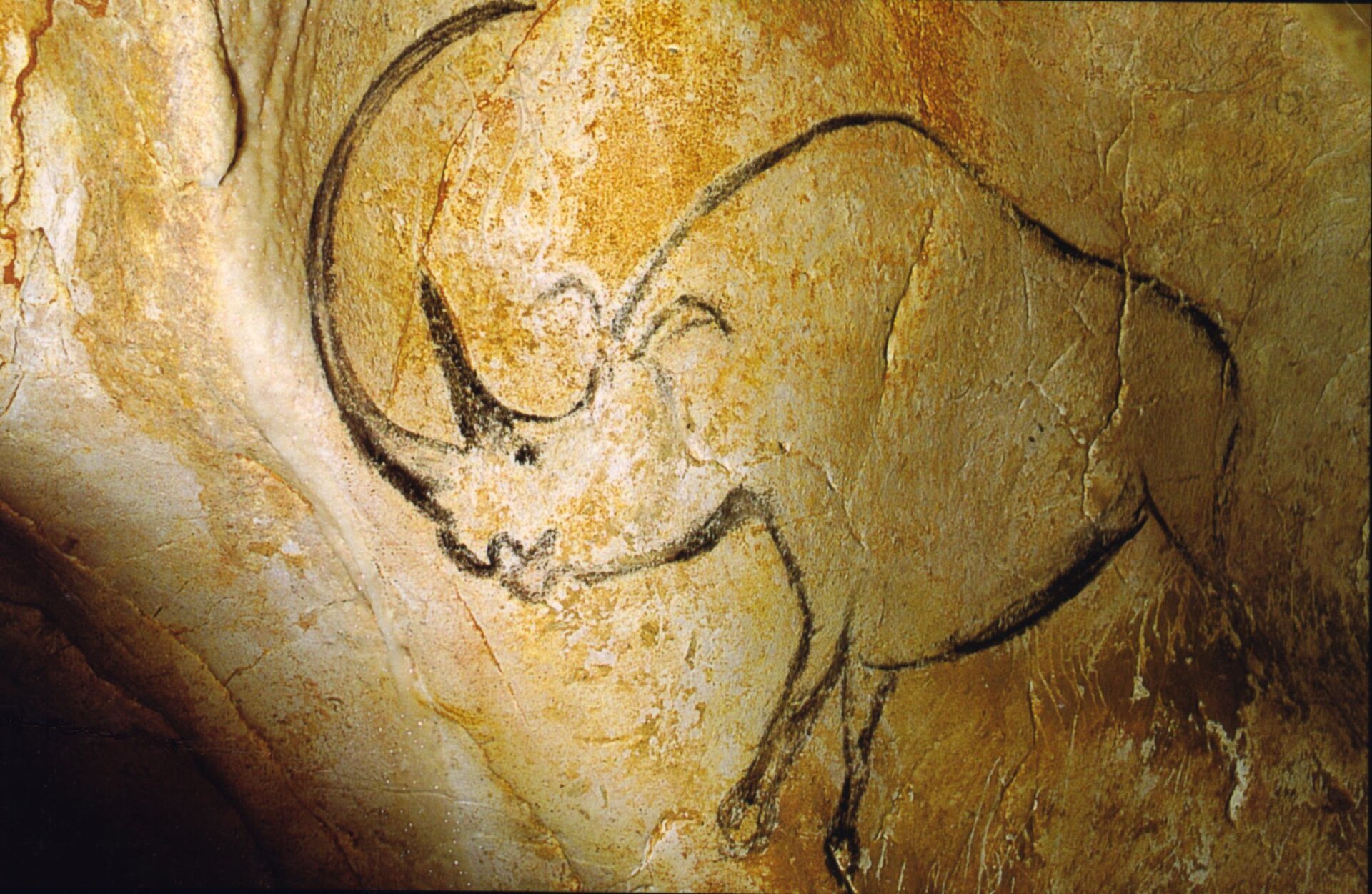
Most visitors expect primitive scratchings. Chauvet delivers something entirely different. The cave holds over 400 paintings and engravings, and every one of them is remarkable. The artists painted predators — cave lions mid-hunt, a woolly rhinoceros charging from the rock face, a group of horses with shaded muzzles and distinct expressions.
The technique stuns modern observers. Artists used perspective, captured movement, and blended charcoal to create depth. One panel shows a herd of bison in a running sequence that resembles early animation. Another depicts two rhinoceroses locking horns in combat. These were not simple people leaving marks on stone. They were gifted artists working by firelight in total darkness — leaving something that would outlast everything their world built above ground.
Enjoying this? 7,000 France lovers get stories like this every week.
Thinking about it for retirement? If you’ve started thinking seriously about retiring there, our complete our full Retire in France guide covers the visa, healthcare, cost-of-living, and the regions worth shortlisting.
The Wild Gorge Above the Cave
The cave sits beneath the Gorges de l’Ardèche — a 30-kilometre canyon the Ardèche river carved through pale limestone over millions of years. The river drops 300 metres along its course, creating rapids, still pools, and hidden beaches shaded by cliff walls that tower overhead. Canoeists paddle the gorge every summer without knowing that the world’s oldest paintings lie sealed in the cliffs just above the waterline.
The canyon rewards those who look up and slow down. Griffon vultures circle the thermals above the rim. Wild orchids grow from rock fissures. The water shifts from green to turquoise to deep blue as the canyon deepens. If you are planning your trip to France and want somewhere that feels genuinely wild, the Ardèche gorge delivers what most of France no longer can. France’s other great gorge, the Verdon in Provence, draws larger crowds — but the Ardèche feels older, quieter, more earned.
The Stone Arch That Guards the Entrance
At the upstream entrance to the gorge stands the Pont d’Arc — a 54-metre natural stone arch that the river carved across millennia. Kayakers drift beneath it every day in summer, entering the gorge without realising the world’s oldest paintings lie a few kilometres downriver. The arch has become the symbol of the entire region, and it earns the status.
Geologists estimate the river took around 10,000 years to cut through the limestone ridge, eventually bypassing the original river loop entirely. The arch is all that remains of that ridge. Standing beneath it on a summer morning, with the water glittering and the cliffs pressing in from both sides, you feel the full weight of deep time in the stone above you.
Visiting the Cave Today
Scientists sealed the original Chauvet Cave permanently. Human breath — the CO2 and humidity alone — would accelerate decay and undo 36,000 years of natural preservation. France built an answer: the Caverne du Pont d’Arc, a full-scale replica that opened near Vallon-Pont-d’Arc in 2015. Teams spent years mapping every surface and recreating every painting to within a millimetre. UNESCO awarded the original cave World Heritage status in 2014.
The replica is extraordinary. It is not a consolation prize. Artists who built it trained from detailed digital scans of the original cave. The interior replicates the temperature and silence of the real thing. Walking through it, you understand why those three explorers stood motionless in December 1994 and could not speak. Lyon makes an excellent base for the journey south — roughly two hours by road from the gorge.
What is the best time to visit the Ardèche Gorge?
Late April through June and September offer the ideal balance — warm enough for canoeing but before peak-season crowds flood the waterway. July and August bring intense heat and heavy traffic on the river.
Can visitors enter the original Chauvet Cave?
No. Scientists permanently sealed the original cave to protect the 36,000-year-old paintings. The Caverne du Pont d’Arc, a full-scale replica near Vallon-Pont-d’Arc, is open year-round and reproduces every painting at a 1:1 scale.
How long does the canoe descent take?
The classic two-day route covers 30 kilometres from Vallon-Pont-d’Arc to Saint-Martin-d’Ardèche, with an overnight stop at the Gaud campsite midway through. Shorter half-day options cover only the upper section past the Pont d’Arc.
Where is the Ardèche Gorge?
The gorge runs through the Ardèche department in southern France, roughly two hours south of Lyon and three hours from Marseille. Vallon-Pont-d’Arc serves as the main base for both the gorge and the cave replica.
The Ardèche does not appear on most France itineraries. That is exactly what makes it worth finding. Thirty-six thousand years of human creativity, sealed in limestone above a wild river — still largely unknown to the world that rushes past it every summer.
Join 7,000+ France Lovers
Three times a week, get France’s hidden gems, seasonal guides, local stories, and the art of la vie française — straight to your inbox.
Subscribe free — enter your email:
📲 Know someone who’d love this? Share on WhatsApp →
Love more? Join 65,000 Ireland lovers → · Join 43,000 Scotland lovers → · Join 29,000+ Italy lovers →
Free forever · Unsubscribe anytime
🇫🇷 You Might Also Love
Tours & experiences you might love


Powered by Viator. Some links are affiliate links — we may earn a small commission at no extra cost to you.

Leave a Reply