
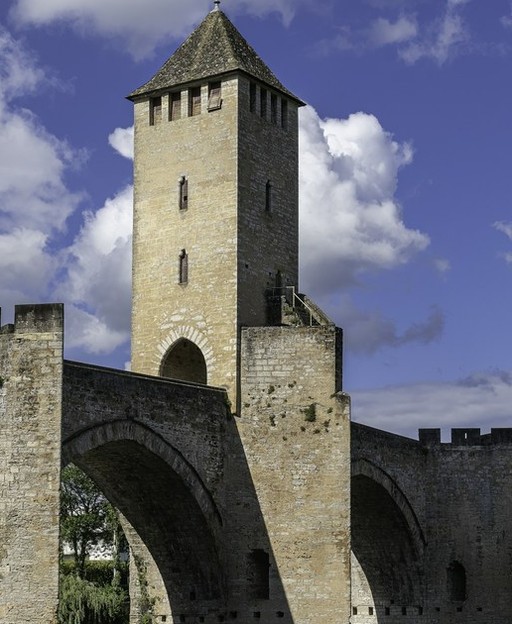
The Pont Valentré at Cahors is one of the finest medieval bridges in France. Six pointed arches carry it over the River Lot. Three tall towers guard the road. Few bridges look so much like a castle.
How the Pont Valentré was built
Cahors chose to build the bridge on 30 April 1306. Work began in 1308. The bridge opened to traffic in 1350, but builders kept working until 1378 (Wikipedia).
That is seventy years of effort. The town was rich from trade and banking. It wanted a strong crossing over the Lot.
Tension between France and England was rising. Within about thirty years, the Hundred Years’ War would begin. So the bridge needed to be a fortress as well as a road.
The bridge is 138 metres long and about five metres wide. Its tallest tower rises roughly 40 metres. Today only walkers may cross it.
The legend of the Devil’s bridge
Every great old bridge needs a legend. This one has a good one.
The story says the master builder grew tired of the slow work. He made a pact with the Devil. The Devil would obey every order until the bridge was done. In return, the builder would give up his soul.
The Devil worked hard. Then the builder had a clever idea. He ordered the Devil to carry water in a sieve. The Devil failed, and the builder kept his soul.
The Devil took his revenge. Each night, so the tale goes, he loosens one stone in the central tower. The stone never stays put.
Look high on the middle tower. You will see a small carved imp. Architect Paul Gout added it during his big restoration, which ran from 1867 to 1879. Locals say it fools the Devil into thinking the stone is his own.
How to see the bridge
Walk across slowly. Stop in the middle and look at the water. The arches frame the Lot beautifully, especially in the soft light of early morning.
For the best view of all, cross to the far bank. From there you can see the whole bridge at once. The towers and arches line up in a long stone row.
🇫🇷 Enjoying this? France lovers get stories like this every week. Subscribe free →
The cathedral with two great domes
The old town holds another treasure. Cahors Cathedral is dedicated to Saint Stephen. Pope Calixtus II consecrated it on 10 September 1119.
Step inside and look up. Two huge domes cover the nave. Each rises about 32 metres. They give the church a look closer to the East than to the French north.
One dome holds 14th-century frescoes. They show the stoning of Saint Stephen and eight prophets. A chapel off the cloister has 15th-century paintings of the Last Judgement.
The cloister is later. Bishop Antoine de Luzech had it built in 1504, in the Flamboyant Gothic style. Its carved stone is delicate and full of detail.
A town older than its bridge
Cahors was a city long before the bridge. The Cadurci, a Celtic people, lived here first. They worshipped a spring and called the place Divona. The name Cahors comes from Cadurcorum, the Latin form of their name (Wikipedia).
The Romans later made it a large town. A Roman amphitheatre is one of the town’s sights.
The setting is lovely. The old town sits inside a tight loop of the River Lot. Limestone hills rise all around it. The river almost wraps the centre like an arm.
A town in a river loop gets a natural moat. The bridge turned that river into a gateway as well as a barrier.
Money, learning and a pope
In the Middle Ages, Cahors had a famous name for finance. Local moneylenders, called Cahorsins, charged interest on loans. The poet Dante even linked the town’s name with lending in his Inferno.
Learning came too. The University of Cahors ran from 1331 to 1751. After that, its faculties moved to Toulouse.
One native son rose very high. Jacques Duèze was born in Cahors in 1244. He became Pope John XXII. A medieval tower in town still carries his name.
Wealth and ambition explain the big stone projects. A rich town could afford a cathedral, a university and a great fortified bridge.
Crossing the bridge as a pilgrim
Picture a medieval walker. He has trudged for days from Le Puy. His feet ache and his pack is heavy.
Then he sees the towers over the water. Beyond them lies the town, with its cathedral and its markets. It must have felt like a promise of rest.
Today you can follow in those steps. Many walkers still take the Via Podiensis. Stand at either end of the bridge and imagine that first sight.
The three towers show how seriously builders took defence. This was a bridge made to guard the town, not just to serve it.
What to look for on the bridge
Take your time. The bridge rewards a slow look.
Count the arches first. There are six, all pointed in the Gothic style. Then count the towers. There are three, each with a pointed roof.
Look at the stone. Some of it is medieval. Some dates from the great restoration of the 1800s. The work of Paul Gout shaped the bridge you see today.
Then find the imp. It is small and easy to miss. Look high on the central tower, and let the legend do the rest.
More to see in Cahors
Give yourself time beyond the big two. The Tower of Pope John XXII is a fine medieval landmark. The Roman amphitheatre shows how old the town really is.
Music lovers should check the calendar. The Cahors Blues Festival has run every July since 1982. Dates and details change, so confirm them with the tourist office.
Wander the narrow streets of the old centre. Stop at a café. Watch the light change on the limestone. Cahors is a town for slow afternoons.
Why Cahors suits heritage travellers
Many visitors rush past the Lot valley. They head for Paris, Provence or the Riviera. That is a shame.
Cahors gives you Roman roots, medieval banking, a pilgrim road and a famous wine. All of it fits inside one small town. The story is easy to follow, and the sights stand close together.
If your family has roots in south-west France, this is a place to know. Cahors is the historic centre of Quercy. Walking its streets can bring those roots to life.
A town on the pilgrim road
Cahors lies on the Via Podiensis. This is the old pilgrim route from Le Puy-en-Velay towards Santiago de Compostela. Walkers still pass through today.
If you like medieval stone, this part of France is rich in it. Read our guides to Conques Abbey and Moissac Abbey. Both sit on pilgrim paths.
You might also enjoy the clifftop village of Rocamadour and the hilltop basilica at Vézelay.
The black wine of the Lot
Cahors is also famous for wine. The grape is Malbec. Locals call it Auxerrois or Côt. By law, red Cahors must hold at least 70% Malbec (Wikipedia).
The vines grow on gravel terraces above the Lot. The wine is deep, dark and firm. That is why people call it “black wine”.
Cahors wine has a long history. In the 13th century, traders shipped it to England through Bordeaux. The vineyards suffered badly from phylloxera in the 1880s. Growers replanted, and the wine won AOC status in 1971.
Sit down at a local table and try a glass. It goes well with duck, lamb and strong cheese.
Planning your visit
Cahors is easy to explore on foot. The bridge, the cathedral and the old streets all sit close together. Allow a full day to see them without rushing.
Check opening times for the cathedral and cloister before you go. The Cahors tourist office lists current hours and events.
Combine Cahors with the Lot valley and nearby Dordogne. Our Lascaux guide is a good next stop. For wider planning, start with our France trip planning hub.
Frequently asked questions
When was the Pont Valentré built?
Work began in 1308 and the bridge opened in 1350. Builders finished in 1378.
Can you walk across the Pont Valentré?
Yes. The bridge is open to walkers only. Cars cannot cross it.
Why is it called the Devil’s bridge?
A local legend says the builder made a pact with the Devil. The Devil still loosens a stone in the central tower each night.
What is Cahors wine made from?
Red Cahors must be at least 70% Malbec. Growers may add Merlot or Tannat.
You Might Also Enjoy
- Conques Abbey: The Pilgrim Village With a Medieval Last Judgement
- Rocamadour: The Cliffside Village Worth the Climb
- Moissac Abbey: The Cloister Where Romanesque Stone Comes Alive
Plan Your France Trip
Ready to plan? Visit our Start Here: Planning Your Trip to France hub for routes, seasons and practical tips.
Join the France Lovers
Every week, get France’s hidden gems, seasonal guides, local stories, and the art of la vie française — straight to your inbox.
Subscribe free — enter your email:
Free forever · One email per week · Unsubscribe anytime
Tours & experiences you might love


Powered by Viator. Some links are affiliate links — we may earn a small commission at no extra cost to you.

Leave a Reply