
Conques is a tiny village in the Aveyron. Barely a few hundred people live here. Yet its abbey church holds one of the great carved scenes of the Middle Ages.
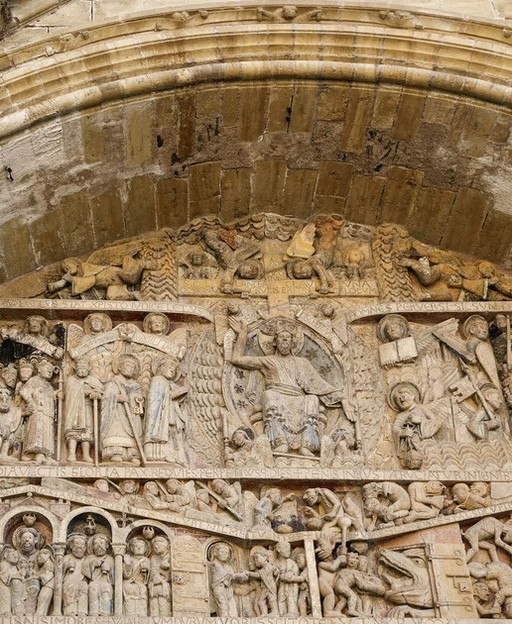
That scene is a Last Judgement. It fills the stone arch above the west door of the church of Sainte-Foy. Pilgrims have stood under it for nearly nine hundred years.
This guide explains how Conques became a pilgrim stop. It covers the relics, the carving and the modern glass. It also helps you plan a visit.
Where Conques sits on the pilgrim road
Conques lies in a steep, wooded gorge in southern France. The village drops down the hillside in tiers of grey stone. Roofs of rough stone slate cover most of the houses.
The village stands on the Via Podiensis. This is the old pilgrim road that starts at Le Puy-en-Velay. It runs south-west towards the Pyrenees. Its goal is the shrine of Saint James at Santiago de Compostela in Spain.
Walkers still follow this route today. Many carry a scallop shell, the old sign of a pilgrim. You will meet them on the narrow lanes at dusk.
The same road shaped Vézelay in Burgundy, where another great pilgrim church crowns a hill. Conques shows the quieter, more remote side of that world.
The monks, the girl and the stolen relics
Local tradition says a hermit named Dadon settled in this valley around the year 800. Other monks joined him. A monastery grew up around them.
The monastery was small and poor. It needed a saint to draw visitors. In the Middle Ages, a saint’s bones meant pilgrims, gifts and fame.
The monks chose Sainte Foy, known in English as Saint Faith. She was a young girl from Agen, a town some distance to the west. Tradition says she died for her faith in the early fourth century.
Her bones lay in Agen. The monks of Conques wanted them. According to the abbey’s own story, one monk stayed in Agen for years. He won the trust of the guardians of the relics. Then he took them and carried them home.
Historians call this kind of act a “holy theft”. The story may be part legend. But the effect is clear. Pilgrims came to Conques, and the abbey grew rich.
The church that pilgrims built
The crowds soon outgrew the old church. The monks built a new one. Work ran from about 1050 to about 1130.
The new church is Romanesque. It has thick walls, round arches and a calm, heavy shape. Inside, the nave rises in tall, narrow bays. A gallery runs above the aisles.
The builders planned for crowds. Pilgrims could walk around the apse and past the side chapels. They could see the shrine without stopping the services.
The stone is warm and golden in some lights, and grey in others. The slate roofs and the pale towers make a soft pattern against the green hills.
If you like this style, see Saint-Savin Abbey for painted Romanesque walls. For what came next, read how Gothic cathedrals reached for the sky.
The Last Judgement over the door
The carving above the west door is the reason most people come. It is called a tympanum. That is the half-circle of stone between a door and the arch above it.
The sculptors made it in the early twelfth century. It holds around 124 figures. Many still show traces of their old paint.
Christ sits at the centre, in a mandorla. That is an almond-shaped halo. His right hand points up. His left hand points down.
The saved stand on his right. Angels lead them towards a row of arches. Among them are monks and kings. A small kneeling figure among them is often said to be Sainte Foy.
The damned fill the other side. Here the carvers had fun. Devils drag sinners to the jaws of hell. A glutton is spitted. A thief is hanged. Each sin meets its own punishment.
Look closely at the lowest band. Latin words run along the stone. They tell the viewer what each scene means. Most pilgrims could not read. The images did the teaching.
The carving is small enough to study in detail. Stand back first. Then walk close and look at single faces. Early light and late light give the best shadows.
The golden statue in the treasury
The abbey treasury holds one of the best collections of medieval goldwork in France. Its star is the Majesty of Sainte-Foy.
This is a seated statue of the saint. Its wooden core is covered in gold. Gems, enamel and carved stones decorate it. The makers reused older pieces, including ancient cameos. The head may come from an even older object.
The statue holds her relics. It is not a portrait. It is a reliquary, a precious case made to honour the bones of a saint.
The stare of the little golden figure surprised many visitors, even in the Middle Ages. It still does. It feels both holy and strange.
The treasury also shows other reliquaries, crosses and jewelled objects. Many came from gifts made by pilgrims.
🇫🇷 Enjoying this? France lovers get stories like this every week. Subscribe free →
Pierre Soulages and the light inside
The inside of the church holds a modern surprise. Between 1987 and 1994, the painter Pierre Soulages designed all of its windows. There are 104 of them.
Soulages came from nearby Rodez. He is known for his deep black paintings. He worked with glassmakers to create a new kind of pale, milky glass.
The glass has no figures and no bright colours. It lets in soft, shifting light. It changes through the day, from grey to gold.
Some people expected modern windows to clash with the Romanesque stone. Many visitors find the opposite. The plain glass lets the old walls and arches speak.
How to plan a visit to Conques
Conques is remote. You need a car, or a long walk, to reach it. The roads in the gorge are narrow and winding. Allow extra time.
Plan at least a full day. Two nights is better. The village is quiet after the day visitors leave. That is the best time to see it.
Here is a simple way to spend your time:
- Morning: see the tympanum in clear light, then step inside the church.
- Midday: visit the treasury and the cloister remains.
- Afternoon: walk down to the old bridge over the river Dourdou.
- Evening: stay for the quiet streets and the lamps.
Wear sturdy shoes. The lanes are steep and the stone is uneven. Check opening times with the local tourist office before you go. Hours change with the season.
Conques pairs well with a wider trip through south-west France. Read our Dordogne travel guide for the next region north-west. Or follow the Plantagenet story at Fontevraud Abbey.
For help with routes, seasons and booking, use our France trip planning hub.
Frequently asked questions about Conques
Where is Conques abbey?
Conques is in the Aveyron department, in the Occitanie region of southern France. The abbey church of Sainte-Foy stands at the heart of the village.
Why is Conques famous?
Conques is famous for its Romanesque abbey church and its carved Last Judgement. It is also known for the relics of Sainte Foy. And it sits on the pilgrim road to Santiago.
Who made the windows in the abbey church?
The painter Pierre Soulages designed the 104 windows. He made them between 1987 and 1994, working with glassmakers.
How long should I spend in Conques?
Plan at least one full day. An overnight stay is better. You can see the village without day crowds in the evening and early morning.
Can I walk to Conques on the pilgrim road?
Yes. Conques lies on the Via Podiensis, which starts at Le Puy-en-Velay. Many walkers stop here on the way to Santiago de Compostela.
You Might Also Enjoy
- Vézelay: The Hilltop Basilica at the Start of the Pilgrim Road
- Saint-Savin Abbey: France’s Hidden Sistine Chapel of Romanesque Art
- Gothic Cathedrals of France: How Medieval Builders Reached for the Sky
Plan Your France Trip
Ready to build your own route? Start with our complete guide to planning your trip to France.
Join the France Lovers
Every week, get France’s hidden gems, seasonal guides, local stories, and the art of la vie française — straight to your inbox.
Subscribe free — enter your email:
Free forever · One email per week · Unsubscribe anytime
Tours & experiences you might love

Powered by Viator. Some links are affiliate links — we may earn a small commission at no extra cost to you.

Leave a Reply