
Autun cathedral holds one of the great surprises of Burgundy. A medieval sculptor signed his name above the door and told the world he made it. His name was Gislebertus, and his Last Judgement still stops visitors in their tracks.
Autun: a Roman city with a medieval soul
Autun began life as Augustodunum, a Roman town founded around 15 BC. Its gates and its great theatre still stand. Walk the streets and you feel two thousand years at once.
The cathedral rose much later. Builders worked on Saint-Lazare in the early twelfth century. The bishop wanted a church grand enough for the relics of Saint Lazarus. Pilgrims were the lifeblood of Burgundy then, and Autun wanted its share.
The new church copied the Romanesque style of nearby Cluny. It used round arches, thick walls and rich carving. Local builders also borrowed from the Roman gates around them. The fluted columns inside echo those old stones.
Gislebertus and the Last Judgement
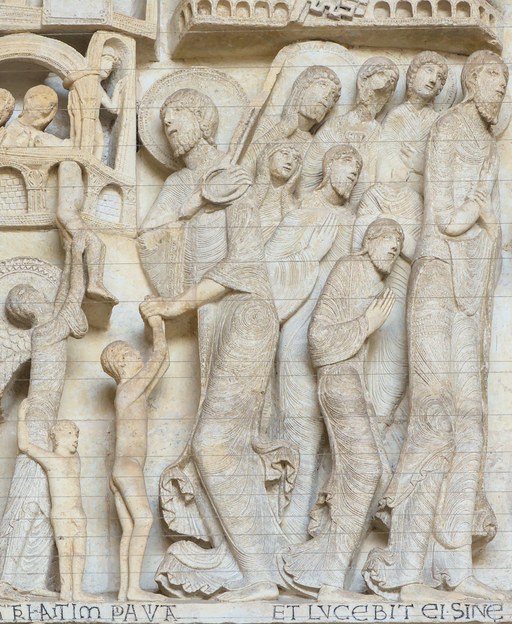
The west door carries the famous tympanum. This is the carved half-circle above the doorway. It shows the Last Judgement in stone.
Christ sits at the centre, tall and calm. Angels and saints stand to one side. On the other side, devils drag sinners downward. The scene reads like a story told without words. Medieval pilgrims could not all read, so the stone did the preaching.
The sculptor was bold. He stretched his figures, bent their limbs and gave them sharp, fearful faces. Look at the small naked souls. Some cling to angels. Others cower as a devil tips the scales against them.
Under Christ’s feet, a short line is cut into the stone. It reads Gislebertus hoc fecit, meaning “Gislebertus made this”. Few sculptors of the age signed their work. He did, and so we know his name nine centuries on.
How to read the carving
Look at the tympanum in three bands. The top shows Christ in glory. The middle holds the dead rising from their graves. The lowest band is the judgement itself.
On the lower band, an angel and a devil weigh souls on a scale. The devil tugs at one pan with a clawed hand. A tiny soul clings on and hopes the angel wins. The carver gave even the smallest figure a clear feeling.
Medieval viewers took the lesson to heart. You will be judged, so live well. The carving made that message plain in a way no sermon could match.
The Roman town beside the cathedral
Do not skip the Roman remains. The Porte d’Arroux and the Porte Saint-André are two of the gates that guarded Augustodunum. Both are still standing at the edge of the old town.
The Roman theatre was one of the largest in Gaul. Its curved seating still marks the ground. Imagine thousands of citizens filling it for a play.
The mix of Roman and Romanesque makes Autun special. One town shows how France moved from the ancient world into the Middle Ages.
Saint Lazarus and the pilgrims
The cathedral takes its name from Lazarus, the man Christ raised from the dead. Autun’s church leaders brought relics of the saint here around 1146. Pilgrims soon followed.
This mattered for the town. Pilgrims need beds, food and prayer. A great church with a famous saint brought trade and pride. The sculpted door was the town’s public face, and it told every traveller what kind of place Autun wanted to be.
Nearby Vézelay, with its relics of Mary Magdalene, drew crowds of its own. Burgundy in the twelfth century was a land of rival shrines.
The tympanum that was hidden
The story has an odd twist. In the eighteenth century, church leaders found the carving too rough for their taste. They covered it with plaster. They also knocked off the head of Christ.
The plaster did its own kind of good. It shielded the stone from weather and from damage for decades. In the 1830s workers uncovered the tympanum again. Experts then began to see how rare it was.
Today the Autun tympanum counts among the finest Romanesque carvings in France. Art lovers travel here just to stand beneath it.
Eve and the Musée Rolin
Gislebertus carved more than the main door. He also made capitals inside the church. They show Bible scenes, animals and travellers on the road.
His most famous figure is Eve. She once lay across a lintel on another doorway. Her body curves through the stone as she reaches for the fruit. Today this carving is kept in the town museum, the Musée Rolin. It is a short walk from the cathedral.
Seeing Eve after the tympanum shows his range. One work is a grand stage. The other is a quiet, almost private moment.
🇫🇷 Enjoying this? 7,000 France lovers get stories like this every week. Subscribe free →
Why Autun matters to heritage travellers
Many French-Canadian and American visitors trace family roots to Burgundy. If your line comes from this region, your ancestors knew this church. They prayed under this carving. Some were baptised nearby.
That makes Autun a place of personal pilgrimage. You stand where your people stood. The same stone faces looked down on them.
Pair the cathedral with the other great Burgundian churches. Read our guides to Cluny Abbey and Vézelay. Together they tell the story of medieval faith in this region.
Planning your visit
Autun sits in the Saône-et-Loire department, in the hills of the Morvan. The town is small and easy to walk. Give it a full day if you can.
Start at the cathedral and study the west door slowly. Then see the Roman gates and the old theatre. Finish at the museum for Eve. The Autun tourist office has maps, visiting details and current opening times. Check there before you go, as hours change.
For wider Burgundy ideas, browse the official Burgundy tourism site. Our own Burgundy travel guide covers the wine villages nearby.
Frequently asked questions
Who carved the Last Judgement at Autun cathedral?
A sculptor named Gislebertus carved it in the early twelfth century. He signed the work with the words Gislebertus hoc fecit, placed under the feet of Christ.
Why was the Autun tympanum covered in plaster?
Church leaders in the eighteenth century thought the Romanesque style looked crude. They plastered over the carving. Workers uncovered it again in the 1830s.
Where can I see Gislebertus’s Eve?
The Eve carving is kept in the Musée Rolin in Autun, a short walk from the cathedral. Check the museum for current opening times.
How long should I spend in Autun?
One full day lets you see the cathedral, the Roman gates, the theatre and the museum without rushing. Pilgrims and art lovers may want longer.
You Might Also Enjoy
- Cluny Abbey: The Burgundy Monastery That Shaped Medieval Europe
- Fontenay Abbey: The Cistercian Abbey Hidden in a Burgundy Valley
- Gothic Cathedrals of France: How Medieval Builders Reached for the Sky
Plan Your France Trip
Ready to build a heritage trip? Start with our France trip planning hub. It brings together regions, seasons and practical tips in one place.
Join 7,000+ France Lovers
Every week, get France’s hidden gems, seasonal guides, local stories, and the art of la vie française — straight to your inbox.
Subscribe free — enter your email:
Free forever · One email per week · Unsubscribe anytime
Tours & experiences you might love


Powered by Viator. Some links are affiliate links — we may earn a small commission at no extra cost to you.

Leave a Reply