
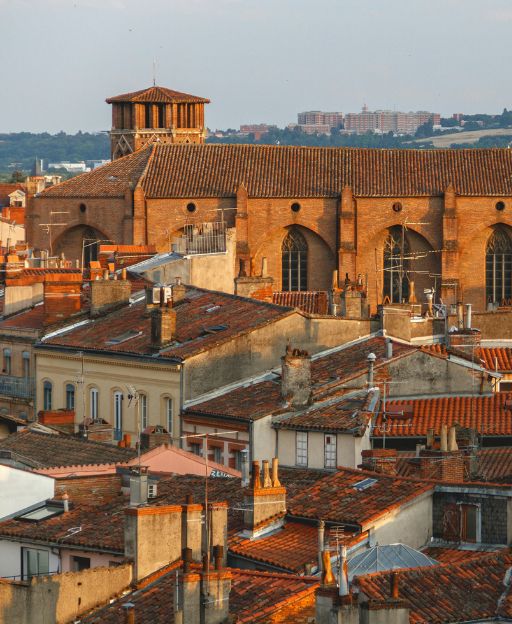
Stand anywhere in Toulouse at golden hour and the whole city turns pink. The terracotta bricks catch the late sun and glow — not orange, not red, but something warm and alive. Locals call it La Ville Rose. The Pink City. But under that warmth sits a place with a long memory and a complicated relationship with Paris.
Built From the Earth
Every building in Toulouse uses the same material: a pinkish-red brick fired from the local clay of the Garonne Valley. Stone was scarce in this part of France, so builders used what they had. The result is a city unlike anywhere else — warm, cohesive, almost Mediterranean in character.
Walk the old streets at dusk and the effect is extraordinary. The bricks absorb the day’s heat and radiate it back long after the sun disappears. Cafés spill onto the pavements. The city slows down. Nobody seems in a hurry.
Paris has its limestone. Alsace has its half-timbering. Toulouse has its brick. Each building material tells a story about where a place comes from and what it values. In Toulouse, the bricks say: we belong to this earth, and we have been here a long time.
The Crusade Paris Would Rather You Forgot
Most visitors arrive knowing nothing of what happened here in the 13th century. The Cathar faith spread across this region like wildfire. It was a Christian movement, but Rome declared it heresy — and sent an army south to deal with it.
The Albigensian Crusade, launched in 1209, brought northern French armies into the lands around Toulouse. They massacred entire villages. Béziers, just 80 kilometres east, lost most of its population in a single afternoon. Survivors fled. Communities collapsed.
Toulouse survived the initial assault but paid a heavy price. The Inquisition that followed operated from within the city itself. Those striking red-brick towers you see at the Jacobins convent? Dominican friars built them — the same order that ran the heresy trials. The faith that once defined this region disappeared within a generation.
If you want to understand this chapter of history more deeply, the castles the Cathars left across the south of France still stand in the hills, silent and strange.
Enjoying this? 7,000 France lovers get stories like this every week.
Thinking about it seriously? If you’ve started actually planning a move, our complete our complete Moving to France guide walks through every step, every cost, and the paperwork that catches most people out.
The Language They Tried to Kill
Before the crusade, the south of France spoke Occitan. Troubadours wrote their love poetry in it. Courts conducted business in it. The language had nothing to do with French. After centuries of Parisian rule and deliberate suppression, it nearly vanished.
Today it survives. Street signs in Toulouse carry both French and Occitan names. Schools teach it. A few radio stations broadcast in it. You hear it occasionally in markets and older neighbourhoods — not often, but enough to know it never quite died.
The story of Occitan and how it refuses to disappear is one of the most quietly defiant chapters in French history.
What Toulouse Puts on the Table
Toulouse has its own sausage — la saucisse de Toulouse — and no one here will let you forget it. Fat, coarsely ground, seasoned simply. It anchors the region’s most famous dish: cassoulet, a slow-cooked bean stew with duck confit and pork. The version in Toulouse differs from those in Carcassonne and Castelnaudary, and every cook in the region argues about which is correct.
The city also produces violet-flavoured everything. Violet sugar, violet liqueur, violet chocolate. The tradition dates to the 19th century, when the flower became Toulouse’s unofficial emblem. Shops near the Capitole sell violet confectionery that makes a far better souvenir than a fridge magnet.
The City Worth the Journey
Toulouse is France’s fourth-largest city but behaves like a large, confident market town. Over 130,000 students keep the streets lively and the prices reasonable. Airbus runs its headquarters here, making Toulouse the quiet capital of European aviation.
The Canal du Midi begins here and runs 240 kilometres south-east to the Mediterranean — one of the great engineering feats of 17th-century France. The Capitole, Toulouse’s grand main square, is one of the finest in the country. The Musée des Augustins holds a superb collection of medieval sculpture. The covered market at Victor Hugo runs every Saturday morning and shows you exactly how the city eats.
For anyone planning a trip to southwest France, our complete France travel planning guide covers everything you need before you book.
Frequently Asked Questions About Toulouse
What is Toulouse best known for?
Toulouse is famous for its distinctive terracotta brick buildings that glow warm pink in the evening light, earning its nickname La Ville Rose. It is also home to Airbus headquarters, a major university city, and the starting point of the Canal du Midi.
Is Toulouse worth visiting for tourists?
Yes, absolutely. Toulouse rewards visitors who look beyond Paris and Lyon. The old town is compact and walkable, the food culture is exceptional, and the city sits close to both the Pyrenees and the Cathar castle country of the Languedoc.
What is the best time to visit Toulouse?
Late spring (May to June) and early autumn (September to October) offer the best weather and fewer crowds. Summer brings warmth and long evenings but busy streets. Winter is mild by French standards and ideal for exploring the city’s markets and museums without the queues.
How do you get to Toulouse from Paris?
The high-speed TGV connects Paris Gare Montparnasse to Toulouse Matabiau in around four to four-and-a-half hours. Regular flights exist, but the train is more comfortable and drops you directly in the city centre.
Join 7,000+ France Lovers
Three times a week, get France’s hidden gems, seasonal guides, local stories, and the art of la vie française — straight to your inbox.
Subscribe free — enter your email:
📲 Know someone who’d love this? Share on WhatsApp →
Love more? Join 65,000 Ireland lovers → · Join 43,000 Scotland lovers → · Join 29,000+ Italy lovers →
Free forever · Unsubscribe anytime
No other city in France glows quite like this at dusk. Not Paris, not Marseille, not Lyon. Toulouse turns pink, holds the warmth, and dares you to leave without understanding what this place has been through. Most visitors do leave, heading to the Pyrenees or Carcassonne. The ones who stay a little longer tend to come back.
🇫🇷 You Might Also Love
Tours & experiences you might love


Powered by Viator. Some links are affiliate links — we may earn a small commission at no extra cost to you.

Leave a Reply