
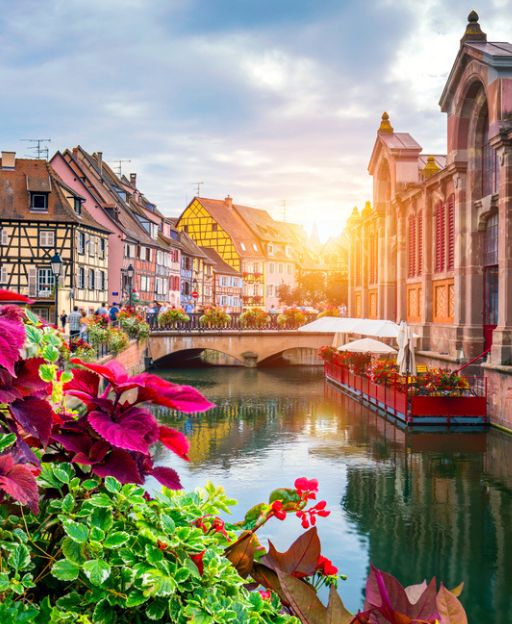
There is a street in northeastern France that stops first-time visitors mid-step. Colourful half-timbered houses lean over a narrow canal. Window boxes overflow with geraniums. The water mirrors every painted façade, as if the town has been rehearsing this moment for centuries.
That town is Colmar. And the view you see on every postcard is entirely real — but the story behind it goes far deeper than any photograph can show.
Built on the Profits of Medieval Trade
Colmar sits in the Alsace region, wedged between the Vosges mountains and the Rhine. The location was no accident. Major trading routes converged here during the Middle Ages. Wine, grain, leather, and cloth all passed through Colmar’s market halls on their way north and south. The town grew rich on the profits.
Those early merchants built to impress. Half-timbered houses rose in shades of ochre, rose, and sage green. Carved wooden galleries stretched across upper storeys. Painted shutters framed every window in contrasting colours. Many of these houses date from the 14th to the 17th century. Builders constructed them to last, and they have.
The Tanners’ Quarter tells this story best. Tanners raised tall, narrow houses here so wet animal hides could dry in the high upper floors. You can still see the original wooden galleries where hides once hung. The district itself has remained almost unchanged for four centuries.
How a Canal District Got an Italian Name
Colmar has no geographic connection to Venice. The town sits on a flat Alsatian plain, some 600 kilometres from Italy. But when French administrators first mapped the Lauch river district in the early 19th century, someone noticed the resemblance: narrow waterways, colourful buildings pressing close on either side, flat-bottomed boats ferrying goods to market.
The name “La Petite Venise” — Little Venice — arrived and never left.
Today, those flat-bottomed boats carry tourists rather than wine barrels. The boatmen who pole them through the canals know every bridge, every arch, every cluster of flowers hanging over the water from May to September. Many of these families have worked the same stretch for generations.
Enjoying this? 7,000 France lovers get stories like this every week.
Thinking about it seriously? If you’ve started actually planning a move, our complete our complete Moving to France guide walks through every step, every cost, and the paperwork that catches most people out.
A Town That Survived Four Centuries of Conflict
Alsace has changed hands between France and Germany more often than any other region in Europe. Street names switched from French to German and back within living memory. Families who spoke only French found themselves inside a German administrative zone after 1871. France returned after 1918. Germany came back in 1940. France prevailed again in 1945.
Each shift brought disruption. But Colmar’s historic centre survived all of it. During the final months of the Second World War, Allied bombing targeted German positions across Alsace. Much of the region suffered severe damage. Colmar’s medieval quarter came through largely intact. Allied commanders had received intelligence about the architectural significance of the old town. They exercised restraint where the military situation allowed.
The town also benefited from its compact geography. The medieval street plan offered few clear military targets. Retreating German forces chose different ground. The result is that Colmar’s 14th-century market hall, its painted bourgeois houses, and its cathedral still stand exactly where their builders placed them.
If you are planning a broader trip through France, the France trip planning guide covers transport, accommodation, and the best seasonal timing for every region.
The Masterpiece That Most Visitors Walk Past
The Unterlinden Museum occupies a former Dominican convent, two minutes’ walk from the central market square. Many visitors glance at the exterior and move on. Those who enter find the Isenheim Altarpiece waiting for them.
Matthias Grünewald painted this multi-panel work around 1515 for a hospital monastery that treated patients with ergotism — a disfiguring disease caused by contaminated grain. Grünewald painted Christ’s suffering with raw, unflinching detail. He depicted swollen and blackened skin. He showed contorted limbs. He did not romanticise death. He confronted it directly.
Art historians rank the Isenheim Altarpiece among the greatest paintings ever made. Its influence reached 20th-century expressionists including Ernst Ludwig Kirchner and Otto Dix. The work has never left Colmar. It has remained in this room for more than 500 years.
Alsace’s distinctive architecture — including the cultural forces that shaped Colmar’s iconic half-timbered style — has a history worth understanding. The piece on why every house in Alsace looks German explains how centuries of shifting borders created one of France’s most distinctive regional identities.
What to Do Beyond the Canal Views
Most visitors photograph the same four or five spots along La Petite Venise. Colmar rewards those who wander further.
Les Halles — the covered market hall — opens every morning except Sunday. Farmers and producers from surrounding villages bring cheese, charcuterie, fruit, and Alsatian wine. This is where residents shop, not tourists.
Colmar also sits at the southern end of the Alsace Wine Route. The vineyards begin just outside town and stretch north for 170 kilometres through some of the most scenic wine country in France. Day trips to nearby villages like Eguisheim, Riquewihr, and Kaysersberg require nothing more than a car and a free afternoon. The Alsace Wine Route guide covers every major stop along the way.
Frequently Asked Questions About Visiting Colmar
What is the best time to visit Colmar?
Late May to early July offers warm weather, flowers in bloom, and fewer crowds than midsummer. December brings Colmar’s famous Christmas market — one of the oldest in France — but accommodation fills weeks in advance. Avoid the second half of August if possible, when tourist numbers peak.
How do you get to Colmar from Paris?
Direct TGV trains run from Paris Gare de l’Est to Colmar in under two hours. Multiple services operate daily. The station sits roughly 15 minutes on foot from La Petite Venise and the historic centre.
Is Colmar worth visiting as a day trip from Strasbourg?
Yes. Regional trains connect Strasbourg and Colmar in around 30 minutes. Many visitors combine both cities during a single Alsace trip. Colmar rewards a full day on its own, but the main highlights are comfortable in four to five hours.
What is the Isenheim Altarpiece and why does it matter?
The Isenheim Altarpiece is a multi-panel painting by Matthias Grünewald, completed around 1515 and displayed in the Unterlinden Museum. Art historians consider it one of the greatest works of the late medieval period. Its depiction of human suffering directly influenced expressionist painters four centuries later.
Colmar does not need to try hard. The geraniums flower every summer without prompting. The canal reflects whatever light falls on it. The Altarpiece has waited patiently for five centuries. All of it simply endures — and invites you to come and stand still for a while.
Join 7,000+ France Lovers
Three times a week, get France’s hidden gems, seasonal guides, local stories, and the art of la vie française — straight to your inbox.
Subscribe free — enter your email:
📲 Know someone who’d love this? Share on WhatsApp →
Love more? Join 65,000 Ireland lovers → · Join 43,000 Scotland lovers → · Join 29,000+ Italy lovers →
Free forever · Unsubscribe anytime
🇫🇷 You Might Also Love
Tours & experiences you might love


Powered by Viator. Some links are affiliate links — we may earn a small commission at no extra cost to you.

Leave a Reply