
In December, something happens to Alsace that makes visitors question whether the place is real. Coloured lights thread through half-timbered streets. The scent of vin chaud drifts from every cobbled courtyard — and the markets themselves look exactly as they did five hundred years ago.
The Oldest Christmas Markets in the World
Strasbourg held its first Christmas market in 1570. That makes it the oldest in France and one of the oldest anywhere on earth.
These markets began as practical winter fairs — a place where craftspeople could sell their work before the cold sealed everything shut until spring. Five hundred years later, the format has barely changed.
The stalls sell handmade things. The food is local. The atmosphere belongs entirely to the season.
Why Alsace Was Made for This
Alsace sits in northeastern France, tucked between the Rhine and the Vosges Mountains. Its villages look more German than French — steeply pitched roofs, painted half-timbered facades, and narrow cobbled lanes.
This is because Alsace changed hands between France and Germany four times between 1871 and 1945. The architecture stayed German. The culture blended. The result is something that belongs fully to neither country and entirely to itself.
In December, that distinctive setting becomes extraordinary. Medieval squares fill with wooden market stalls. The gingerbread buildings behind them look painted from a story you half-remember.
The Villages That Outshine the Cities
Most visitors head straight to Strasbourg or Colmar. Both are magnificent. But the smaller Wine Route villages deliver something the cities cannot — a sense that you have stumbled into something private.
Eguisheim
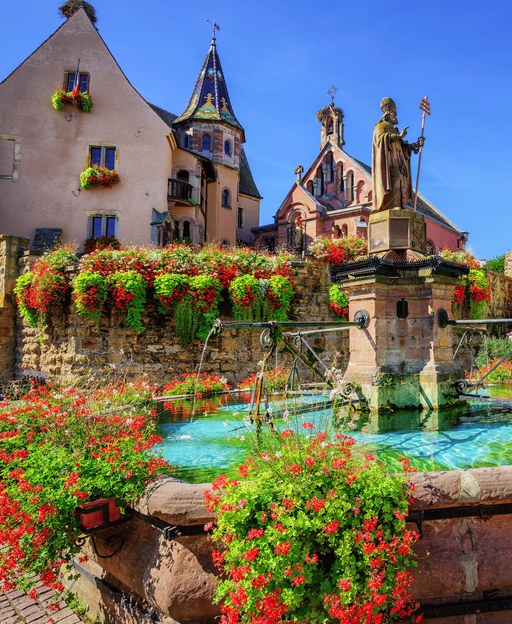
Eguisheim sits at the southern end of the Wine Route and holds its market in a circular medieval square. The stalls wrap around the central fountain, and the lantern light reflects in the water. The village has fewer than two thousand residents. In December, visitors arrive on foot from the surrounding vineyards.
Ribeauvillé
Ribeauvillé runs three separate markets on the same weekend. One focuses on handcraft, one on food, and one on nativity scenes that local families have collected over generations. The town sits beneath the ruins of three medieval châteaux on the ridge above — visible from the market stalls on a clear evening.
Kaysersberg
Kaysersberg — birthplace of Albert Schweitzer — strings its market along a medieval bridge and into the ruins of a castle behind the village. The combination of fortified architecture and candlelit stalls is genuinely unlike anything in Germany, Belgium, or Austria.
Enjoying this? 7,000 France lovers get stories like this every week.
Thinking about it seriously? If you’ve started actually planning a move, our complete our complete Moving to France guide walks through every step, every cost, and the paperwork that catches most people out.
What You Find at the Stalls
Alsatian Christmas markets sell things you won’t find at German or British counterparts.
Bredala are the traditional Alsatian biscuits — gingerbread rounds, cinnamon stars, anise rings. Families make them at home each year using recipes that rarely get written down. Each stall’s batch tastes slightly different.
Hand-carved wooden figures come from workshops in the Vosges hills above the city. These carvers supply markets from Strasbourg to Colmar, using the same methods their grandparents used.
The vin chaud here uses a local twist — Gewurztraminer or Riesling instead of the heavier red wines common elsewhere. The result is lighter, spiced, and entirely its own.
How to Plan Your Visit
The markets open in late November and run through 24 December. Late November to mid-December offers the best balance — full atmosphere, manageable crowds.
Strasbourg is two hours from Paris by TGV. The Wine Route villages are all within 30 to 60 minutes by bus or car. Accommodation across the region books out by October for December weekends — plan at least two to three months ahead.
Start with the France planning hub to map out your wider trip. For a deeper look at the villages, wine, and food along the route, the Alsace Wine Route guide covers everything you need before you go.
What is the best time to visit the Alsace Christmas markets?
The markets open in late November and run through 24 December. Late November to mid-December gives you the full atmosphere with smaller crowds. The final two weekends before Christmas are the busiest and least relaxed.
Which Alsace village has the best Christmas market?
Strasbourg has the largest and oldest market. But Eguisheim, Ribeauvillé, and Kaysersberg offer something more intimate — local producers, smaller crowds, and a scale that makes the whole experience feel personal rather than touristic.
Do I need to book accommodation in advance for the Alsace Christmas markets?
Yes. Hotels and gîtes across the region fill weeks in advance for December weekends. Book two to three months ahead, especially if you want to stay in one of the smaller Wine Route villages.
After the last market stall folds its shutters, the village goes quiet. The cobblestones are still warm from the lanterns. Somewhere behind you, the smell of cinnamon and pine clings to everything.
There are places in the world that look exactly as you imagined them. In December, Alsace is one of them.
Join 7,000+ France Lovers
Three times a week, get France’s hidden gems, seasonal guides, local stories, and the art of la vie française — straight to your inbox.
Subscribe free — enter your email:
📲 Know someone who’d love this? Share on WhatsApp →
Love more? Join 65,000 Ireland lovers → · Join 43,000 Scotland lovers → · Join 29,000+ Italy lovers →
Free forever · Unsubscribe anytime
🇫🇷 You Might Also Love
Tours & experiences you might love


Powered by Viator. Some links are affiliate links — we may earn a small commission at no extra cost to you.

Leave a Reply