
Seven hundred years ago, the hills of southern France ran with blood. The Catholic Church called them heretics. The Cathars called themselves Good Christians. In the mountains of Languedoc, a remarkable movement took root — and was burned out of existence. The Cathars of Languedoc have never been truly forgotten. Their ruined castles still rise from the cliffs. Their story still haunts the region. And their legacy shaped southern France in ways that echo to this day.
Who Were the Cathars of Languedoc?
The Cathars were a Christian religious movement. They lived mainly in the Languedoc region of what is now southern France. They were at their strongest between 1100 and 1250.
They were not a small fringe group. At their peak, the Cathars had hundreds of thousands of followers. Nobles, merchants, farmers, and clergy all joined the movement. The Count of Toulouse himself was sympathetic to their cause.
The word “Cathar” comes from the Greek word katharos, meaning “pure.” The Cathars called themselves “Good Christians” or Bonshommes — Good Men. They lived simply. They preached freely. They built close communities across the south.
The region itself explains why Catharism grew so strong here. Languedoc means “the land of the Oc language.” In the north, people said “Oïl” for yes. In the south, they said “Oc.” This was a different culture, a different tongue, a different world. The troubadour tradition flourished here. Religious freedom felt natural. The south had always been its own place.
The area saw trade with the Arab world and with Italian merchants. New ideas moved freely. When Cathar preachers arrived from northern Italy and Bulgaria, their message fell on ready ears.
What Did the Cathars Believe?
The Cathars held beliefs that set them apart from Rome. They believed in two powers, not one. A good God created the spiritual world. An evil power created the material world. To be truly free, a person had to escape the physical.
This belief is called dualism. It was not unique to France. Similar ideas had appeared in Bulgaria, northern Italy, and the east. But nowhere did they take root so deeply as in Languedoc.
The Cathars had two levels of members. The perfecti were the fully initiated. They lived strict lives. No meat. No sex. No worldly goods. They walked in pairs, preached in public, and healed the sick. Towns welcomed them. They were known for their honesty and their care for the poor.
The credentes were ordinary believers. They could live normal lives. Many waited until their deathbeds to receive the consolamentum — a form of spiritual baptism. They believed this act released their soul from the material world for good.
The Cathars rejected the Catholic Church entirely. They saw Rome as corrupt. They had no churches, no gold, no Pope, and no grand buildings. This made them deeply dangerous to the established power of the age.
Catharism was also, by the standards of the time, remarkably equal. Women could become perfectae — female perfecti. They preached and led communities. This was almost unheard of in medieval Europe.
The Huguenots, three centuries later, would face a similar rejection from Catholic France. The pattern of religious difference and persecution has deep roots in French history.
The Albigensian Crusade: A War Against France Itself
In 1208, Pope Innocent III had had enough. A papal legate was murdered in southern France. The Pope blamed the Cathars. He called for a crusade — not against Muslims in the Holy Land, but against Christians in southern France.
The Albigensian Crusade — named after the town of Albi, a major Cathar centre — began in 1209. Northern French nobles saw their chance. A crusade meant land, wealth, and Church approval. Simon de Montfort led the campaign with brutal focus.
The first great atrocity came at Béziers in July 1209. The crusaders sacked the city. They killed thousands — Cathars and Catholics alike. A papal legate is said to have told the soldiers: “Kill them all. God will know his own.” The exact quote may be legend. The massacre was very real.
Carcassonne fell next. Its young Viscount Raimond-Roger Trencavel surrendered to save his people. He died in prison three months later, aged just 24. Simon de Montfort took his lands.
The war dragged on for two decades. De Montfort himself died under a stone thrown from the walls of Toulouse in 1218. The crusade ground on. The Count of Toulouse fought back. Entire towns changed hands multiple times. But the military outcome was never truly in doubt.
By the 1220s, the crusade had crushed most military resistance. Then came the Inquisition — a systematic hunt for Cathars who remained in hiding. Inquisitors travelled from town to town. Neighbours reported neighbours. The records they kept are now invaluable tools for genealogists tracing Languedoc ancestry.
🇫🇷 Enjoying this? 7,000 France lovers get stories like this every week. Subscribe free →
The Fall of Montségur: The Last Stand
Montségur is the name that echoes loudest from this history. High in the Ariège mountains, the castle was the last great Cathar refuge. Perfecti from across Languedoc gathered there as the crusade closed in.
In May 1243, the French forces laid siege to it. For ten months, Montségur held. The garrison was small. The perfecti inside prayed, fasted, and waited. They had nowhere to go.
On 2 March 1244, Montségur surrendered. The terms were clear. Soldiers could leave freely. But the perfecti would have one chance to recant their faith. Not one did.
On 16 March 1244, more than 200 perfecti walked down from the castle to the field below. They walked into a great fire that the crusaders had built. They were burned alive. They sang as they walked in. No perfectus fled. No one gave up their faith.
The field at the base of Montségur is called the Champ des Crémats — the Field of the Burned. It is a quiet meadow today. A stone marker stands there. Visitors still leave flowers.
Montségur fell. But the Cathars did not die at once. Small groups survived in hiding in the Pyrenean foothills. The Inquisition hunted them for another century. The last known perfectus, Guillaume Bélibaste, was burned at the stake in 1321.
Then, at last, silence.
The Cathar Castles You Can Visit Today
The landscape of southern France keeps the memory alive. The castles are still there. Many of them stand just as they did when the Cathars sheltered within them.
Montségur sits at 1,207 metres on a sheer rocky peak in the Ariège. The climb takes about 45 minutes on foot. The views reach across the Pyrenees. The rebuilt keep dates from after the siege, but the rock itself was where the perfecti made their last stand.
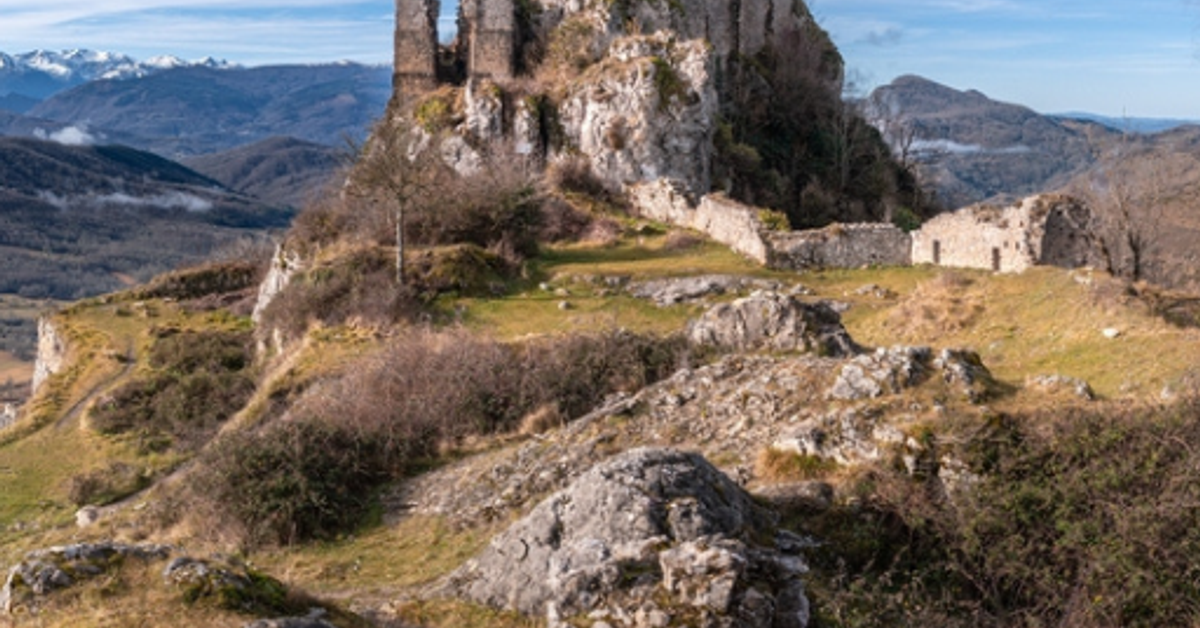
Château de Roquefixade stands not far from Montségur. It is one of the finest Cathar frontier castles. Ruins rise from a dramatic limestone ridge. The Pyrenees stretch behind it. On a clear day, you can see for 60 kilometres in every direction.
Peyrepertuse is perhaps the most spectacular of all. Built onto a long ridge 800 metres above sea level, it looks more like a stone ship than a castle. The climb is steep and the wind fierce. But from the top, the history feels very real and close.
Quéribus was the last Cathar castle to fall, in 1255. It rises from a single spike of rock above the plain. In winter, clouds swirl below the walls. It is one of the most striking sights in all of France.
Carcassonne is the grandest of all. Its double walls, 52 towers, and cobbled streets make it the best-kept medieval fortress in Europe. The Cathars knew it well. So did Simon de Montfort.
The area between Carcassonne and the Pyrenees is your focus for a Cathar heritage visit. Most of the key sites are within two hours’ drive of each other. The best time to go is May to September, when the mountain paths are clear.
If you want to plan your trip in detail, our guide to planning a French heritage trip walks you through everything — from finding your ancestral village to visiting the archives départementales.
Could Your Ancestors Have Been Cathars?
This is a question worth asking — especially if your family has roots in southern France, or in the French-Canadian or Acadian diaspora.
The Cathar diaspora never got the attention given to the Acadians or the Huguenots. But after the crusade, many Cathar families scattered. Some went east to northern Italy. Some went south into the Pyrenean foothills. Some converted outwardly and lived quietly, their beliefs buried deep.
If your ancestors came from Ariège, Aude, Tarn, or Hérault, you are from Cathar country. The departmental archives of these regions hold records going back centuries. Many are free to access online. The Inquisition records are among the most detailed medieval documents that survive in France — a grim fact, but a useful one for family researchers.
Surnames from the area often carry traces of Occitan — that ancient southern tongue the Cathars spoke. Names like Bonhomme, Pons, Durand, Guilhem, and Raimond all have deep roots in Languedoc. You can read more about these French surnames of Languedoc and their origins.
If you want to trace your French roots more broadly, our full guide to tracing French ancestry covers the key archives, databases, and research steps for Canadians and Americans.
Your ancestors left France. For some of them, it was not a choice. Now it is time to go back — and understand why.
Frequently Asked Questions
What were the Cathars, and where did they live?
The Cathars were a Christian religious movement in southern France. They lived mainly in Languedoc — a region that today covers departments such as Ariège, Aude, Hérault, and Tarn. Towns like Albi, Béziers, and Carcassonne were major Cathar centres in the 12th and 13th centuries.
Why did the Catholic Church launch a crusade against the Cathars?
The Cathars rejected the authority of Rome and taught that the material world was corrupt. They saw the Church’s wealth and power as a sign of spiritual failure. Pope Innocent III declared them heretics and launched the Albigensian Crusade in 1209 to destroy the movement by force.
What happened at Montségur in 1244?
After a ten-month siege, more than 200 Cathar perfecti refused to give up their faith at Montségur. They were burned alive in a field at the base of the castle. The site is called the Champ des Crémats — the Field of the Burned — and is still visited by people from around the world today.
Can you still visit Cathar castles in France?
Yes. Montségur, Peyrepertuse, Quéribus, Roquefixade, and Carcassonne are all open to visitors. Most are in the Ariège and Aude departments of southern France. The best time to visit is May to September, when the mountain paths and castle ruins are at their most accessible.
How long did the Cathar religion survive after the crusade?
Catharism as an organised movement effectively ended with the fall of Montségur in 1244. Small groups survived for decades in the Pyrenean foothills. The last known perfectus, Guillaume Bélibaste, was burned at the stake in 1321, more than 75 years after Montségur fell.
You Might Also Enjoy
- French Surnames of Languedoc: Origins, Meanings and Family Heritage — trace the names that survived the crusade and the Inquisition
- The Huguenots: France’s Great Exodus and Its Global Legacy — another story of French religious persecution with a worldwide diaspora
- Why Brittany Feels Like a Country Within a Country — discover another proudly distinct region of France
Plan Your France Trip
Ready to explore Cathar country for yourself? Our planning hub covers everything you need — from choosing the right region to booking trains, finding accommodation, and visiting the archives. Start planning your France trip here.
Join 7,000+ France Lovers
Every week, get France’s hidden gems, seasonal guides, local stories, and the art of la vie française — straight to your inbox.
Subscribe free — enter your email:
Free forever · One email per week · Unsubscribe anytime
Tours & experiences you might love


Powered by Viator. Some links are affiliate links — we may earn a small commission at no extra cost to you.

Leave a Reply