
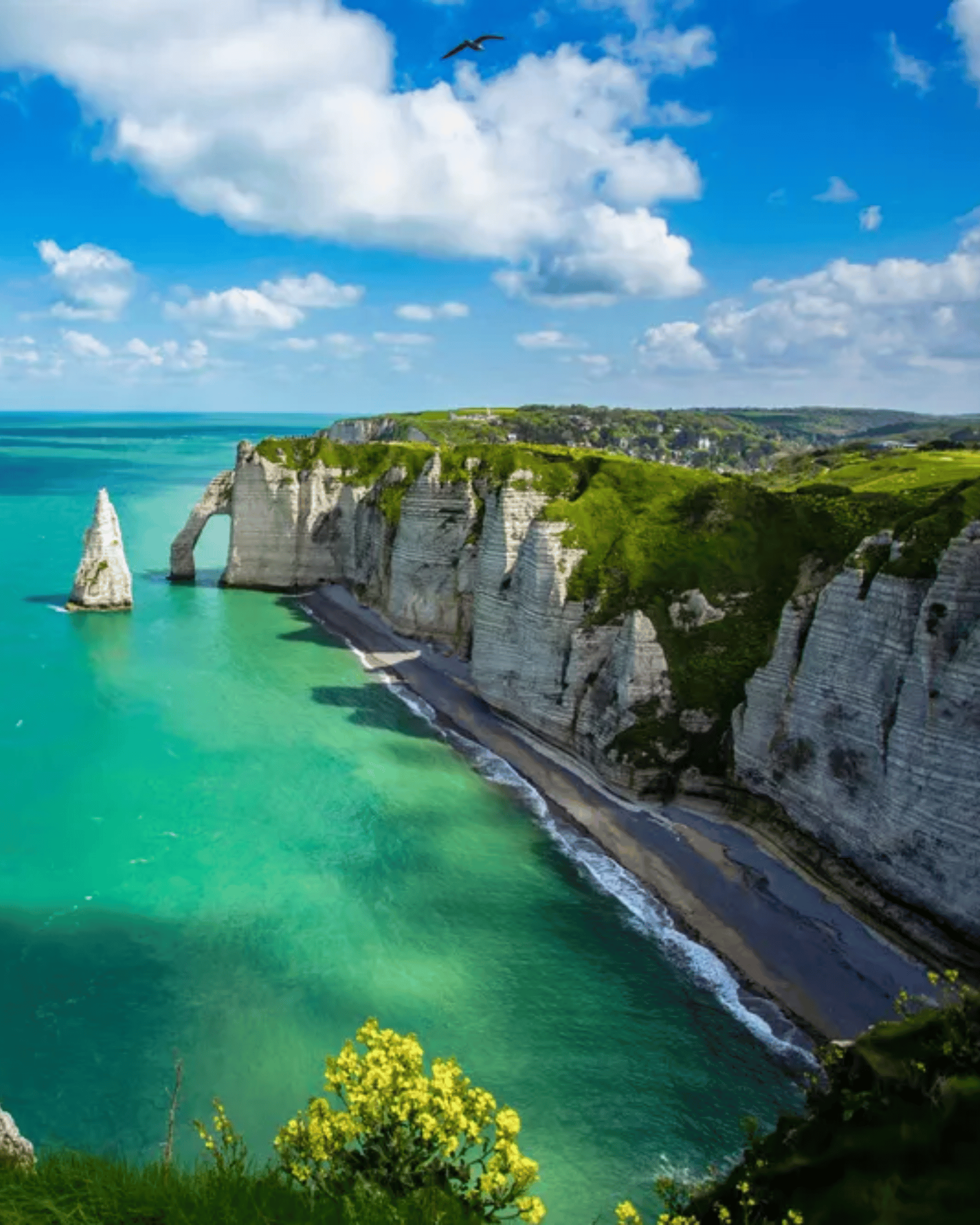
Étretat is a small town on the Normandy coast, about 200 kilometres north-west of Paris. It is famous for its white chalk cliffs, natural rock arches, and a pointed rock formation known as the Needle. The cliffs here are among the most photographed in France — and for good reason. But there is more to Étretat than a dramatic backdrop. If you are planning a visit, here is everything you need to know.
Where Are the Cliffs of Étretat?
Étretat sits on the Alabaster Coast — known in French as the Côte d’Albâtre — in the Seine-Maritime department of Normandy. The town has a population of around 1,400, which swells considerably in summer as visitors arrive from across France and beyond.
The cliffs here are made of chalk laid down over millions of years, then shaped by the sea into arches, caves, and stacks. The result is a coastline that looks almost sculpted. Three main cliff formations define the landscape: the Falaise d’Aval to the west, the Falaise d’Amont to the east, and the Manneporte arch, which is the largest of the three and only accessible by boat or kayak.
L’Aiguille — or the Needle — is a slender chalk stack rising about 70 metres from the sea just off the Falaise d’Aval. It is one of the most recognisable features of the Normandy coast and appears in paintings, photographs, and literature going back more than a century.
Getting to Étretat from Paris
By car, Étretat is roughly two and a half hours from Paris, depending on traffic. Take the A13 motorway towards Rouen, then the A29 north towards Le Havre, and follow signs to Étretat from there. Parking in the town centre can be limited in peak summer months, so arriving early in the morning is advisable.
By public transport, the journey takes around three hours. Take a train from Paris Saint-Lazare to Le Havre (approximately two hours), then a regional bus from Le Havre bus station to Étretat. Buses run several times daily, and the ride takes about 45 minutes. Alternatively, you can take a train to Fécamp and travel by taxi or bus from there.
There is no direct train to Étretat, so the car is the most straightforward option if you are travelling as a group or with luggage. Day trips from Paris are entirely feasible — the cliffs themselves take two to three hours to walk properly, leaving time for lunch in the town before heading back.
Walking the Clifftops
The best views of the cliffs are from the top, not from the beach. Two main walks leave from the town, one heading west to the Falaise d’Aval and one heading east to the Falaise d’Amont. Both are well-marked and suitable for most fitness levels, though the paths can be muddy after rain and some sections are steep.
The western walk to the Falaise d’Aval is the more popular of the two. From the clifftop, you look directly down at the arch and across to the Needle. The views are clearest in the morning before haze sets in, and the light tends to be better for photography in the first half of the day. Allow around 45 minutes for the round trip if you walk at a steady pace.
The eastern walk to the Falaise d’Amont is slightly less crowded and gives a good view back over the town and along the full sweep of the coast. At the top, you will find a small chapel — the Chapelle Notre-Dame de la Garde — and a monument to two French aviators who disappeared over the Atlantic in 1927. The walk takes around 30 minutes each way from the town centre.
Wear sturdy shoes and stay well back from the cliff edges. The chalk erodes and the edges can be unstable. There are no barriers along most of the path, and sections of the cliff do fall occasionally.
The Beach at Étretat
Unlike many French coastal towns, Étretat does not have a sand beach. The shoreline is made entirely of smooth grey pebbles — large ones near the water and smaller ones further up. Swimming is possible but the entry into the water is rough underfoot, and waves can be strong. The beach is open and the water clean, but it is not the kind of beach suited for building sandcastles or relaxing on a towel.
The beach is at its best in low season, when it is quiet and you can sit with the cliffs directly in front of you without crowds. In July and August, it gets very busy. Arrive before 9am if you want a peaceful experience.
Étretat Through the Eyes of Artists
Étretat has been drawing artists since the nineteenth century. Claude Monet painted the cliffs here more than 50 times between 1883 and 1886, capturing them in different seasons and different light. Gustave Courbet also painted the arches extensively. The town attracted writers too, including Guy de Maupassant, who grew up nearby and set several of his stories along this coast.
The most enduring fictional connection is with Arsène Lupin, the gentleman thief created by Maurice Leblanc. Leblanc lived in Étretat for many years, and the town features prominently in the Lupin stories. His former home, the Villa Orphée, now operates as a small museum called La Maison de Lupin. It is open to visitors and worth an hour of your time, particularly if you have watched the Netflix series that brought Lupin back to a new audience.
Les Jardins d’Étretat
On the clifftop above the Falaise d’Aval sits one of the more unusual gardens in Normandy. Les Jardins d’Étretat is a contemporary garden designed by Russian landscape architect Alexandre Grivko, opened in 2017. It sits on the site of an older garden created by the actress and playwright Nathalie Clifford Barney, and the layout still follows the original terraces.
The garden is compact — about two hectares — but uses topiary, water features, and planting in a way that feels modern rather than formal. The views over the cliffs and sea from within the garden are exceptional. Admission is charged, and the garden is open from late March through to November. Book tickets in advance during summer, as it fills up quickly.
Where to Eat in Étretat
The town has a good selection of restaurants and crêperies for its size, mostly concentrated around the central market square. Seafood is the obvious choice — mussels, oysters, and scallops from the Normandy coast are excellent here. Most restaurants offer a set lunch menu (formule) at a reasonable price, which is usually the best value option.
Normandy is also known for its apple-based products: cider, calvados (apple brandy), and pommeau (a blend of apple juice and calvados). These appear on most restaurant menus and in the town’s shops. A small covered market operates in the central square on certain days of the week and sells local produce, cheese, and prepared foods.
Best Time to Visit
Étretat is worth visiting at any time of year, but the experience varies considerably by season. Spring (April and May) offers mild weather, smaller crowds, and good light for photography. The coastal path is at its greenest and the town is quieter before the school holiday rush.
Summer brings reliable weather but also the heaviest visitor numbers. July and August see the town at its busiest, with queues for the cliff walks and difficulty finding parking. If you visit in summer, a very early start makes a real difference.
Autumn and winter are genuinely beautiful on this coast. The light changes dramatically, storms can roll in from the Channel, and the clifftops are almost empty. The cliffs in winter weather have a severity to them that no summer photograph can quite capture. Most restaurants and shops remain open through October, though some reduce their hours or close in November and December.
Practical Information
The cliff walks are free and accessible year-round during daylight hours. Les Jardins d’Étretat charges around €12 for adults. La Maison de Lupin charges a small entrance fee. The beach is free.
There are toilets at the beach and near the main car park. The town has an ATM and several small supermarkets. Mobile signal is generally good in the town centre but can drop on the more exposed sections of the clifftop walks.
Étretat is a relatively short drive from other Normandy highlights. Fécamp, with its Palais Bénédictine and harbour, is 20 kilometres north. Honfleur, one of the most attractive ports in northern France, is around 45 kilometres east along the coast. The D-Day beaches are roughly 100 kilometres further west. Étretat works well as a day stop within a broader Normandy road trip.
Thinking about it seriously?
If you’ve started actually planning a move, our complete our complete Moving to France guide walks through every step, every cost, and the paperwork that catches most people out.
🇫🇷 Discover the France Most Tourists Never Find
Get our free guide to 25 hidden villages of France — then join 7,000+ readers for weekly stories about places most guidebooks never mention.
Get Your Free Village Guide →Tours & experiences you might love


Powered by Viator. Some links are affiliate links — we may earn a small commission at no extra cost to you.

Leave a Reply