
Bordeaux is the most famous wine region in the world. But it is not one thing — it is two. The Gironde Estuary splits the region into a Left Bank and a Right Bank, and the wines produced on each side are profoundly different. The grape varieties are different. The soils are different. The style of winemaking is different. And the wines themselves taste completely different.
If you have ever stood in a wine shop staring at a wall of Bordeaux labels, this is the single most useful thing to understand. Left Bank or Right Bank is the key that unlocks the whole region.
Love France? Get the best of French food, wine, culture, and travel — straight to your inbox. Subscribe free here.
The River That Divides Everything
The Gironde Estuary — and the rivers that feed it, the Garonne and the Dordogne — cuts through Bordeaux from north to south. To the west of this waterway lies the Left Bank. To the east lies the Right Bank. The two banks are only a few kilometres apart in places, but the difference in their soils, climates, and wines is enormous.
The Left Bank sits on deep beds of gravel. These well-drained soils force vine roots deep into the earth in search of water, which stresses the plant and concentrates flavour in the grapes. Gravel also absorbs heat during the day and releases it slowly at night, which helps ripen the thick-skinned Cabernet Sauvignon grape. Cabernet Sauvignon needs warmth to fully ripen. On the Left Bank, it gets it.
The Right Bank is different. The soils here are heavier — limestone, clay, and clay-limestone. These soils retain water more readily, which suits Merlot. Merlot has thinner skin than Cabernet Sauvignon. It ripens earlier. It does not need the same sustained heat. On the Right Bank’s cooler, heavier soils, Merlot thrives.
The Left Bank: Structure, Tannin, and Time
The Left Bank’s most important sub-regions are the Médoc and the Graves. Within the Médoc sit four of the most recognised appellations in the world: Pauillac, Margaux, Saint-Julien, and Saint-Estèphe. These are the home of names like Château Lafite Rothschild, Château Margaux, Château Latour, and Château Mouton Rothschild — the so-called First Growths from the famous 1855 Classification.
Left Bank wines are typically blends dominated by Cabernet Sauvignon, often making up 60 to 80 per cent of the wine, with Merlot and smaller amounts of Cabernet Franc and Petit Verdot making up the rest.
The character of these wines is distinctive. They are firm and structured when young. The tannins — the compounds that give wine its drying, gripping texture — are high and assertive. A young Left Bank Bordeaux from a good vintage can taste almost austere. The fruit is there, but it is held back behind those tannins, like a fist in a glove.
Give them time, and these wines open up. The tannins soften. The fruit deepens. Notes of blackcurrant, cedar, graphite, and tobacco emerge. The best Left Bank wines from great vintages — 2000, 2005, 2009, 2010, 2016 — can evolve for 20, 30, even 50 years. They are built for the long haul.
This is not a style for immediate gratification. If you are opening a young, serious Left Bank Bordeaux without decanting or ageing, you may find it tough going. But open it at 15 or 20 years old, and you will understand why these wines have commanded admiration for centuries.
The Right Bank: Softness, Richness, and Accessibility
The Right Bank is anchored by two appellations: Saint-Émilion and Pomerol. Both sit on the Right Bank of the Dordogne River, and both are dominated by Merlot, which typically makes up 70 to 90 per cent of the blend, with Cabernet Franc as the main supporting grape.
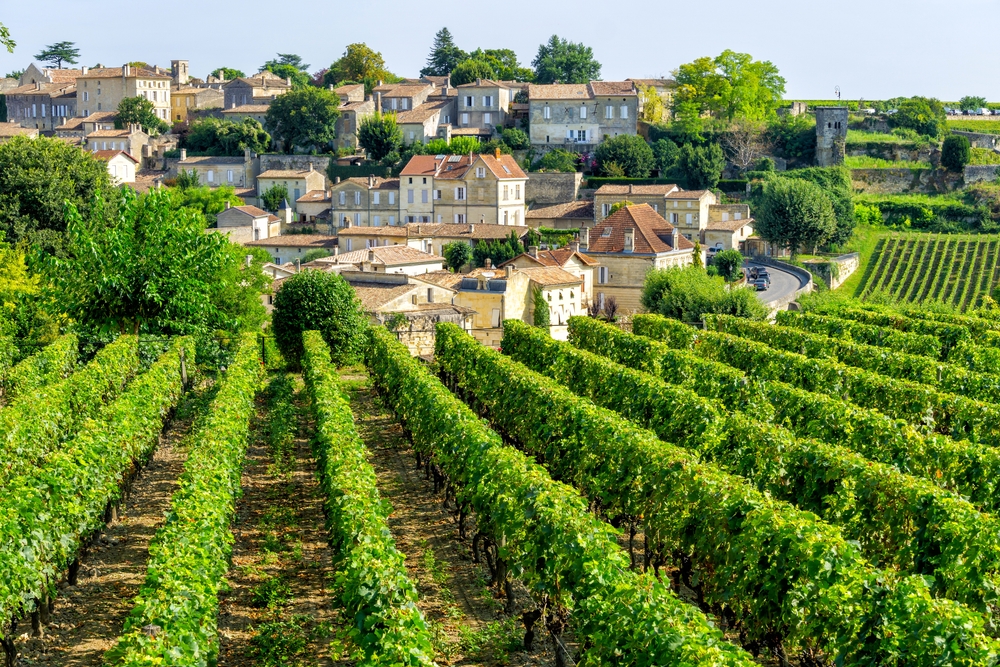
Saint-Émilion is a UNESCO World Heritage Site. Its hilltop town is one of the most picturesque in France, and the surrounding plateau and slopes produce wines of real complexity. The limestone soils of the plateau give wines with structure and mineral precision. The cooler clay slopes produce something richer and more generous.
Pomerol is a small, flat, and almost anonymous-looking appellation. There is no château here that looks like a castle. The estates are modest. But the wines from Pomerol’s iron-rich, clay soils — particularly from the small patch near the village called the “buttonhole” — are among the most sought-after in the world. Château Pétrus, which makes only about 2,500 cases per year from nearly pure Merlot, regularly fetches several thousand pounds per bottle at auction.
Right Bank wines are approachable much earlier than Left Bank wines. The Merlot grape produces wines with lower tannin, more body, and softer, rounder fruit. Expect notes of plum, cherry, chocolate, and sometimes a hint of truffle or earthiness. These are wines you can open at five or six years old and enjoy without a struggle.
That does not mean they are simple. The great names of the Right Bank — Pétrus, Cheval Blanc, Ausone, Le Pin — rival anything produced on the Left Bank for complexity and longevity. But they reach their drinking window sooner, and they are more welcoming at the table when young.
Love France? Get the best of French food, wine, culture, and travel — straight to your inbox. Subscribe free here.
Soil: The Real Reason the Wines Taste Different
The difference in taste between Left Bank and Right Bank Bordeaux comes down mostly to soil. This is not a romantic notion — it is practical viticulture.
Gravel drains fast. Vines in gravel cannot become waterlogged. They are stressed into producing small, flavour-concentrated berries. Gravel is also warm, which helps thick-skinned Cabernet Sauvignon achieve full phenolic ripeness — that is, ripe tannins rather than harsh, green ones.
Clay holds water. Vines in clay can access moisture even in dry years. Clay also stays cool, which suits Merlot’s earlier-ripening cycle. The iron-rich clay of Pomerol, in particular, is thought to contribute to the distinctive richness and density of wines like Pétrus.
Neither soil type is superior. They are simply different, and they produce different wines. The winemaker’s job on each bank is to work with what the soil gives them.
Choosing a Bottle: What to Look For
If you are buying a bottle and want to know what you are getting before you open it, the appellation on the label is your guide.
Left Bank appellations to know: Pauillac, Margaux, Saint-Julien, Saint-Estèphe, Pessac-Léognan (part of the Graves). Wines from these appellations will be Cabernet Sauvignon-dominant. They will be firm and structured. They will need time, or at least a long decant.
Right Bank appellations to know: Saint-Émilion, Pomerol, Fronsac, Canon-Fronsac, Lalande-de-Pomerol. These will be Merlot-dominant. They will be rounder and more approachable. They are better choices if you want to drink the wine relatively young.
If the label says simply “Bordeaux” or “Bordeaux Supérieur,” the wine can come from anywhere in the region, and the blend could be anything. These are entry-level wines and are priced accordingly. Good value can be found here, but do not expect the complexity of an appellation-level wine.
Vintages: When the Year Matters
Bordeaux’s Atlantic climate means vintage variation is significant. A cold, wet summer will hold back ripeness. A warm, dry growing season will produce concentrated, age-worthy wine. Knowing the vintage helps you decide whether to drink a wine now or wait.
Recent standout vintages for Bordeaux: 2016, 2015, 2010, 2009, 2005. These years produced wines of exceptional ripeness and structure on both banks. If you are buying to age, these are the vintages to seek out.
More modest vintages — 2013, 2011, 2008 — produced lighter wines that drank better young. They are less likely to reward long cellaring but can offer good drinking at lower prices.
The Right Bank, being slightly warmer in some years due to the clay soils retaining heat, can outperform the Left Bank in cooler vintages. In warm years, the Left Bank’s gravel soils — which moderate heat — can produce more precise, structured wine. The two banks are not always neck-and-neck.
Food Pairing: What to Serve with Each Style
Left Bank Bordeaux, with its firm tannins and blackcurrant fruit, is a natural partner for red meat. Roast lamb with herbs is the classic French pairing — the fat and protein in the meat soften the wine’s tannins, and the herbal flavours echo the wine’s own aromatic complexity. A good steak, duck breast, or aged hard cheese also works well.
Right Bank Bordeaux, softer and more generous, is more versatile at the table. It pairs well with duck confit, braised short rib, mushroom dishes, and even a well-seasoned roast chicken. Its rounded texture makes it easier to pair with dishes that have a little sweetness or richness.
Both styles are served at room temperature — around 16 to 18 degrees Celsius. Serving Bordeaux too cold mutes the aromatics and exaggerates the tannins. Serving it too warm makes the alcohol dominant and the fruit flat.
Visiting Bordeaux: Which Side to Explore
If you visit Bordeaux, the city itself sits on the Left Bank of the Garonne. The city centre, with its grand 18th-century architecture and the celebrated Cité du Vin wine museum, is on the Left Bank. From here, the Médoc wine road runs north along the river — a straightforward drive through Margaux, Saint-Julien, Pauillac, and Saint-Estèphe.
The Right Bank requires a short drive east, through the Entre-Deux-Mers region, to reach Saint-Émilion. The town itself is worth visiting independently of the wine — the medieval streets, the underground monolithic church, and the views across the vineyards are genuinely impressive. Most of the major châteaux in Saint-Émilion and Pomerol offer tastings, though the most prestigious estates require advance booking.
A two-day trip to the Bordeaux wine region could reasonably cover both banks: one day in the Médoc for Left Bank structure, one day in Saint-Émilion for Right Bank softness. The contrast between the two — in landscape, in style, and in taste — makes the comparison vivid in a way no amount of reading can replicate.
Love France? Get the best of French food, wine, culture, and travel — straight to your inbox. Subscribe free here.
Two Philosophies, One Region
Left Bank or Right Bank is ultimately a question of what you want from a wine. Do you want something built for the long term — something that rewards patience, that will still be evolving in 20 years? That is the Left Bank. Do you want something approachable, generous, and ready to drink in the nearer term, without sacrificing complexity? That is the Right Bank.
Neither answer is wrong. The great thing about Bordeaux is that it produces both, in abundance, across every price point. The debate between Merlot and Cabernet Sauvignon runs through the heart of the region — and after centuries of winemaking, neither side shows any sign of conceding ground.
Thinking about it for retirement?
If you’ve started thinking seriously about retiring there, our complete our full Retire in France guide covers the visa, healthcare, cost-of-living, and the regions worth shortlisting.
Tours & experiences you might love


Powered by Viator. Some links are affiliate links — we may earn a small commission at no extra cost to you.

Leave a Reply