
Alsace sits on France’s border with Germany. In 74 years, this single region changed nationality four times. No other part of Europe has a story quite like it — and no other landscape holds the marks of history so visibly in its streets and its people.
A Land Between Two Nations
Alsace lies in the far northeast of France. The Rhine River forms its eastern edge, separating it from Germany. The Vosges Mountains rise to the west. This geography made Alsace a prize worth fighting over for centuries.
Walk the streets of Strasbourg or Colmar today. You will find a place that defies easy labels. The buildings are half-timbered and Germanic in style. Many families still speak Alsatian — a German dialect — at home. The food is choucroute and tarte flambée. Yet the loyalty is firmly French.
In 2021, Alsace reorganised itself as the Collectivité européenne d’Alsace. The name says something. Alsace sees itself as a European region, not merely a French one. Its identity grew from centuries of crossing borders — not choosing between them.
Ancient Roots: Celtic, Roman, and Frankish
People have lived in Alsace for thousands of years. Celtic tribes farmed the Rhine plain long before the Romans arrived. Julius Caesar conquered the region in 58 BC. The Romans built roads, towns, and vineyards. Many of those wine estates still exist today.
Germanic tribes took over after Rome’s decline. The Alemanni settled in the 3rd century AD. The Franks followed under Clovis I. For generations, Alsace formed part of the Frankish kingdom. When Charlemagne’s empire split in 843 AD, the Treaty of Verdun gave Alsace to the eastern Frankish realm — the German-speaking world.
Alsace stayed within the Holy Roman Empire for over 700 years. German was the language of courts, churches, and markets. Strasbourg grew into one of Europe’s great intellectual cities. In 1434, Johannes Gutenberg developed his printing press there. The city already had the minds to use it.
How Alsace Became French — 1648
The Thirty Years’ War (1618–1648) reshaped Europe. France fought and won. The Treaty of Westphalia (1648) ended the conflict. It handed most of Alsace to France. Louis XIV then captured Strasbourg itself in 1681, completing French control of the region.
The French crown moved carefully. Alsace kept its own laws, its German language, and its Lutheran faith. French culture blended with German roots. A new identity took shape — neither fully French nor fully German.
By the Revolution, Alsace stood firmly with France. Alsatians fought in the revolutionary armies. In 1792, Rouget de Lisle composed La Marseillaise in Strasbourg. France’s national anthem was born on a border that had once been German. Alsace had written itself into the heart of French history.
If your family traces its French roots to Alsace, this era left deep records. Our guide on how to trace your French ancestry explains where those records are held and how to access them.
Lost to Germany — 1871
🇫🇷 Enjoying this? 7,000 France lovers get stories like this every week.
Thinking about it seriously? If you’ve started actually planning a move, our complete our complete Moving to France guide walks through every step, every cost, and the paperwork that catches most people out.
France and Prussia went to war in 1870. France lost. The German empire set its price. In 1871, France signed the Treaty of Frankfurt and gave up Alsace and most of Lorraine.
Around 160,000 Alsatians chose to leave. They moved west into France. Others went further — to the United States, to South America, to North Africa. Alsatian surnames spread across the world: Kuentz, Muller, Roth, Schreiber, Bauer, Weiss, Jung, Beck. If your ancestors left France in the 1870s or 1880s, they may have been fleeing this very border change.
Those who stayed became citizens of Imperial Germany. German became the language of schools, courts, and street signs. Officials arrived from Berlin. The textbooks changed. But the people did not forget.
Many Alsatians kept their French loyalties under German rule. They called themselves Alsatian first — not French, not German. This quiet resistance shaped a generation and set the stage for what came next.
The Huguenots experienced a similar forced displacement from France nearly two centuries earlier. Read our piece on the Huguenots and France’s great exodus to understand how emigration shaped French families across the world.
Back to France — 1918
Germany lost the First World War. The armistice came in November 1918. French troops marched into Strasbourg. Crowds lined the streets. Many people wept openly.
The Treaty of Versailles (1919) made it official. Alsace returned to France after 47 years of German rule. The tricolore flew again over the cathedral.
But the return brought its own tensions. France imposed its language, laws, and administration rapidly. Some Alsatians felt their distinct identity was again at risk — this time from Paris rather than Berlin. They had preserved their German dialect and Lutheran customs under German rule. Not all of France understood or respected this.
Lost and Found Again — 1940 to 1944
Germany invaded France in 1940. Hitler moved quickly on Alsace. He did not occupy it as conquered territory. He annexed it — declared it German once more.
The Nazi administration expelled French speakers. They banned the French language in public life. They conscripted young Alsatian men into the German army against their will. Around 130,000 men served under this forced draft. Many went to the Eastern Front. The Alsatians called themselves Malgré-Nous — “despite ourselves.”
Liberation came in late 1944. Allied forces fought through the Vosges and across the plain. The last German troops left Alsace in February 1945. The French flag returned. In 74 years, Alsace had changed nationality four times.
A Culture That Belongs to Both — and Neither
Ask an Alsatian today what they are. Most will say: Alsatian. They take pride in their own identity — one that fits no single nation fully.
The Alsatian language, Elsässisch, is a West Central German dialect. Around 43% of Alsatians still speak or understand it. The numbers fall with each generation. But the language survives in villages, in old songs, in family expressions that have no French equivalent.
The food tells the same story. Choucroute — sauerkraut braised with sausages and pork — is Alsace’s signature dish. Tarte flambée (Flammkuchen in German) is a thin flatbread with crème fraîche, onions, and lardons. The region’s wines — Riesling, Gewurztraminer, Pinot Gris — use grape varieties more common in Germany than in Burgundy or Bordeaux. The Christmas markets here feel unmistakably Germanic. Yet the cooking uses French technique and French produce.
Alsace belongs to France. It has never been only French. Both things are true at once.
The Architecture That Carries History
You can read Alsace’s story in its buildings. The half-timbered colombage houses appear in every village. Crossed beams, painted panels, and flower-hung window boxes — this is a Germanic building tradition that survived centuries of French rule.
Strasbourg’s cathedral is another story in stone. Construction began in 1015. It continued for centuries. The sandstone tower stood as the world’s tallest building from 1647 to 1874. Inside, Romanesque and Gothic styles sit side by side. Each reflects a different era, a different hand.
The villages of the Alsace Wine Route preserve their medieval streetscapes almost unchanged. Eguisheim, Riquewihr, and Kaysersberg look much as they did in the 16th century. Walking their cobbled lanes, you feel the full weight of what happened here.
For families tracing their Alsatian roots, these villages are where your story began. Our guide to planning a French heritage trip will help you find your family’s commune and access the right local records.
Alsace and the Diaspora
The emigrations of 1871 and 1940 scattered Alsatian families across the world. Many settled in the American Midwest. Cities like St Louis, Cincinnati, and Milwaukee had large communities of German-French descent. Alsatian surnames — Bauer, Weiss, Jung, Beck, Meyer, Schmitt, Roth — became common in Missouri, Ohio, Illinois, and Wisconsin.
If you carry one of these names and your family came from the Alsace-Lorraine border region, your ancestors likely lived through one of Europe’s most contested borders. You can trace them. The Archives départementales du Bas-Rhin (in Strasbourg) and the Archives départementales du Haut-Rhin (in Colmar) hold civil and parish records going back centuries. Many are now available online for free.
See our deep dive on French surnames of Alsace-Lorraine for the origins and meanings of the region’s most common family names.
What to See in Alsace
Strasbourg — The regional capital. Its old town, the Grande Île, is a UNESCO World Heritage Site. The cathedral, the Petite France canal quarter, and the European Parliament all sit here. Strasbourg is the seat of the Council of Europe — a fitting home for a city that has been French and German.
Colmar — Often called the wine capital of Alsace. Its Little Venice district, with flower-lined canals and half-timbered houses, is one of France’s most photographed streetscapes. The Unterlinden Museum holds Grünewald’s Isenheim Altarpiece — one of the great works of Northern European art.
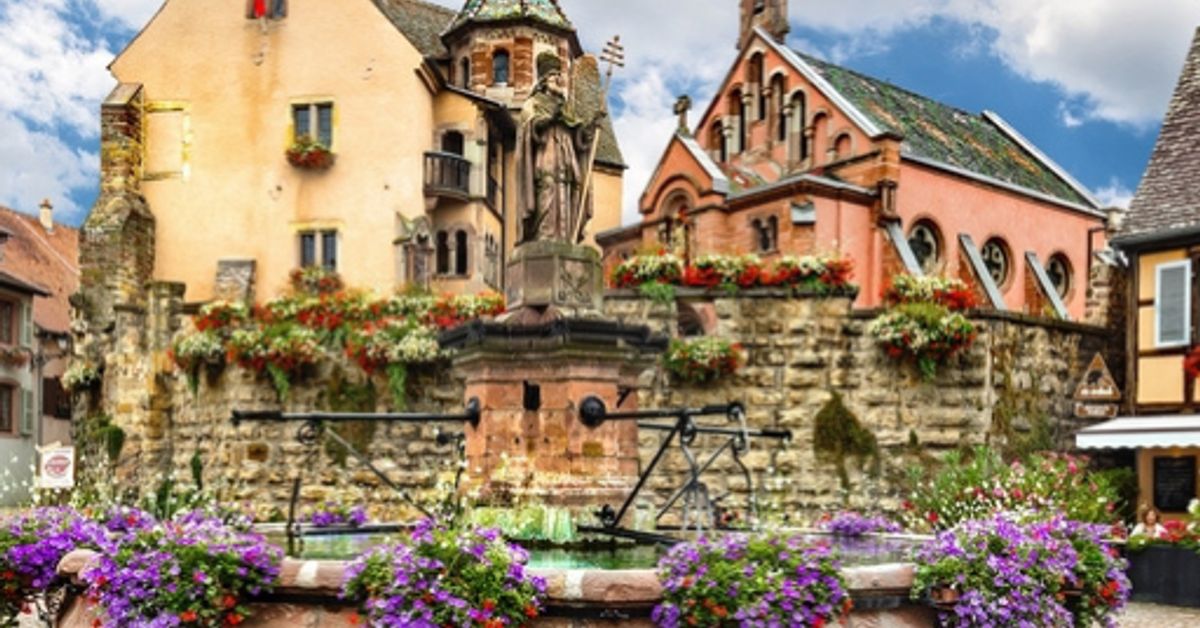
Eguisheim — A perfectly preserved circular medieval village. Voted France’s favourite village in 2013. Its cobbled lanes run in concentric rings around an old castle keep. The square at the centre, with its painted fountain and geranium-draped houses, looks exactly as it has for 500 years.
The Alsace Wine Route — The Route des Vins d’Alsace runs 170 kilometres from Marlenheim to Thann. It passes 119 wine villages. Drive it slowly in October when the vines turn gold and the harvest is in full swing.
Hartmannswillerkopf — Also called Vieil Armand, this ridge in the Vosges was a brutal First World War battlefield. It sits above the wine villages. Standing there, you understand what people fought for — and what it cost. A Franco-German memorial now marks the site jointly.
Frequently Asked Questions About Alsace
When did Alsace become part of France?
Most of Alsace became French after the Treaty of Westphalia in 1648, which ended the Thirty Years’ War. France completed its control when Louis XIV captured Strasbourg in 1681. Before this, Alsace had been part of the Holy Roman Empire for over 700 years.
Why did Alsace change between France and Germany so many times?
Alsace sits on the Rhine — the traditional border between the Germanic and Romance worlds. France took it in 1648. Germany claimed it after defeating France in 1871. France reclaimed it after the First World War in 1919. Germany annexed it again from 1940 to 1944. Each change followed a major European war and shifted the balance of power on the continent.
Do people in Alsace still speak German?
Many Alsatians speak or understand Alsatian, a West Central German dialect. Around 43% of the population has some knowledge of it. Everyday use has fallen since the 1940s, but the language survives in older communities, rural villages, and cultural traditions like folk music and local festivals.
Is Alsace a good destination for heritage travel?
Yes. Alsace has strong infrastructure for heritage visitors. The departmental archives in Strasbourg and Colmar hold civil and parish records stretching back centuries. The region’s preserved villages, cathedrals, and war memorials make it one of France’s most historically layered travel destinations. Many diaspora visitors come to find their family’s home commune.
What Alsatian surnames are common in the United States?
Many Alsatian families emigrated to the United States after 1871, when Germany took the region. Common Alsatian surnames in America include Bauer, Weiss, Jung, Beck, Meyer, Schmitt, Roth, Muller, Kuentz, and Schreiber. These names appear frequently in Missouri, Ohio, Wisconsin, Illinois, and New York — states with large German-French immigrant communities in the 19th century.
You Might Also Enjoy
Discover more about France’s heritage regions and family history:
- French Surnames of Alsace-Lorraine: Origins, Meanings and Family Heritage
- The Huguenots: France’s Great Exodus and Its Global Legacy
- The Acadians: Expelled from Nova Scotia, Forever French
Plan Your France Trip
Ready to explore Alsace and France’s other heritage regions? Our complete France travel planning guide covers everything from getting here to finding your family’s ancestral village.
Join 7,000+ France Lovers
Every week, get France’s hidden gems, seasonal guides, local stories, and the art of la vie française — straight to your inbox.
Subscribe free — enter your email:
Love more? Join 64,000 Ireland lovers → · Join 43,000 Scotland lovers → · Join 30,000 Italy lovers →
Free forever · One email per week · Unsubscribe anytime
Tours & experiences you might love


Powered by Viator. Some links are affiliate links — we may earn a small commission at no extra cost to you.

Leave a Reply