
Cannes sits on the southern coast of France, about 30 kilometres west of Nice, where the Alpes-Maritimes mountains meet the Mediterranean Sea. Most people know it for its international film festival, but there is far more to this city than a red carpet. The port, the old town, the islands just offshore, and the stretch of coast that links it to the rest of the Côte d’Azur make Cannes one of the most practical and rewarding bases on the French Riviera.
This guide covers the key things to see, where to stay, how to get around, and when to visit — without the fluff.
Cannes at a Glance
- Where: Côte d’Azur, about 30 km west of Nice.
- Getting there: Fly to Nice, then a 30–40 minute train.
- Don’t miss: Le Suquet old town and a ferry to the Lérins Islands.
- Best months: May (outside festival week), June, and September.
- Avoid: Film festival fortnight in May, when prices spike.
The Port of Cannes
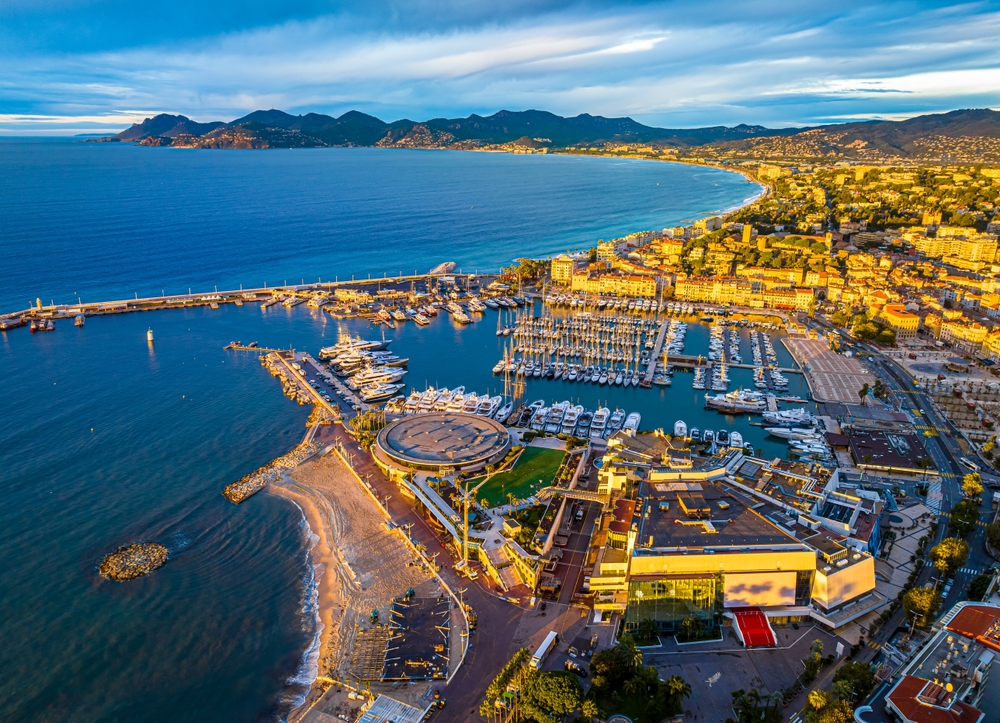
The Vieux Port — the old port — is the natural starting point for any visit to Cannes. It sits at the western end of La Croisette, the famous boulevard that runs along the seafront, and it is the place where yachts, fishing vessels, and passenger ferries all share the same stretch of water.
At night, the port takes on a different quality. The lights from the restaurants and hotels reflect off the water, the masts of moored yachts cut across the skyline, and the outline of the Esterel hills closes off the view to the west. It is one of those scenes that looks exactly like you expect it to — and still impresses when you see it in person.
During the day, the port is functional as much as it is scenic. Ferries depart regularly from the Quai des Îles for the Lérins Islands, a trip of around 15 minutes that takes you to one of the most undervisited spots on the Riviera. The old port is also the place to watch the fishing boats unload their catch early in the morning — a reminder that, beneath the glamour, Cannes remains a working coastal town.
The Port Pierre Canto, at the opposite end of La Croisette, is where the largest private yachts tend to moor. It is a different atmosphere from the old port — more corporate, less characterful — but worth a walk if you want to see the scale of some of the vessels that call Cannes home during the summer season.
Love France? Get our weekly guide.
Every week we share travel tips, local stories, and practical advice for exploring France — from the Riviera to the Atlantic coast. Join thousands of readers who love France as much as you do.
Subscribe Free →Le Suquet: The Old Town
Most visitors spend their time on La Croisette and miss Le Suquet entirely. This is a mistake. The old town sits on a hill directly above the Vieux Port and is the oldest part of Cannes, with narrow lanes, stone staircases, and small restaurants that have been here far longer than the film festival.
At the top of the hill is the Castre Museum, housed in a 12th-century monastery. The collection is eclectic — archaeological finds from across the Mediterranean, Asian artefacts, paintings, and instruments — but the real reason to make the climb is the view from the tower. On a clear day you can see from the Esterel hills in the west to the Cap d’Antibes in the east, with the Lérins Islands sitting in the sea directly below.
The streets around Le Suquet are also where you will find some of the more honest restaurants in Cannes — places that serve local food at prices that do not assume you have just arrived by yacht.
The Lérins Islands
Two islands sit off the coast of Cannes: Sainte-Marguerite and Saint-Honorat. Both are reachable by ferry from the Vieux Port, and both are worth visiting for entirely different reasons.
Sainte-Marguerite is the larger of the two. It is largely forested, with walking paths, beaches, and the Fort Royal — a 17th-century fortress that once held the Man in the Iron Mask. No one has ever confirmed the prisoner’s identity, but you can still see the cells where he was held. The fort now holds a small museum on the island’s history and finds from local marine archaeology.
Saint-Honorat is smaller and quieter. It has been home to a working Cistercian monastery since the 5th century, and the monks still farm the island, producing wine and spirits that can be bought at the abbey shop. There are no cars on the island, and outside of the summer peak it can feel remarkably peaceful — a significant contrast to the activity on the mainland just 20 minutes away.
La Croisette and the Beach
La Croisette is the 2-kilometre boulevard that defines Cannes for most visitors. It runs along the seafront from the Palais des Festivals in the west to the Port Pierre Canto in the east, lined with hotels, restaurants, and shops. At the western end stands the famous Palais des Festivals, host of the film festival each May, its pavement set with the handprints of film directors and actors.
Beaches along La Croisette come as a mix of private and public. The private beaches charge for sunloungers and service, and during the summer they are the domain of the hotel guests and those willing to pay the fees. The public beach sections, by contrast, are free to use, though they can get crowded in July and August. If you want a beach in Cannes without the cost or the crowds, head to the free stretch just west of the Palais des Festivals, or take the ferry to Sainte-Marguerite, where the beaches are far less busy.
Discover more of France every week.
From Cannes to Corsica, Bordeaux to the Loire Valley — our newsletter covers all of France, with practical advice and local insight you will not find in the guidebooks.
Get the Newsletter →Getting to Cannes and Getting Around
The most practical way to reach Cannes from the UK is to fly into Nice Côte d’Azur Airport and take the train. The train from Nice to Cannes runs frequently — roughly every 30 minutes throughout the day — and takes around 30 to 40 minutes. It costs a few euros and drops you right in the centre of Cannes, a short walk from La Croisette and the port.
The train line that runs between Nice and Cannes continues westward to Antibes and Grasse, and eastward to Monaco and the Italian border at Ventimiglia. Buying a ticket for a day trip to Antibes, Monaco, or Èze is cheap and fast — one of the genuine advantages of Cannes as a base for exploring the Riviera.
Within Cannes itself, most of the main sights are walkable from the centre. The old town is uphill from the port but manageable on foot. Taxis are available but expensive, particularly during the film festival period when demand pushes prices up significantly. The local bus network (Palmbus) covers the wider Cannes area and connects to neighbouring communes.
Where to Stay
Cannes has a full range of accommodation, from the famous grand hotels on La Croisette to budget options a few streets back from the seafront. The Hôtel Carlton, the Hôtel Majestic, and the Hôtel Martinez are the names most associated with the film festival, and they charge accordingly. Booking during the festival in May is almost impossible without reserving many months in advance, and prices during that week are a different category entirely.
For a more affordable stay, the streets immediately behind La Croisette offer plenty of smaller hotels and apartment rentals. The Rue d’Antibes runs parallel to the seafront, one block inland — a useful reference point. Hotels here are typically 30 to 50 per cent cheaper than those with direct sea views, and the beach is still a short walk away.
If you are visiting in July or August and have not yet booked, manage expectations: Cannes is one of the busiest destinations on the Côte d’Azur during peak summer. Prices run high and availability stays tight. The shoulder months — May (outside festival week), June, September, and October — offer better value and more comfortable visiting conditions.
What to Eat in Cannes
Cannes sits in the Provence-Alpes-Côte d’Azur region, and the local food reflects that — olive oil, tomatoes, courgettes, aubergines, anchovies, and fresh fish are all staples. Socca, the chickpea flour pancake found across this stretch of the Riviera, is worth trying if you see it on a menu or at a market stall. It is a dish of Nice rather than Cannes specifically, but it appears across the region and is an honest, inexpensive snack.
The Marché Forville, a covered market a few minutes’ walk from the port, is one of the best places to eat well in Cannes without spending much money. The morning market (closed on Mondays) sells fresh produce, cheese, olives, and charcuterie. Several stalls also sell prepared food — rotisserie chicken, pissaladière (the local onion tart), and fresh pasta. A picnic from Forville and a short ferry ride to the Lérins Islands makes for an excellent afternoon.
For restaurants, the rue du Marché Forville and the streets around Le Suquet tend to offer better value than the waterfront. The proximity to the tourist trade on La Croisette does not help prices, and the quality difference between the two areas is often significant.
When to Visit Cannes
The French Riviera has one of the most reliably mild climates in France. Summers are hot and dry, with daytime temperatures regularly reaching 28–32°C in July and August. The sea reaches its warmest between July and September. Winters are mild but quieter, with many of the private beach operators closing between October and March.
The Cannes Film Festival takes place each year in May, typically over two weeks. If you are not attending the festival, avoid this window — prices spike, the town fills up, and access to parts of La Croisette is restricted. Outside of festival week, May and early June are ideal: warm, not yet crowded, and with long days that make full use of the light.
September is the other strong option. The summer crowds thin out after the French school term begins in early September, prices drop, and the sea is still warm enough to swim. October brings rain more frequently, but the coast is rarely cold, and the light on the harbour at that time of year has a quality that July’s overhead sun does not match.
Planning a trip to France?
Our weekly newsletter covers the Riviera, Paris, Normandy, the Alps, and everything in between. Practical advice, honest recommendations, and the local knowledge that makes the difference between a good trip and a great one.
Join Our Newsletter →Cannes Beyond the Festival
If Cannes is one stop on a wider French trip, we’ve written about plenty more. Take the lavender fields of Valensole in nearby Provence, the chalk cliffs of Étretat, or the view of Mont Blanc from the French Alps. The Cannes Film Festival is the reason most people have heard of the city, but it accounts for two weeks of the year. For the other fifty, Cannes functions as a busy but manageable Riviera town with good transport links, a decent market, a working port, and a coastline that rewards those who look beyond the obvious.
The combination of the old port at night, the island ferries, the market at Forville, and the old town on the hill gives Cannes a texture that the film festival imagery does not fully capture. It is not the cheapest destination on the Côte d’Azur, and in high summer it is not the quietest. But as a base for exploring this stretch of the Mediterranean, it is one of the most practical — and the view across the port when the light goes down is exactly as good as it looks in the photographs.
Image: Aerial view of Cannes port and the French Riviera coastline. Credit: Shutterstock / Alexey Fedorenko.
Thinking about it for retirement?
If you’ve started thinking seriously about retiring there, our complete our full Retire in France guide covers the visa, healthcare, cost-of-living, and the regions worth shortlisting.
🇫🇷 Discover the France Most Tourists Never Find
Get our free guide to 25 hidden villages of France — then join 7,000+ readers for weekly stories about places most guidebooks never mention.
Get Your Free Village Guide →Tours & experiences you might love


Powered by Viator. Some links are affiliate links — we may earn a small commission at no extra cost to you.

Leave a Reply