
Beneath the elegant boulevard that runs through Épernay, where pale limestone townhouses line the street and the town moves at a genteel pace, lies one of the most extraordinary hidden worlds in France. More than 100 million bottles of Champagne sleep in the dark just a few metres below where visitors stroll. Almost no one above ground knows they are there.
Born in a Roman Quarry
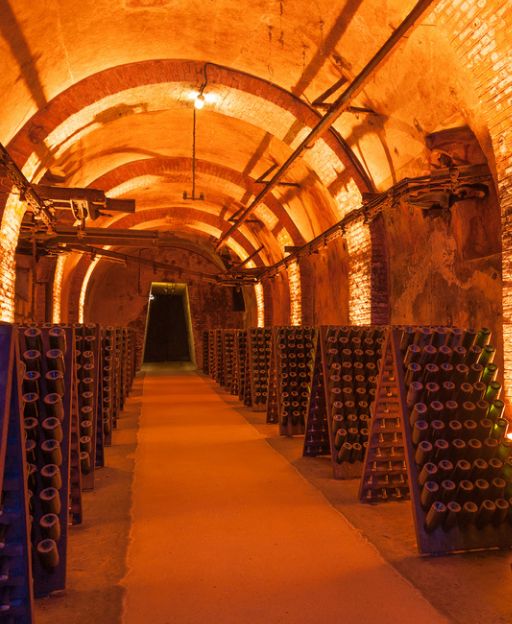
The tunnels were not built for wine. The Romans dug them first, quarrying the soft chalk bedrock — called crayères — to construct the region’s cathedrals and city walls. What they left behind were vast, vaulted chambers of pale limestone, stretching dozens of metres underground.
The air inside stays at a constant 10 to 12 degrees Celsius throughout the year. Cool, dark, and still — not by design, but by the nature of chalk itself.
When the great Champagne houses discovered them in the 18th century, they recognised something the Romans had not. The tunnels were a near-perfect ageing environment. The Maisons moved in, and they never left.
The Street That Hides Its Riches
Épernay’s Avenue de Champagne has been called the most expensive street in the world. Moët & Chandon, Perrier-Jouët, De Castellane — the names on the wrought-iron gates read like a wine list from a palace dinner.
But the real wealth is underground. Moët & Chandon alone has 28 kilometres of cellars running beneath the avenue. Veuve Clicquot’s network spreads beneath Reims, carved into chalk that glows a warm amber in torchlight.
Walk the avenue, and you are standing above hundreds of millions of bottles. Each one is slowly completing its second fermentation in the dark, building pressure and developing the bubbles that will eventually become someone’s celebration.
The Widow Who Changed Everything
Most people associate Champagne’s origins with Dom Pérignon, the Benedictine monk who supposedly “tasted the stars.” He didn’t invent the wine — but he did refine it, introducing cork stoppers and developing techniques for blending grapes from different villages.
The more radical innovation came a century later from a young widow named Nicole-Barbe Clicquot-Ponsardin. When her husband died in 1805, she inherited the family wine business at the age of 27 — deeply unusual for a woman in Napoleonic France.
In 1816, she invented the riddling table: a board drilled with angled holes, into which upturned bottles were inserted and rotated daily. Over weeks, the sediment crept slowly towards the bottle’s neck. When the neck was briefly frozen and uncapped, the sediment plug shot out cleanly, leaving the wine brilliantly clear.
In essence, that process still makes every bottle of traditional Champagne today.
🇫🇷 Discover the France Most Tourists Never Find
Get our free guide to 25 hidden villages of France — then join 7,000+ readers for weekly stories about places most guidebooks never mention.
Get Your Free Village Guide →Why the Cold and Dark Matter
Champagne is a wine of extremes — fragile and patient at the same time. Heat damages it. Light turns it. Movement disturbs the slow chemistry happening inside each bottle.
The chalk tunnels offer the opposite: stillness, darkness, and a temperature that barely changes between January and August. Bottles rest on their sides or in riddling racks, undisturbed for years. Some prestige cuvées age for a decade or more before they ever see daylight.
In 2015, UNESCO granted World Heritage status to the Champagne region — recognising the cellars, the hillside vineyards, and the Maisons themselves as a cultural landscape unlike any other in Europe. Wine and wine culture runs deep across France; if you want to understand what really happens during France’s wine harvest season, Bordeaux offers a very different but equally passionate story.
What You See When You Go Down
Most of the great Champagne houses offer cellar tours open to visitors, and they are worth every minute. You descend a staircase, and the air changes immediately — cooler, slightly damp, with a faint mineral smell that exists nowhere above ground.
The corridors stretch ahead in near-darkness. Bottles are stacked in long chalk alcoves, millions of them, labelled and numbered. Somewhere among them is a bottle that has been sleeping since before you were born.
Guides tend to speak quietly. It feels appropriate. Épernay is just over an hour from Paris by train and one of the finest day trips from the capital — the contrast between the city’s energy and the silence underground makes the experience all the more striking. And if you’re still in the early stages of planning, the France travel planning guide is the right place to begin.
The next time a Champagne cork pops at a celebration, consider what’s in the glass. A wine that has spent years in near-total darkness beneath a French town, tended by generations of hands that learned their craft from those who came before them. The tunnels remember all of it. They just don’t say so.
Join 7,000+ France Lovers
Three times a week, get France’s hidden gems, seasonal guides, local stories, and the art of la vie française — straight to your inbox.
Subscribe free — enter your email:
Love more? Join 65,000 Ireland lovers → · Join 43,000 Scotland lovers → · Join 30,000 Italy lovers →
Free forever · Unsubscribe anytime
🇫🇷 You Might Also Love
Thinking about it for retirement?
If you’ve started thinking seriously about retiring there, our complete our full Retire in France guide covers the visa, healthcare, cost-of-living, and the regions worth shortlisting.
Tours & experiences you might love


Powered by Viator. Some links are affiliate links — we may earn a small commission at no extra cost to you.

Leave a Reply