
Paris gave the world a revolution of ideas. It happened in the 1700s. And it changed civilisation forever.
The French Enlightenment was born in coffeehouses and salons. It spread through pamphlets and arguments. It challenged kings and priests. It gave the world democracy and human rights. It spread the belief that reason could solve anything.
The thinkers who led it were called the philosophes. They were brilliant. They were brave. And several of them ended up in exile or prison for their work.
This is the story of how France changed how the world thinks.
When Did the Enlightenment Begin?
Historians usually date the French Enlightenment from around 1715. That was when Louis XIV died. His long, rigid reign had stifled French thought.
After his death, something opened up. Writers began to question authority. Scientists pushed the limits of knowledge. The Church lost its grip on every debate.
The movement peaked in the mid-1700s. By 1789, its ideas had sparked both the French and American revolutions. The Enlightenment lasted about 75 years. But its effects lasted centuries.
France did not invent the Enlightenment alone. English thinkers like John Locke laid early groundwork. Scottish philosophers played a role. But Paris became the movement’s capital. The philosophes made France the centre of the intellectual world.
Voltaire: France’s Great Wit and Rebel
No name defines the French Enlightenment more than Voltaire. He was born François-Marie Arouet in Paris in 1694. He chose the pen name Voltaire to protect himself. Good thing. His writing made powerful enemies.
Voltaire mocked religious fanaticism with sharp wit. He attacked intolerance, superstition, and injustice. He spent two years in exile in England. The experience changed him deeply. He admired English freedoms. He brought those ideas back to France.
His most famous work, Candide, appeared in 1759. It was a darkly comic novel. It ridiculed blind optimism and religious hypocrisy. The Church banned it. Naturally, everyone read it.
Voltaire lived to the age of 83. He wrote more than 2,000 books and pamphlets. Even on his deathbed, he kept writing. He is buried in the Panthéon in Paris — a fitting tribute from the republic his ideas helped build.
Rousseau: The Philosopher of the People
Jean-Jacques Rousseau was born in Geneva in 1712. He moved to Paris as a young man. He fell in with the philosophes. But he often disagreed with them sharply.
Where Voltaire trusted reason, Rousseau trusted feeling. He believed humans were naturally good. Society corrupted them.
His most famous work, The Social Contract, appeared in 1762. It opened with one of history’s most quoted sentences. “Man is born free, and everywhere he is in chains.”
He argued that government gets its power from the people. Not from God. Not from birth. The people give power — and the people can take it back.
This idea terrified kings. It inspired revolutionaries.
Rousseau also wrote Emile in 1762. It transformed thinking about childhood. He argued that children should learn through experience. Not rote memorisation. Both books were banned in Paris and burned in Geneva. Rousseau spent years on the run.
Like Voltaire, he rests in the Panthéon — unlikely neighbours in death, forever rivals in life.
Diderot and the Greatest Book of the Age
Denis Diderot had an audacious dream. He wanted to write down everything humanity knew.
The result was the Encyclopédie. It was published in 28 volumes between 1751 and 1772. It contained 71,818 articles and nearly 3,000 illustrations. Diderot co-edited it with Jean le Rond d’Alembert.
They recruited the greatest minds in France. Voltaire wrote articles. Rousseau wrote on music. Scientists, surgeons, and craftsmen all contributed. The Encyclopédie was democratic by design.
It said a craftsman’s knowledge mattered as much as a philosopher’s. It said ordinary people deserved to understand the world. Knowledge belonged to everyone.
The Church condemned it in 1759. Pope Clement XIII formally banned it. The French government tried to shut the project down. Diderot kept going anyway. His files were seized by police. He pressed on.
He spent 25 years of his life on the project. The Encyclopédie became the defining text of the Enlightenment. It proved that reason and knowledge could be shared with all.
Montesquieu: The Man Who Designed Modern Government
Charles-Louis de Secondat, Baron de Montesquieu, was not a famous wit. He was a lawyer and political thinker. But his ideas shaped the modern world more than almost anyone else’s.
His masterwork was The Spirit of the Laws, published in 1748. It argued for the separation of powers. He said government should be divided. A legislature should make laws. An executive should enforce them. A judiciary should interpret them.
Each branch would check the others. No single person could hold all power. This was the architecture of liberty.
The American Founding Fathers read Montesquieu carefully. James Madison called him “the oracle of liberty.” The US Constitution puts Montesquieu’s ideas into practice. France’s own constitutions drew on his work. So did the legal systems of dozens of countries.
🇫🇷 Enjoying this? 7,000 France lovers get stories like this every week. Subscribe free →
The Parisian Salons: Where Ideas Came Alive
The philosophes did not just write. They talked. They argued. They gathered in salons.
The salons were intellectual gatherings in private homes. Brilliant women hosted them. They invited writers, scientists, politicians, and nobles. They guided the conversation. They shaped the intellectual direction of the age.
Marie-Thérèse Rodet Geoffrin ran one of the most important salons. She hosted the Encyclopédistes every week. She funded the Encyclopédie project with her own money.
Madame du Deffand ran another famous salon. Her protégée, Julie de Lespinasse, eventually opened a rival salon. These women did not just serve tea. They built the intellectual network of Europe.
The Café de Procope on the Rue de l’Ancienne Comédie was another hub. It opened in 1686. Voltaire, Rousseau, and Diderot all drank coffee and argued there. It still exists today. You can sit at the same tables where the Enlightenment was born.
How the Enlightenment Crossed the Atlantic
France’s ideas did not stay in France. They crossed the Atlantic and changed America.
Benjamin Franklin came to Paris in 1778. The French adored him. He was living proof of Enlightenment ideals. A self-made man of science and reason. He embodied everything the philosophes admired.
Thomas Jefferson followed. He served as the American minister to France from 1784 to 1789. He read widely, visited the great thinkers, and brought their ideas home.
Jefferson’s Declaration of Independence echoes Enlightenment thinking on every page. The idea that “all men are created equal” did not spring from thin air. It came from decades of French philosophy.
The Marquis de Lafayette fought in the American Revolution. He carried Enlightenment ideals with him. He brought American ideas back to France. The two revolutions inspired each other. The French Enlightenment helped birth the United States — and the American experiment gave French revolutionaries hope.
The Institut de France: Where the Tradition Lives On
The Enlightenment built institutions to preserve knowledge. The most important is the Institut de France.
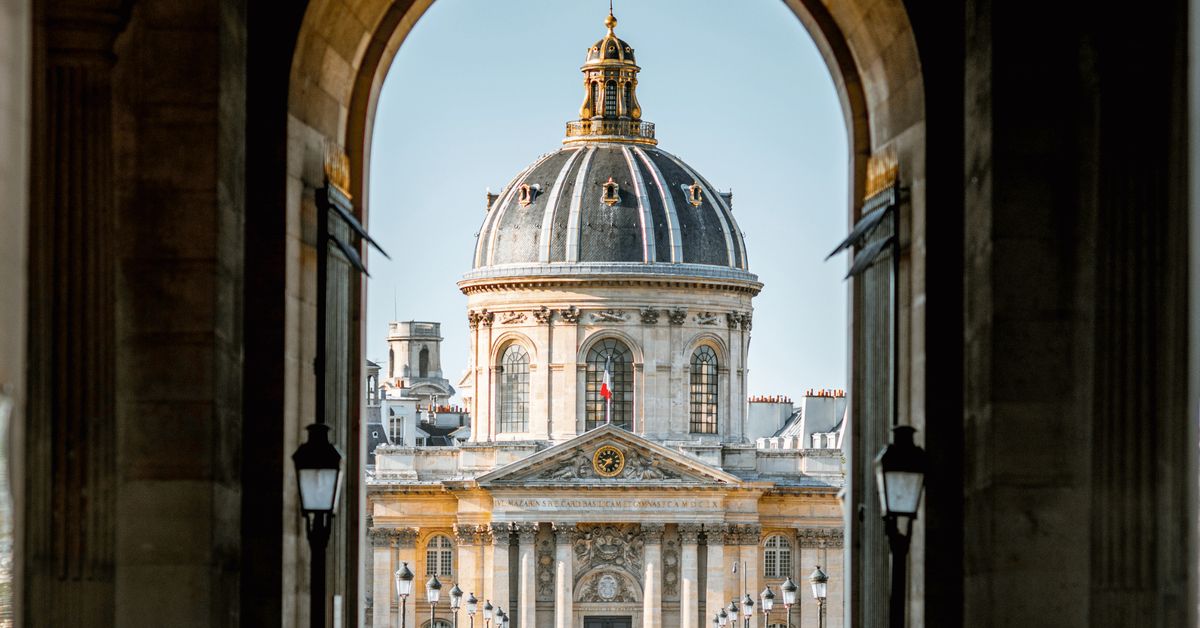
Founded in 1795, it brought together France’s great academies. The Académie Française — guardian of the French language — sits within it. So does the Académie des Sciences.
The building stands on the left bank of the Seine. Its great dome has watched over Paris for more than two centuries. It still brings together France’s greatest scholars and thinkers today.
When you walk past the Institut de France, you walk past a monument to the Enlightenment. The ideas born in salons and coffeehouses live on inside its walls.
The Enlightenment and the French Revolution
The Palace of Versailles represented the old world. The Enlightenment built the new one.
By 1789, Enlightenment ideas had spread everywhere. Ordinary people questioned why a king ruled by divine right. They asked why the Church held so much land and power. They demanded liberty, equality, and justice.
Voltaire, Rousseau, and Montesquieu did not cause the Revolution directly. They had been dead for years when it began. But their words filled the minds of the men who stormed the Bastille.
The Revolution’s motto — Liberté, Égalité, Fraternité — came straight from Enlightenment thinking. The Declaration of the Rights of Man and of the Citizen echoed Rousseau’s social contract. France dismantled a monarchy. It tried to build a republic based on reason.
It was messy, violent, and imperfect. But the Enlightenment’s fingerprints were everywhere.
Why the French Enlightenment Still Matters
The French Enlightenment changed how humans see themselves. It said reason matters. It said evidence matters. It said every person deserves dignity and rights.
These ideas feel obvious today. In 1750, they were explosive.
The Enlightenment gave the world the idea of universal human rights. It gave the world modern science and medicine. It gave the world the separation of church and state. It gave the world secular public education.
It also had blind spots. The Enlightenment’s faith in reason sometimes became arrogance. Some philosophes failed to apply their principles to empire or to slavery. History is rarely tidy.
But the core insight endures. Reason is a tool for liberation. Knowledge belongs to everyone. Power answers to the people.
France gave this to the world. And the world is still living by it. The next time you enjoy a right, vote in an election, or read a book freely — thank the philosophes.
Frequently Asked Questions About the French Enlightenment
What was the French Enlightenment?
The French Enlightenment was an intellectual movement in 18th-century France. Philosophers used reason and science to challenge the Church, royal power, and social inequality. It lasted roughly from 1715 to 1789 and shaped modern democracy.
Who were the key figures of the French Enlightenment?
The main figures were Voltaire, Rousseau, Diderot, and Montesquieu. Voltaire championed religious tolerance. Rousseau argued that power came from the people. Diderot compiled the Encyclopédie. Montesquieu designed the separation of powers that shapes modern governments today.
How did the French Enlightenment influence the American Revolution?
French Enlightenment thinkers directly shaped the American Founding Fathers. Montesquieu’s ideas on the separation of powers appear in the US Constitution. Thomas Jefferson drew on French philosophy when writing the Declaration of Independence. Benjamin Franklin was a celebrated figure in Paris salons.
What was the Encyclopédie?
The Encyclopédie was a 28-volume collection of human knowledge, edited by Denis Diderot and Jean le Rond d’Alembert. Published between 1751 and 1772, it contained over 70,000 articles. The Church banned it twice. It became the defining text of the Age of Reason.
Where can I experience Enlightenment history in Paris today?
The Café de Procope on the Rue de l’Ancienne Comédie is the oldest café in Paris and still welcomes visitors. The Institut de France stands on the Quai de Conti across from the Pont des Arts. The Panthéon holds the tombs of both Voltaire and Rousseau.
You Might Also Enjoy
- The Marquis de Lafayette: The French Hero Who Helped America Win Independence
- Charlemagne: The King Who Made Europe
- Palace of Versailles: The Complete Guide for First-Time Visitors
Plan Your France Trip
Ready to walk the streets where the Enlightenment was born? Our France travel planning hub has everything you need — from first-time visitor guides to regional itineraries and heritage travel tips.
Join 7,000+ France Lovers
Every week, get France’s hidden gems, seasonal guides, local stories, and the art of la vie française — straight to your inbox.
Subscribe free — enter your email:
Love more? Join 64,000 Ireland lovers → · Join 43,000 Scotland lovers → · Join 30,000 Italy lovers →
Free forever · One email per week · Unsubscribe anytime
Tours & experiences you might love


Powered by Viator. Some links are affiliate links — we may earn a small commission at no extra cost to you.

Leave a Reply