
Imagine arriving in a small French city to find a medieval chapel balanced on a spike of volcanic rock, 85 metres above the rooftops. Below it, a cathedral that pilgrims have blessed and wept in since the 9th century. And at the edge of the plateau, thousands of walkers lacing their boots before a 1,600-kilometre journey south to Spain.
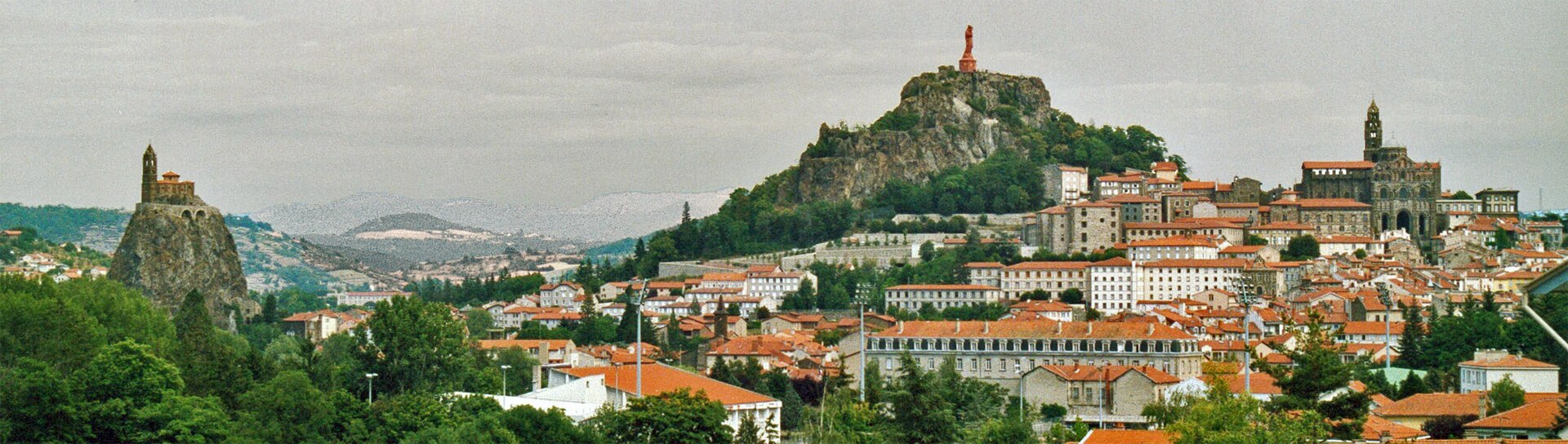
This is Le Puy-en-Velay. Most travellers drive straight past it. That is their loss.
A City Built on Fire
The Auvergne highlands of central France hold one of Europe’s most dramatic volcanic landscapes. Ancient eruptions shaped this plateau over millions of years and left behind hard basalt plugs — columns of solidified magma that the surrounding softer rock has since eroded away.
Le Puy-en-Velay grew up around three of these stone spires. They thrust upward from the valley floor at impossible angles, giving the city a skyline that looks designed rather than geological.
Medieval builders understood the drama immediately. They climbed these rocks. They built on them. And in doing so, they created a place unlike anything else in France.
The Needle in the Sky
The most startling sight in Le Puy-en-Velay is the Chapel of Saint-Michel d’Aiguilhe. Aiguilhe means needle — the chapel sits at the top of an 85-metre volcanic spike that juts out of the city floor like a fang.
A bishop named Gothescalck built the original chapel in 962 AD after one of the first documented pilgrimages to Santiago de Compostela. He brought back a relic from Spain and wanted somewhere worthy to keep it. He chose a volcanic needle.
Visitors today climb 268 steps cut directly into the rock. The views from the top stretch across the entire Velay basin. Farmers’ fields, distant ridgelines, and the city below — all framed by the kind of silence that belongs to very old places.
The chapel itself measures just 25 metres long. What it lacks in size it makes up in age. Gothescalck’s pilgrimage happened before the First Crusade, before Notre-Dame de Paris existed, and before most of Europe could read.
The Cathedral That Launched a Million Journeys
At the foot of the Rocher Corneille — a second volcanic plug — stands the Cathedral of Notre-Dame du Puy. Builders raised it in stages between the 9th and 12th centuries. Today, UNESCO lists it as a World Heritage site as part of the Routes of Santiago de Compostela in France.
The cathedral’s most famous possession is the Black Madonna. A dark-complexioned statue of the Virgin Mary has occupied this space since at least the medieval period. Revolutionary soldiers burned the original during the 1790s. Craftsmen made the current version in 1856 from a cannon captured in the Crimean War.
Pilgrims have touched this figure for centuries before beginning their walk south. Some arrived barefoot after weeks on the road just to reach this starting point. Many carried only a staff and a scallop shell. All of them stood in this same nave, looking at this same black statue, before taking their first step.
Today, over 200,000 walkers register their pilgrimage credential at the cathedral each year before departing on the Via Podiensis — the French Camino. Many historians consider this one of the oldest continuously active pilgrimage routes in the Western world.
Enjoying this? 7,000 France lovers get stories like this every week.
Thinking about it seriously? If you’ve started actually planning a move, our complete our complete Moving to France guide walks through every step, every cost, and the paperwork that catches most people out.
The Tastes of the Velay
Le Puy-en-Velay produces two things that French law now protects.
The first is green lentils. Farmers earned AOC (Appellation d’Origine Contrôlée) status for Lentilles vertes du Puy in 1996, making them the only lentil in the world to hold this designation. Volcanic soil gives them a distinctive peppery flavour and a firm texture that holds up well in a simple vinaigrette. Order them in any local restaurant — usually cold, dressed with mustard and shallots.
The second is Verveine du Velay, an herbal liqueur made from verbena plants that grow in the highland meadows. Locals drink it after dinner as a digestif. It tastes like the surrounding hills smell — green, faintly medicinal, and genuinely refreshing.
Eat the lentils. Drink the verveine. Both will tell you something about this city that the architecture cannot.
When to Visit and How to Get There
Le Puy-en-Velay sits about 130 kilometres southeast of Clermont-Ferrand and roughly 550 kilometres from Paris. Trains run via Saint-Étienne or Clermont-Ferrand. Most visitors arrive by car, which allows stops at the volcanic landscapes of the Auvergne along the way.
September brings the city to life with the Roi de l’Oiseau festival — a Renaissance spectacle where residents dress in period costume for a citywide archery contest first recorded in 1524. Book accommodation well in advance for this period.
Spring and early summer also work well, when pilgrim departures peak and the cathedral fills with quiet purpose each morning. Arrive before 9am to watch walkers collect their credentials and set off south. You will not forget it.
The cathedral and the Chapel of Saint-Michel d’Aiguilhe both close at lunchtime. Plan around this. Budget two full days to absorb the city properly.
For everything you need to plan your wider French adventure, our France travel planning guide covers regions, seasons, and practical essentials. France also hides remarkable ancient history beyond what most visitors expect — discover the Roman buildings still in daily use across the south.
Frequently Asked Questions
When is the best time to visit Le Puy-en-Velay?
September is the best month, when the Roi de l’Oiseau Renaissance festival runs for three days mid-month. Spring (April to June) also works beautifully — pilgrim departures peak in May and June, and you can watch walkers set off at dawn from the cathedral steps.
How long is the Camino de Santiago from Le Puy-en-Velay?
The Via Podiensis runs approximately 750 kilometres to Saint-Jean-Pied-de-Port at the Spanish border. Most walkers complete this French section in 33–40 days. The full Camino Francés to Santiago de Compostela adds another 800 kilometres beyond the border.
What should I not miss in Le Puy-en-Velay?
Three things are essential: climbing the 268 steps to the Chapel of Saint-Michel d’Aiguilhe, visiting the Cathedral of Notre-Dame du Puy early in the morning before it fills, and eating the green lentil salad at a local brasserie. The panoramic view from the Rocher Corneille, where the iron Notre-Dame de France statue stands, is also worth the climb.
Is Le Puy-en-Velay worth visiting if you are not walking the Camino?
Absolutely. The city’s volcanic landscape, medieval architecture, and UNESCO heritage status make it one of the most visually dramatic cities in France. Non-pilgrims visit for the festivals, the food, and the extraordinary skyline. Two days gives you enough time to see everything at a comfortable pace.
Le Puy-en-Velay asks nothing of you except time. Stand at the bottom of that volcanic needle in the early morning light, watch the mist sit in the valley below, and listen. You will hear footsteps — pilgrims heading south, just as they have been doing for over a thousand years.
Join 7,000+ France Lovers
Three times a week, get France’s hidden gems, seasonal guides, local stories, and the art of la vie française — straight to your inbox.
Subscribe free — enter your email:
📲 Know someone who’d love this? Share on WhatsApp →
Love more? Join 65,000 Ireland lovers → · Join 43,000 Scotland lovers → · Join 29,000+ Italy lovers →
Free forever · Unsubscribe anytime
🇫🇷 You Might Also Love
Tours & experiences you might love


Powered by Viator. Some links are affiliate links — we may earn a small commission at no extra cost to you.

Leave a Reply