
Push open a nondescript door on a busy Parisian boulevard and the city vanishes. No traffic. No crowds. Just the soft glow of gas-style lanterns bouncing off mosaic floors and the smell of fresh coffee drifting from a tiny café. You’ve stepped into one of Paris’s most extraordinary secrets: a passage couvert.
A City That Forgot Its Own Corridors
In the early 1800s, Parisian merchants built covered shopping galleries to protect their customers from mud, rain, and the chaos of unpaved streets. Architects stretched glass and iron roofs over narrow lanes and lined them with boutiques, bookshops, print dealers, and tea rooms.
At their peak, Paris had more than 150 of these arcades. Then Baron Haussmann arrived. His grand renovation of the 1850s carved wide boulevards through the old city and made the passages nearly obsolete overnight.
Fewer than 20 survive today. Most Parisians walk past them every week without a second thought. Most visitors never find them at all.
The Most Beautiful Passages to Visit
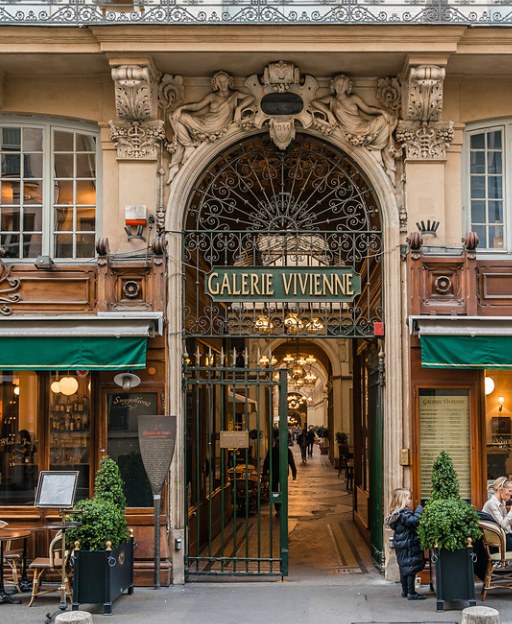
Galerie Vivienne is the queen of them all. Built in 1823, it runs between Rue de Vivienne and Rue des Petits Champs. Its mosaic floor — geometric patterns in terracotta and cream — is one of the most beautiful surfaces in Paris.
You’ll find a wine bar that has operated there for decades, a fine bookshop, and occasionally a boutique with a single rack of unusual clothes. The light through the vaulted glass ceiling changes colour throughout the day.
Passage des Panoramas is older and rougher around the edges — which makes it more atmospheric. Dating from 1799, it houses philatelists who have rented the same cabinets for generations. Stamp collectors, art dealers, and a faint smell of old paper fill every corner.
Galerie Colbert, directly beside Galerie Vivienne, belongs to the Bibliothèque Nationale. It holds temporary exhibitions, a grand rotunda, and a restaurant. The atmosphere is formal and the ironwork extraordinary.
Passage Jouffroy draws a different crowd: antique toy dealers, a wax museum, second-hand booksellers. Walk its full length and you exit directly into Passage Verdeau, its quieter neighbour, where vintage postcards, old cameras, and 19th-century prints fill the window displays.
What You’ll Find Inside
The passages are not museums. They’re working places, and they’ve always been so.
Stamp and coin collectors gather at Passage des Panoramas on Saturday mornings. Bookshops in Galerie Vivienne stay open late. The wine bar in the same gallery fills up around 6pm with locals who’ve finished work and want somewhere unhurried.
That’s the heart of their appeal. Nobody performs for tourists. A bistro table sits where it always has. A clock repair shop occupies a corner where it has stood for a hundred years.
The passages pair well with other hidden corners of the city. The underground lake beneath the Paris Opéra is a short walk away. Between passages, the French art of walking without a fixed destination is a perfect companion.
Enjoying this? 7,000 France lovers get stories like this every week.
Thinking about it for retirement? If you’ve started thinking seriously about retiring there, our complete our full Retire in France guide covers the visa, healthcare, cost-of-living, and the regions worth shortlisting.
When to Go and How to Navigate Them
Opening hours vary between galleries. Most passages open around 7am and close between 9pm and 10pm, but individual shops keep their own schedules. Some close entirely on Sundays.
The best time to visit is mid-morning on a weekday. Crowds are thin. Shopkeepers will talk to you. The light through the glass roofs hits its warmest point.
To walk all five of the main passages in the Grands Boulevards area — Jouffroy, Verdeau, Panoramas, Vivienne, and Colbert — takes about two hours at a comfortable pace. Bring cash; many smaller shops don’t accept cards.
A practical note: Google Maps doesn’t always show passage entrances clearly. Look for unmarked doors set into building facades. Once you know what to look for, you’ll spot them everywhere. For full trip planning help, visit the France travel planning guide.
Frequently Asked Questions
What are the best covered passages to visit in Paris?
Galerie Vivienne and Passage des Panoramas are the most celebrated. For a quieter experience, Passage Jouffroy and Passage Verdeau — connected to each other — offer genuine antique shops and fewer visitors than the famous galleries.
When is the best time to visit the passages couverts in Paris?
Mid-morning on a weekday gives you the best light through the glass roofs and the quietest atmosphere. Avoid Saturday afternoons in Passage des Panoramas, which gets crowded with stamp and coin collectors and their customers.
Are the covered passages in Paris free to enter?
Yes. All passages couverts are free to enter and wander. Individual shops and cafés charge their normal prices, but exploring the galleries themselves costs nothing at all.
How long does it take to walk the Paris covered passages?
Walking all five main passages in the Grands Boulevards area takes around two hours at a relaxed pace. If you stop for coffee or browse the antique shops, allow three hours or a full half-day.
These corridors survived Haussmann. They survived two world wars. They’re still here now, sandwiched between pharmacies and phone shops, waiting behind unmarked doors.
Walk in, and Paris stops for a moment. The mosaic floors and iron lamps hold a version of the city that refuses to disappear.
Join 7,000+ France Lovers
Three times a week, get France’s hidden gems, seasonal guides, local stories, and the art of la vie française — straight to your inbox.
Subscribe free — enter your email:
🇫🇷 Discover the France Most Tourists Never Find
Get our free guide to 25 hidden villages of France — then join 7,000+ readers for weekly stories about places most guidebooks never mention.
Get Your Free Village Guide →📲 Know someone who’d love this? Share on WhatsApp →
Love more? Join 65,000 Ireland lovers → · Join 43,000 Scotland lovers → · Join 29,000+ Italy lovers →
Free forever · Unsubscribe anytime
🇫🇷 You Might Also Love
Tours & experiences you might love


Powered by Viator. Some links are affiliate links — we may earn a small commission at no extra cost to you.

Leave a Reply