
In December, every bakery window in France fills up with chocolate logs. We follow the bûche de Noël from a real log on a Provençal hearth to the Paris pastry shops that turned it into a cake, then show you how to make one at home with no special tools.
A Real Log on the Fire
Long before it was a cake, the bûche de Noël was a piece of wood. In Provence the Christmas Eve ritual was called the cacho-fiò, one of the oldest traditions in the region. France’s official tourism site describes it: the youngest and the oldest at the table carried a log from a fruit tree to the hearth, after walking three times around the table, and sprinkled it with vin cuit, the sweet cooked wine of Provence. The log burned until midnight and was lit again every evening until New Year.
In Marseille, the city’s tourist office tells it with the grandfather at the centre: the eldest burns a big log of olive or fruit wood and blesses the fire. It also notes that the log-shaped cake is a newer arrival on the Christmas table there, even if it seems to carry on that old fireside custom.
How Paris Turned It Into a Cake
Dragging a huge log into the house fell out of fashion, and by the 18th century the custom had faded. It was the pastry cooks of Paris who kept the idea alive, in cake form. As National Geographic Traveller tells the story, Pierre Lacam is widely credited with the first published recipe, in his Mémorial historique et géographique de la pâtisserie of 1890, a heavy book of some 1,600 recipes. His bûche was rounds of génoise sponge stacked with coffee or chocolate buttercream, with little “branches” stuck on and bark piped over the top.
Lacam later wrote that the cake had been invented in 1879 by Antoine Charabot at La Maison Quillet, a Paris pâtisserie that had earlier in the century created French buttercream. By 1886 the bûche was all the rage in the capital, a showpiece for the city’s growing middle class. In those days the sponge was usually vanilla, so a pale “wood” showed inside the dark bark. Chopped pistachios became moss, and meringue mushrooms grew along the sides.
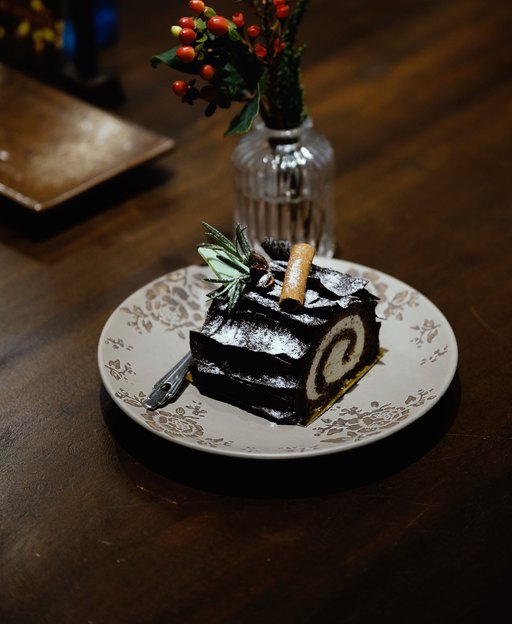
Today most bûches start with a rolled chocolate sponge, and that is what we make below: a cocoa sponge rolled around vanilla whipped cream, with dark chocolate ganache for the bark. You don’t need any piping skills. A fork makes the bark.
Where to Taste It in France
From early December, look in any boulangerie window. In Paris, France’s official tourism site keeps a guide to the city’s bûches, from classic houses such as Lenôtre, Fauchon and Pierre Hermé to the palace hotels. In Provence the Christmas Eve supper still ends with the thirteen desserts. And if your trip takes you to the Alsace Christmas markets, a glass of Alsace vin chaud goes well with a slice.
How to Make a Bûche de Noël at Home
This is a bûche for your own Christmas table: a light cocoa sponge, rolled around vanilla cream, with a chocolate bark you make with a fork. Make the ganache first, and the rest falls into place.
Bûche de Noël (French Chocolate Yule Log)
Ingredients
Equipment
Method
- Make the ganache first. Put the chopped chocolate in a bowl. Heat the 200 ml cream until it just comes to the boil, pour it over the chocolate and leave it for 2 minutes. Stir from the centre outwards until smooth, then stir in the butter. Press plastic wrap onto the surface and leave at room temperature for 1 to 2 hours, until thick enough to spread. If you chill it to speed things up, check it every 10 minutes so it does not set hard.
- Heat the oven to 190°C / 170°C fan / 375°F / gas 5. Grease a 25 x 38 cm (10 x 15 inch) jelly-roll pan, line it with parchment paper and grease the paper.
- Whisk the egg yolks with half the sugar (50 g / ¼ cup) for 2 to 3 minutes, until pale and thick.
- In a clean bowl, whisk the egg whites with the pinch of salt to soft peaks. Add the rest of the sugar a spoonful at a time and keep whisking until the whites are glossy and hold firm peaks.
- Stir a third of the whites into the yolks to loosen them. Sift the flour and cocoa over the top and fold in gently, then fold in the rest of the whites, keeping as much air as you can.
- Spread the batter evenly into the corners of the pan. Bake for 10 to 12 minutes, until the sponge springs back when you press it lightly.
- Dust a clean kitchen towel with icing sugar. Turn the hot sponge out onto it and peel off the parchment. After 1 to 2 minutes, roll the sponge up loosely in the towel, starting from a short end. Leave it to cool completely, seam side down, about 1 hour.
- Whip the 300 ml cold cream with the icing sugar and vanilla until it holds firm peaks. Stop before it turns grainy.
- Gently unroll the sponge. Spread the cream over it, leaving a 1 cm (½ inch) border, and roll it up again without the towel. Set it seam side down on a serving plate and chill for 30 minutes.
- For a branch, cut a short slice off one end on the diagonal and set it against the side of the log. Spread the ganache over the log and the branch, leaving the cut ends bare so the spiral shows. Drag a fork along the length to make bark.
- Chill for at least 1 hour. Just before serving, dust with a little icing sugar for snow.
Notes
Sources
- France.fr: Noël et traditions culinaires en Provence (the cacho-fiò)
- Marseille tourist office: The thirteen desserts of Christmas
- National Geographic Traveller (UK), Sam Bilton, 12 December 2023 (Lacam, Charabot, La Maison Quillet)
- France.fr: où acheter les meilleures bûches de Noël à Paris
- Recipe compared with King Arthur Baking, Meilleur du Chef and SBS Food
Checked November 2026.
Frequently Asked Questions
Who invented the bûche de Noël?
Nobody knows for certain. Pierre Lacam published one of the first recipes in 1890, and he later wrote that Antoine Charabot of La Maison Quillet in Paris invented the cake in 1879.
Was the first bûche de Noël chocolate?
Not usually. In the 19th century a vanilla génoise sponge was more common, filled and covered with coffee or chocolate buttercream. The rolled chocolate sponge came later.
Can I make a bûche de Noël the day before?
Yes. Make it up to a day ahead and keep it covered in the fridge, then dust it with icing sugar just before you bring it to the table.
Tours & experiences you might love


Powered by Viator. Some links are affiliate links — we may earn a small commission at no extra cost to you.

Leave a Reply