Most visitors to France turn south — towards Provence, the Loire, the Riviera. But the train north, the one most tourists ignore, leads to a city that stops you in your tracks. Lille is one of France’s most surprising places, and almost no one outside France knows it.
Photo: Shutterstock
A City That Changed Hands and Never Forgot It
Lille sat at the heart of medieval Flanders for centuries before France claimed it in 1667. Louis XIV captured it after an 11-day siege. The French flag went up. The Flemish soul stayed put.
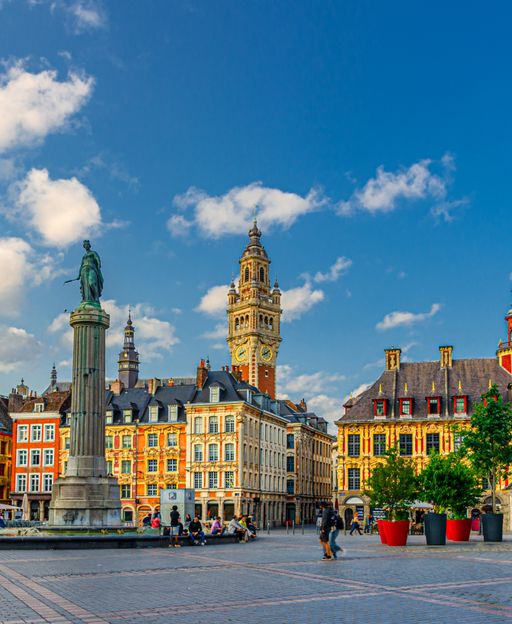
Walk through Vieux Lille today and the tension is visible. Rose-brick townhouses and white stone facades line every street. Stepped gables peer down from rooftops that belong more to Bruges or Ghent than Paris. The language is French. The architecture is not.
France holds many distinct regional identities — from the Occitan south to the Breton west — but French Flanders stands apart. It feels like a different country at the border of France, because for most of its history, it was.
What the Grand Place Reveals
Every Flemish city built its life around a grand square. Lille is no different.
The Place du Général de Gaulle, known locally as the Grand Place, sits at the city’s heart. A column at its centre honours the city’s resistance to an Austrian siege in 1792. Café terraces ring the edges and fill from morning until late evening.
On one side stands the Vieille Bourse — a 17th-century trading hall decorated with carved garlands and flame urns, almost absurdly beautiful for a building that once housed cloth merchants. Inside its arcaded courtyard, booksellers lay out second-hand paperbacks every afternoon. Tango dancers sometimes use the space as an impromptu floor. Nobody organises this. It simply happens.
If you are still deciding where to base yourself on a France trip, our France planning guide walks through every region and helps you choose.
Eating Like a Fleming in the Heart of France
Food separates Lille from the rest of France as much as architecture does.
In Paris, you eat French. In Lille, you eat Flemish — or a version of it shaped by five centuries of border friction. Carbonnade flamande (beef braised in dark beer) appears on menus alongside moules-frites and waterzooi, a creamy chicken or fish stew that originated in Ghent. These are not tourist dishes. Locals order them as a matter of course.
The drinking culture reinforces this. Lille has more estaminets — traditional Flemish taverns — than any other French city. These wood-panelled rooms serve regional beers by the pint alongside games of boules and low lighting. Estaminet ‘T Rijsel, one of the most beloved, writes its menu in Chti (the local dialect) and serves portions that would confuse a Parisian waiter.
For something sweeter, Meert has stood on the Rue Esquermoise since 1761. General de Gaulle ate here as a child. The gaufres — waffles filled with Madagascar vanilla cream — remain one of Lille’s great small pleasures.
🇫🇷 Discover the France Most Tourists Never Find
Get our free guide to 25 hidden villages of France — then join 7,000+ readers for weekly stories about places most guidebooks never mention.
If you’ve started thinking seriously about retiring there, our complete our full Retire in France guide covers the visa, healthcare, cost-of-living, and the regions worth shortlisting.
Subscribe free →
A Museum That Most of France Has Forgotten
Few people know that Lille holds the second-largest fine arts collection in France.
The Palais des Beaux-Arts sits near the Grand Place in a grand 19th-century building. Inside, Rubens, Goya, van Dyck, and Donatello share wall space with an exceptional collection of Flemish masters. Rembrandt hangs in a side gallery that many visitors walk straight past.
Admission costs less than a restaurant main course. You could spend an entire morning inside and still not see everything. For anyone interested in planning a broader France trip, Lille makes a natural first stop — one that most visitors never put on the itinerary, and then never stop talking about.
The World’s Biggest Car Boot Sale
Once a year, Lille transforms into something entirely different.
Every September, the Braderie de Lille turns the entire city into a flea market. Around two million visitors arrive over a single weekend. Vendors line a hundred kilometres of streets. Locals bring out tables stacked with vintage furniture, old vinyl records, forgotten kitchen items, and things that defy categorisation.
The Braderie dates to the 12th century, when lords permitted servants to sell their masters’ used goods for a day. It now ranks as the largest antiques fair in the world — and Lille hosts it with the casual confidence of a city that has seen stranger things.
What is the best time to visit Lille in France?
Spring and early summer (April to June) bring mild weather and the best outdoor café life. The Braderie de Lille in early September draws two million visitors over one weekend and is unmissable if you can plan around it.
How do you get from Paris to Lille?
The TGV from Paris Gare du Nord reaches Lille Flandres in under an hour. Eurostar trains from London also stop at Lille Europe, making it a natural first stop on any France trip without backtracking.
What makes Lille feel different from other French cities?
Lille spent centuries as the capital of Flanders before France absorbed it in 1667. Flemish stepped gables, estaminet taverns, dark-beer cuisine, and a distinct local dialect called Chti make it feel unlike anywhere else in France — closer in spirit to Bruges or Ghent than to Paris.
Is Lille worth visiting for a weekend trip?
Lille is ideal for a weekend. The old town, the Grand Place, the Palais des Beaux-Arts, and the estaminets reward two full days of unhurried exploration. It is compact, walkable, and full of places that feel genuinely lived-in.
Lille does not try to compete with Paris or Provence. It exists as its own thing — a city that holds its Flemish history lightly but unmistakably. Come for a weekend. You will understand why nearly everyone who finally makes it here asks the same question: why did no one tell me about this place sooner?
Join 7,000+ France Lovers
Three times a week, get France’s hidden gems, seasonal guides, local stories, and the art of la vie française — straight to your inbox.
Subscribe free — enter your email:
Already a free subscriber? Upgrade to Premium for exclusive Sunday guides, hidden gems, and local secrets.
Powered by Viator. Some links are affiliate links — we may earn a small commission at no extra cost to you.
Other newsletters you might like
How To Move To Ireland
A daily newsletter and blog for people moving to Ireland — visas and immigration, finding work, housing, healthcare, cost of living, banking, driving, schools and settling in.




Leave a Reply