
Most people pass through the Dordogne Valley on the way somewhere else. They stop briefly, glance at the river, and keep driving. What they miss is one of the most quietly astonishing stretches of land in all of France.
The Dordogne is one of France’s longest rivers. Yet for most visitors, it exists mainly as a name on a cheese label or a line in a property magazine. The villages along its upper stretch — limestone, ancient, and almost untouched — are among the least-visited of France’s most beautiful places.
Why It Is Called the Black Périgord
The Périgord Noir takes its name from the trees, not the stone. Dense canopies of oak and chestnut cover the hills so thickly that sunlight barely reaches the forest floor before midday.
Against this darkness, the limestone villages along the river glow gold. You round a bend in the road, the trees thin, and there is a village — pale and amber and impossibly old — sitting above the water as if it has always been there. It has.
The heart of the region stretches roughly from Sarlat-la-Canéda in the east to Les Eyzies in the west. A valley floor stitched together by the river, a few quiet roads, and a series of cliff-top villages that most touring itineraries skip entirely.
La Roque-Gageac: A Village Built Into Rock
La Roque-Gageac doesn’t sit beside the cliff. It grows out of it. Some of its houses use the rock face as a back wall. Others are carved directly into the limestone. The village curves along a tight bend in the river, its reflection visible in the water on calm mornings.
The south-facing cliff traps warmth so effectively that palm trees and agaves grow here — unusual this far inland. In January, when the rest of the Dordogne is grey and cold, the gardens of La Roque-Gageac still bloom.
Canoes launch from the gravel bank below the village each summer morning. Drifting downriver past the cliffs is the best way to understand the scale of what you are looking at. The village is listed among the Plus Beaux Villages de France — France’s official register of its most remarkable settlements.
Two Castles, One River, Five Hundred Years of Rivalry
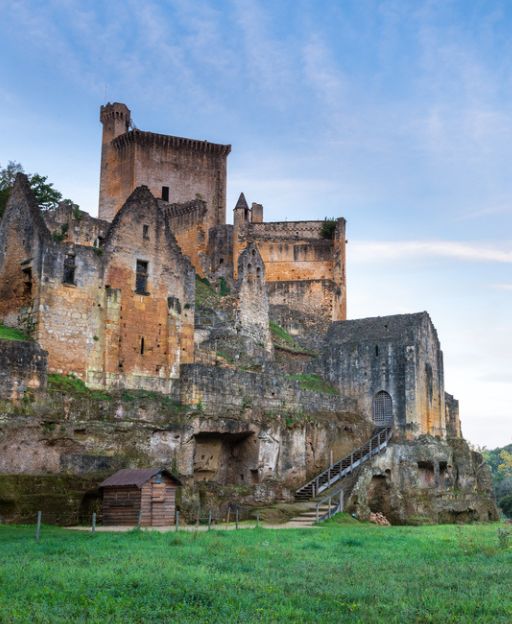
Beynac and Castelnaud face each other across the water. Both castles sit on limestone cliffs. Both were built in the 12th century. For generations, they were enemies.
Beynac was loyal to the French crown. Castelnaud fell under English Plantagenet control for much of the Hundred Years’ War. For two centuries, these two fortresses controlled everything that moved along this stretch of the river. The struggle between them shaped the fate of southern France.
Today, you can stand on the terrace at Beynac and look directly across at Castelnaud, a kilometre away. No roads, no rooftops, no pylons between them — just water, cliffs, and the rival castle on the opposite bank. The view hasn’t changed in 600 years.
This same pattern repeats across southwest France. If you have ever wondered why every village square in the region follows an identical geometric plan, the medieval history behind it is just as fascinating.
🇫🇷 Discover the France Most Tourists Never Find
Get our free guide to 25 hidden villages of France — then join 7,000+ readers for weekly stories about places most guidebooks never mention.
Get Your Free Village Guide →Domme and the View That Stops You Mid-Sentence
Domme sits on a limestone plateau 150 metres above the valley floor. Philip III ordered it built in 1283, and the geometric bastide layout is still intact — a near-perfect grid of streets inside a fortified wall.
But the reason most visitors come is the view from the southern edge of the plateau. The entire Dordogne Valley spreads below in a single glance: river bend, floodplain, wooded hills, castle turrets on distant cliffs. Locals drink morning coffee at the belvedere as though it is the most ordinary setting in the world.
The walk from the Porte des Tours — the original fortified gate, still standing — to the southern viewpoint takes about ten minutes. It is one of the best short walks in France, and it costs nothing.
Why Most Visitors Miss the Best of It
Sarlat-la-Canéda gets most of the crowds. Its medieval centre is extraordinary, and the Saturday market fills every street with cheese, walnut oil, and foie gras sellers. It deserves the attention. But the back roads between La Roque-Gageac, Beynac, and Domme carry a fraction of the visitors, and the scenery is just as good.
Hire a car. Follow the D703 along the river rather than the main routes. Stop when something catches your eye. The cliffs here change colour as the light shifts — pale cream in the morning, deep amber by late afternoon.
May, June, and September give you warm weather, quieter roads, and a quality of light that July and August cannot match. The Dordogne also sits within easy reach of other extraordinary cliff villages that carry remarkable histories. If you are planning your trip to France, this valley deserves more than a passing glance on the map.
Join 7,000+ France Lovers
Three times a week, get France’s hidden gems, seasonal guides, local stories, and the art of la vie française — straight to your inbox.
Subscribe free — enter your email:
Love more? Join 65,000 Ireland lovers → · Join 43,000 Scotland lovers → · Join 30,000 Italy lovers →
Free forever · Unsubscribe anytime
There are places in France that feel complete — where nothing is missing, and nothing needs to be added. The villages of the Dordogne Valley are like that. Stay long enough and the thought of leaving stops making sense.
🇫🇷 You Might Also Love
Thinking about it seriously?
If you’ve started actually planning a move, our complete our complete Moving to France guide walks through every step, every cost, and the paperwork that catches most people out.
Tours & experiences you might love


Powered by Viator. Some links are affiliate links — we may earn a small commission at no extra cost to you.

Leave a Reply