
Étretat sits on the Normandy coast about 200 kilometres north-west of Paris. It is a small town, with a pebble beach rather than sand and no grand resort promenades. What it has — and what has drawn painters, writers and travellers for two centuries — are chalk cliffs of a scale that catches you off guard the first time you see them.
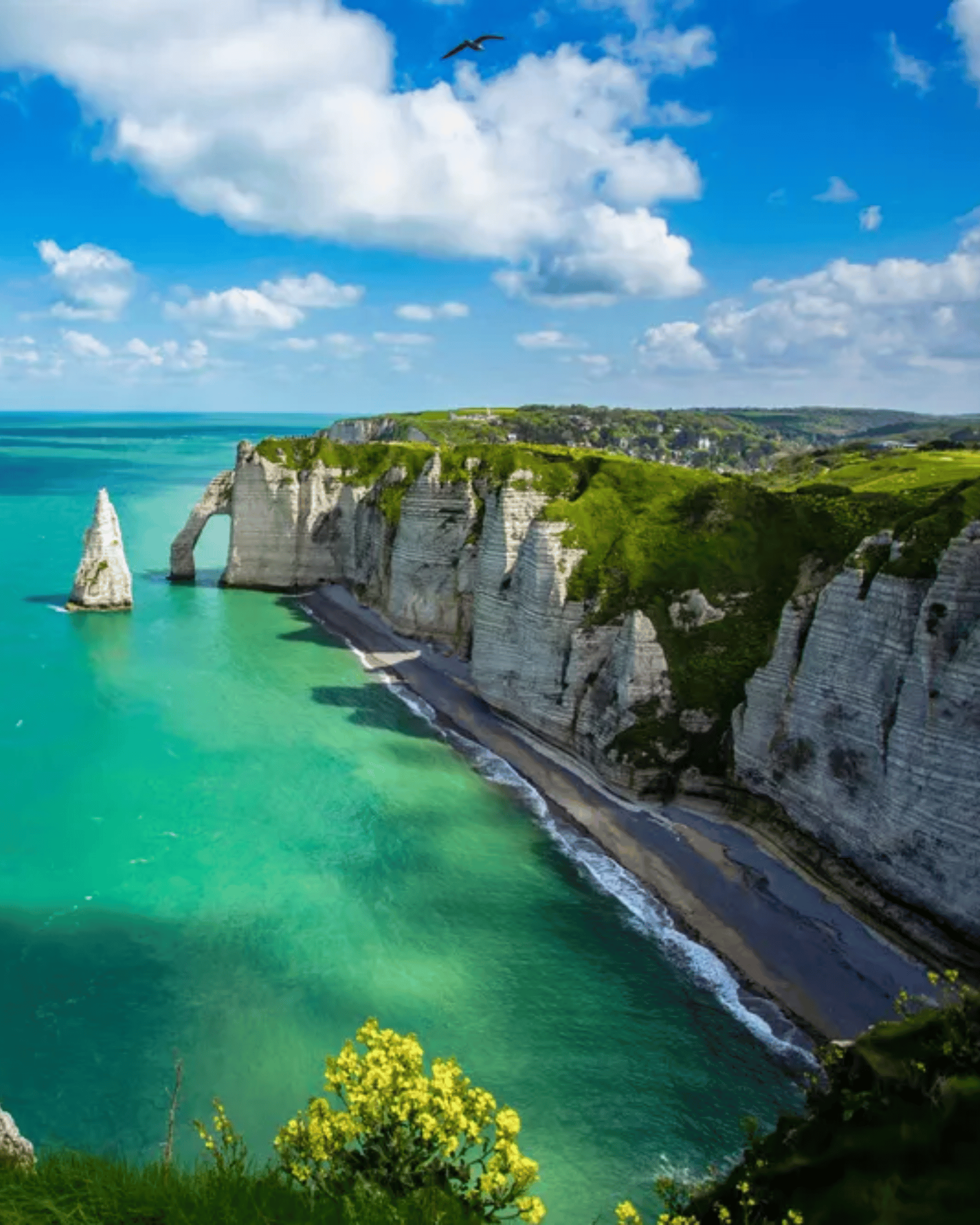
The arches and the sea-stack known as the Aiguille, or the Needle, rising 70 metres from the water just offshore, make Étretat one of the most photographed natural sites in France. Claude Monet painted these cliffs more than 50 times. Standing on the clifftop looking down at the chalk arches and the turquoise water, it is not difficult to understand why he kept coming back.
The Three Cliffs
There are three main cliff formations at Étretat, each with a different character:
Falaise d’Aval — to the west of town and the most famous. This is the cliff with the large arch (Porte d’Aval) and the Needle standing just offshore. The majority of photographs and paintings of Étretat are taken from this direction. The clifftop path above Falaise d’Aval gives you the classic elevated view, and a steep path leads down to the beach below the arch.
Falaise d’Amont — to the east. Steeper and far less visited than Aval. A small chapel, Notre-Dame de la Garde, sits at the top, and there is a monument to aviators Nungesser and Coli, who disappeared on an attempted transatlantic flight in 1927. The light hits this cliff in the afternoon, making it worth visiting later in the day.
Falaise de Manneporte — further west along the coastal footpath from Falaise d’Aval. The arch here is actually larger than the famous Porte d’Aval, but fewer visitors make the walk. Good footwear is essential on the path.
All three cliffs are chalk, the same formation as the White Cliffs of Dover across the Channel. The coastline was shaped from the same ancient seabed, and the geological connection is visible in the colour and texture of the rock. Cliff falls do happen, particularly after wet weather, so stay behind any barriers at the top and do not walk directly below the cliff faces.
Get more stories from France, straight to your inbox. Our free newsletter covers hidden corners, travel tips and local culture from across the country. Subscribe here — it’s free.
Monet at Étretat
Monet first came to Étretat in 1868 and returned many times through the 1880s. He worked in all weathers — morning mist, rough seas, calm afternoons, stormy light — and produced a series of canvases that now sit in museums in Paris, New York, London and across the world.
What drew him back, by his own account, was the combination of scale and constant change. The chalk cliffs shift colour depending on the light: white and sharp-edged on a clear morning, cream and soft in afternoon sun, grey and almost silver on an overcast day. The sea changes the mood of the whole scene. A calm, clear day produces vivid turquoise water; a rough Atlantic swell turns everything dark and dramatic.
Several of Monet’s Étretat paintings are held at the Musée d’Orsay in Paris. If you are visiting Paris before or after Étretat, the comparison between the painted cliffs and the real thing is worth making. The paintings are accurate in their geography even when stylised in their colour.
Getting There
Étretat is not on a main train line, so getting there requires a connection:
By train and bus: Take a direct train from Paris Saint-Lazare to Le Havre, which takes around two hours. From Le Havre bus station, buses run to Étretat in about 45 minutes. Taxis are also available from Le Havre.
By car: From Paris, the drive is roughly 2.5 hours via the A13 and A29 motorways. Parking in Étretat is limited in summer, particularly near the beach. Arriving early or using the car parks on the edge of town and walking in is the better approach.
From Rouen: About 1.5 hours by car. Rouen is an excellent base for a wider Normandy trip and has good rail connections to Paris.
Once you are in Étretat, the town is small enough to cover on foot. The walk from the centre to the top of Falaise d’Aval takes around 15 minutes and is well signposted.
What to Do
Walk the clifftops. The coastal footpath between the two main cliff formations passes above the town and provides the elevated views that feature in most photographs. A relaxed walk taking in both Aval and Amont takes about an hour. The descent to the beach below Falaise d’Aval is steep but manageable in dry weather.
The Jardins d’Étretat. These cliff-top gardens above Falaise d’Amont have been extensively redesigned in recent years and combine contemporary garden art with direct views over the cliffs and sea. They are ticketed, and worth the cost in late spring and summer when the planting is at its best.
The beach. The pebble beach at the foot of the cliffs is where locals swim in summer. It is not a beach for a long afternoon of sunbathing, but walking it at low tide — with the cliffs rising on both sides and the Needle visible offshore — is one of the better ways to understand the scale of the place. The sea caves in the cliff base at Falaise d’Aval are accessible at low tide.
The town centre. Étretat has a covered market hall (Les Halles), a seafront lined with restaurants, and a small number of shops. It functions as a genuine small town rather than a purpose-built tourist destination, which gives it a more grounded atmosphere than some coastal resorts.
Get more stories from France, straight to your inbox. Our free newsletter covers hidden corners, travel tips and local culture from across the country. Subscribe here — it’s free.
Where to Stay
Hôtel Dormy House — one of the most well-known hotels in Étretat, positioned directly above Falaise d’Aval with rooms overlooking the sea. It books up early in summer and is best reserved several months ahead.
Château Les Aygues — a converted manor house on the edge of town, with more space and a quieter setting than the seafront options.
Le Havre — if accommodation in Étretat itself is full or expensive, Le Havre has a much wider range of hotels and is 45 minutes away by bus. Le Havre is also worth visiting in its own right: the postwar city centre was designed by Auguste Perret and is a UNESCO World Heritage Site.
Camping: Several campsites operate in the hills around Étretat, some with cliff views. A practical option if you are travelling by car.
When to Visit
July and August are the busiest months. Étretat is small enough that it can feel genuinely crowded in peak summer, and car parking becomes difficult by mid-morning. For a better experience:
May to June — the clifftop grass is green, the weather is mild and visitor numbers are manageable. Late May can be particularly good.
September to October — lower, warmer light, the summer crowds gone, and the seas often more dramatic. This is the atmospheric light Monet worked with in several of his later Étretat canvases.
Winter — the town quiets down significantly and some businesses close, but the cliffs are yours on a weekday morning. The light at this time of year has a quality you do not get in summer.
The Alabaster Coast
Étretat is one stop on a longer stretch of coastline called the Côte d’Albâtre, the Alabaster Coast, which runs roughly from Le Havre north to Dieppe. The same chalk cliff character continues throughout, and several other towns are worth including in a wider visit:
Fécamp — 20 kilometres south of Étretat. Known for the Abbaye de la Trinité, an impressive medieval church, and the Palais Bénédictine, a 19th-century confection that houses both a museum and the distillery for the Bénédictine liqueur. Quieter than Étretat and often overlooked.
Dieppe — the largest town on this stretch of coast. A working port with a Saturday market, a castle museum with a notable collection of carved ivory, and its own chalk cliffs visible from the seafront. A two-hour drive from Paris makes it viable as a day trip.
Yport — a small fishing village between Fécamp and Étretat, almost entirely unknown to tourists. The beach is quieter and the cliffs surrounding the village are substantial. Worth an hour if you are passing through.
Get more stories from France, straight to your inbox. Our free newsletter covers hidden corners, travel tips and local culture from across the country. Subscribe here — it’s free.
Practical Notes
A day trip from Paris to Étretat is feasible but makes for a long day. Given the travel time by train and bus, staying overnight or making Étretat part of a longer Normandy itinerary is the more sensible approach.
The cliffs look different at different times of day. Morning light hits Falaise d’Aval directly; afternoon light catches Falaise d’Amont. Monet was systematic about this: he worked at specific times in specific spots to catch the light he was after. Taking the same approach — returning to the clifftop at different points during your visit — shows you more of what makes this place distinctive.
The walk from town to the top of Falaise d’Aval and down to the beach and back is manageable in ordinary walking shoes on a dry day. For the path to Falaise de Manneporte or the descent to the caves at low tide, proper footwear is advisable.
There is a reason Monet came back to Étretat more than 50 times. The cliffs change with every hour and every shift in weather, and the scale of the place — the chalk arches, the Needle standing alone in the sea — continues to be surprising even when you know what to expect.
Thinking about it for retirement?
If you’ve started thinking seriously about retiring there, our complete our full Retire in France guide covers the visa, healthcare, cost-of-living, and the regions worth shortlisting.
🇫🇷 Discover the France Most Tourists Never Find
Get our free guide to 25 hidden villages of France — then join 7,000+ readers for weekly stories about places most guidebooks never mention.
Get Your Free Village Guide →Tours & experiences you might love


Powered by Viator. Some links are affiliate links — we may earn a small commission at no extra cost to you.

Leave a Reply