
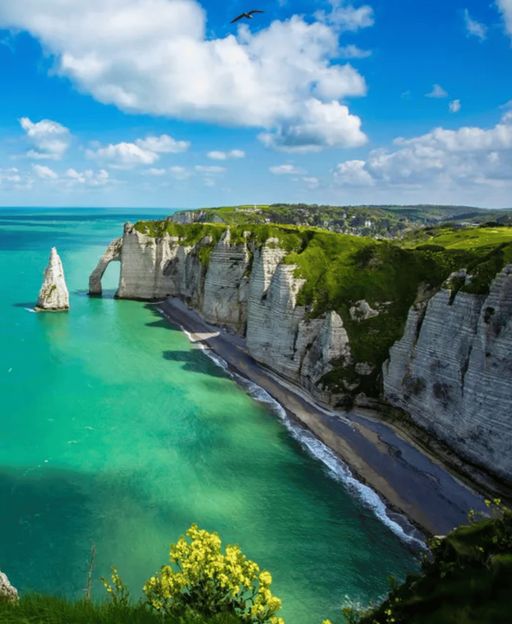
Standing at the edge of Étretat’s chalk cliffs, you understand at once why this stretch of the Normandy coast stopped painters in their tracks. The sea below is a cold, vivid green. The stone arches rise from the water like the frame of something sacred. And the light — that restless, changeable northern light — shifts from one minute to the next.
The Village That Captivated France’s Greatest Painters
Étretat sits on the Normandy coast between Fécamp and Le Havre. For most of its history it was a fishing village. The boats went out. The nets came in. Life moved with the tides.
Then the painters discovered it.
Gustave Courbet came in the 1860s and painted the cliffs with wild, turbulent strokes. His canvases showed the sea at its roughest — waves breaking against chalk, water foaming over shingle. They were unlike anything else being made in Paris at the time.
After Courbet came others. Eugène Boudin. Jean-Baptiste-Camille Corot. And in 1883, Claude Monet arrived for the first time and never quite left.
Why Monet Kept Coming Back
Monet made his first visit to Étretat in the winter of 1883. He stayed for two months. Then he came back in 1885. Then again in 1886.
Across those visits, he produced over forty paintings of the same stretch of coast.
Not forty landscapes of Normandy. Forty paintings of the same cliffs, the same arches, the same solitary needle of rock — each one in different light, different weather, a different hour of the day.
He was chasing something almost impossible to capture: the way morning fog softened the white chalk. The moment when a cloud broke and the sea changed colour. The particular quality of silence after rain swept across the coast and moved on.
He worked outdoors in all conditions. In winter storms, his easel had to be weighted down with stones. Once, a wave reached him at the cliff base and soaked both him and a nearly-finished canvas. He kept painting.
This obsession — painting the same subject over and over to capture time rather than place — would later define his most celebrated work. The Haystacks series. Rouen Cathedral. The Water Lilies at Giverny. Étretat is where that idea first took hold.
What You See When You Stand There
Étretat has three natural arches along a short strip of coast. The most famous, the Porte d’Aval, is visible from the beach below and walkable from the clifftop path above. Most visitors do both.
The pebble beach is dark grey. The water is a sharp, cool green. The chalk face glows white or pale cream depending on the day, and turns gold in evening light. In photographs it looks theatrical. In person it looks impossible.
Beyond the arch, the Aiguille d’Étretat — a solitary needle of chalk — rises straight from the sea. This is the formation that inspired Maurice Leblanc when he created the Arsène Lupin mystery series. His fictional gentleman thief supposedly hid stolen treasures in a secret cave carved into the Needle’s base.
France does that often: folds stories so deeply into its landscape that eventually you cannot separate one from the other.
Enjoying this? 7,000 France lovers get stories like this every week.
Thinking about it seriously? If you’ve started actually planning a move, our complete our complete Moving to France guide walks through every step, every cost, and the paperwork that catches most people out.
The Village Behind the Cliffs
Most visitors see the cliffs and leave. That is a mistake.
Étretat’s village centre is small and largely unchanged. There is a covered market hall from the nineteenth century that still runs on Saturday mornings. Locals come for Normandy butter, aged camembert, and farm cider from the surrounding countryside.
The church of Saint-Nicolas stands just back from the main square. Its carved wooden ceiling took a local craftsman many years to complete and is rarely noticed by visitors moving quickly between the beach and the clifftop path.
In the summer months, Étretat is busy with visitors from across France and beyond. In October or early spring, it is almost empty. That is when it becomes something else entirely — closer, perhaps, to what Monet found when he arrived in February with no one else around.
Getting Here and When to Go
Étretat is around two hours from Paris. There is no direct train to the village — the nearest station is at Bréauté-Beuzeville — but regular buses and taxis connect easily. By car, it is a straightforward drive from Rouen or Le Havre.
Spring and early autumn are the best seasons. Summer brings large crowds to the clifftop path. October brings the kind of light Monet was chasing: soft, shifting, never quite the same twice.
For more on the region, our Normandy Travel Guide covers D-Day beaches, Mont Saint-Michel, and the best routes through the area. Monet’s garden at Giverny makes a natural companion trip — we cover it in our guide to the best day trips from Paris. And if you are still planning your France trip from scratch, the France travel planning hub has everything you need before you go.
Monet came back to these cliffs because they showed him something different every time he arrived. They still do. That might be the best reason to visit anywhere.
Join 7,000+ France Lovers
Three times a week, get France’s hidden gems, seasonal guides, local stories, and the art of la vie française — straight to your inbox.
Subscribe free — enter your email:
🇫🇷 Discover the France Most Tourists Never Find
Get our free guide to 25 hidden villages of France — then join 7,000+ readers for weekly stories about places most guidebooks never mention.
Get Your Free Village Guide →Love more? Join 65,000 Ireland lovers → · Join 43,000 Scotland lovers → · Join 30,000 Italy lovers →
Free forever · Unsubscribe anytime
🇫🇷 You Might Also Love
Tours & experiences you might love


Powered by Viator. Some links are affiliate links — we may earn a small commission at no extra cost to you.

Leave a Reply