
Every morning, the sea returns. It creeps across the bay of Normandy, fills the surrounding sand flats, and turns a rocky island into something that seems entirely alone. For more than a thousand years, that isolation kept Mont-Saint-Michel alive.
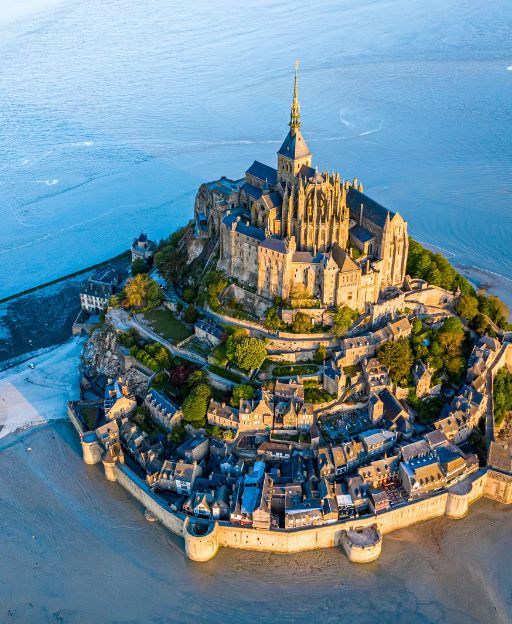
Most people know Mont-Saint-Michel as a postcard image. The spire, the abbey, the perfect shot from the bridge at sunrise. Fewer people know why it exists where it does — and why no army ever managed to take it.
A Rock That Nature Made Impossible to Attack
The Normans began building the Abbey of Mont-Saint-Michel in the 8th century on a tidal island roughly one kilometre off the Normandy coast. The site made little obvious sense. The tides in this bay are among the fastest in Europe — the water rushes in at the speed of a galloping horse.
Monks crossed the sand flats on foot when the tide allowed. When it did not, nobody crossed at all. Pilgrims arrived with the low water, sometimes walking through the night from the mainland.
That same danger became the island’s greatest protection. To attack Mont-Saint-Michel, an army first had to survive the crossing — on foot, with weapons, across treacherous tidal sand — and then hold ground on a tiny rock while the sea tried to take them.
The Hundred Years War — and the Garrison That Held
Between 1337 and 1453, France and England fought the Hundred Years War across the fields and towns of northern France. English forces occupied most of Normandy. Rouen surrendered. Caen fell. The region burned for a generation.
Mont-Saint-Michel did not fall.
A garrison of just 119 knights held the island throughout the English occupation of Normandy. In 1423, English forces mounted a full siege. They built siege towers, positioned cannon along the causeway approaches, and stationed soldiers at the shore. The defenders waited. The tide came in. The English eventually abandoned their position and withdrew.
The island became a symbol of French resistance — one small fortress on a rock in the sea that no enemy managed to take. The garrison held for thirty years. Charles VII sent his personal thanks by letter.
The Village That Lives Inside the Walls
Most visitors walk up the main street, queue for the abbey, and head back down again. But Mont-Saint-Michel is not only an abbey. It is a living medieval village.
About 30 people still live here permanently. Medieval houses crowd together along a single main street — Grande Rue — that climbs steeply toward the abbey entrance. Narrow passageways branch off between buildings. Some open onto stone terraces with views across the bay. Others end at locked doors or staircases that lead nowhere obvious.
The village dates to the 11th century. Pilgrims once slept in these same houses after crossing the bay at night. Merchants sold bread, wine, and relics to the faithful. The island economy ran on devotion and danger in roughly equal measure.
Enjoying this? 7,000 France lovers get stories like this every week. Subscribe free →
The Tides That Still Control Everything
The Bay of Mont-Saint-Michel has one of the highest tidal ranges in Europe — up to 15 metres between high and low water. At low tide, the island sits on a wide expanse of exposed sand flat. When the tide peaks, the sea wraps entirely around the island.
Between 2009 and 2015, engineers restored the natural tidal flow around the island. A new bridge replaced the old causeway, which had trapped silt against the base of the rock for decades. The sandbanks cleared. The island became genuinely isolated again — closer to the way medieval defenders experienced it.
Today the tidal rhythm still controls everything. Tour groups arrive with the low tide. Restaurants fill before sunset. When the tide turns, the bay changes around you in real time.
Planning Your Visit
Go early morning or late afternoon to avoid the heaviest crowds. The abbey opens at 9:30am, and the main street clears significantly after 5pm. Allow at least three hours.
Check the tide tables before you visit — a high tide changes the character of the place entirely. Our Normandy travel guide covers everything from the D-Day beaches to the coastal towns if you want to plan a longer regional trip.
The Normandy fishing villages that tourism hasn’t touched make an excellent afternoon stop nearby. Start your full France planning at our France planning hub.
Frequently Asked Questions
How do you get to Mont-Saint-Michel from Paris?
Take a TGV from Paris Montparnasse to Rennes — about 1 hour 30 minutes. From Rennes, coaches run directly to Mont-Saint-Michel in around 90 minutes. The total journey takes roughly 3 hours. Hired cars are also available from Rennes station for more flexibility.
Is Mont-Saint-Michel worth visiting in winter?
Yes. Winter crowds are small, and the light across the bay in November and December is extraordinary. The abbey opens year-round. Some village restaurants close for the season, but the experience of visiting without summer crowds makes the trip genuinely worthwhile.
What is the best time to see the tides at Mont-Saint-Michel?
The highest tides occur around the spring and autumn equinoxes — roughly March and September. Plan around a high tide: tide tables for the bay are freely available online. The most dramatic tides cover the causeway completely and isolate the island the way it stood for centuries.
Can you walk across the bay to Mont-Saint-Michel?
Yes, but only with a licensed guide. The sand can shift and become unstable, and the tide returns faster than most visitors expect. Guided bay crossings depart from the village of Genêts on the mainland. Never attempt the crossing alone.
Stand on the ramparts when the tide rises and the mainland disappears behind a wall of sea. The island grows quiet. You understand, finally, why no army ever took it.
Join 7,000+ France Lovers
Three times a week, get France’s hidden gems, seasonal guides, local stories, and the art of la vie française — straight to your inbox.
Subscribe free — enter your email:
Free forever · · Unsubscribe anytime
🇫🇷 You Might Also Love
Tours & experiences you might love


Powered by Viator. Some links are affiliate links — we may earn a small commission at no extra cost to you.

Leave a Reply