
In the winter of 1892, Claude Monet rented a room above a linen shop on Rouen’s Rue du Grand-Pont. He pointed his easel at the cathedral facade across the street and barely looked away for weeks. By the time he packed up and left, he had painted it thirty times — and told a friend he still hadn’t captured it.
That obsession tells you everything about Rouen. This is a city that rewards attention. Most visitors spend an afternoon and leave. The ones who stay longer rarely regret it.
The Cathedral That Changes With the Light
Rouen Cathedral stands as one of the tallest Gothic structures in France. What drew Monet wasn’t its height — it was its surface. The west facade shifts with every cloud that passes overhead.
In early morning, the pale stone glows gold. By midday, sharp shadows cut into the carved figures like knives. At dusk, the whole facade turns amber, then charcoal, then almost violet.
Monet painted it in fog, in flat winter light, in midday glare. He switched between dozens of canvases simultaneously, chasing the shifting light from one to the next. The results hang today in the Musée d’Orsay in Paris. But the cathedral itself — in the actual light of an actual morning — remains something the paintings can only suggest.
The Half-Timbered Streets Behind the Postcards
Most visitors photograph the cathedral and leave. That is their loss. Turn right from the main facade and you step into a medieval quarter that survived both the Hundred Years’ War and the wartime bombing that destroyed much of the city.
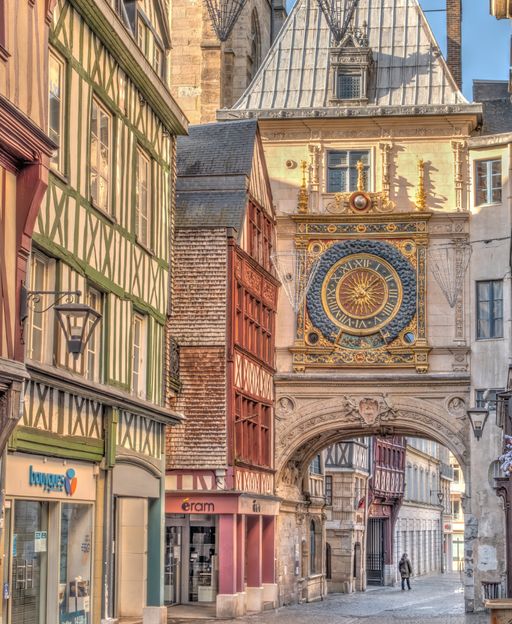
Over 700 half-timbered buildings still stand in old Rouen. Their upper storeys lean towards each other across narrow lanes. The timber frames bow under centuries of weight.
The Rue du Gros-Horloge cuts through the heart of it. The Gros-Horloge — a 14th-century astronomical clock — bridges the street on an ornate stone arch. The clock still keeps time. Around it, the buildings crowd in, the whole scene unchanged in feel since the Middle Ages.
Walk further into the backstreets. Courtyards open up where nothing has changed in three hundred years. Rouen doesn’t curate itself for visitors. It simply exists, and waits.
The Square Where the Past Never Fully Left
The Place du Vieux-Marché sits at the edge of the old town. A pleasant square, lined with restaurants and a covered market hall. People eat lunch at outdoor tables. Children run between the stalls.
One corner tells a different story. The Église Sainte-Jeanne-d’Arc marks the spot where Joan of Arc burned in 1431. She was nineteen. The English declared her a heretic after a politically driven trial that historians have long regarded as judicial murder. The square carries that weight quietly, without drama.
The church spirals upward in a design that evokes the flames. Inside, it displays 16th-century stained glass from a medieval church that wartime bombs destroyed — vivid reds and blues that survived both the destruction and the rebuilding. The contrast with the modern exterior is stark and deliberate.
Enjoying this? 7,000 France lovers get stories like this every week.
Thinking about it for retirement? If you’ve started thinking seriously about retiring there, our complete our full Retire in France guide covers the visa, healthcare, cost-of-living, and the regions worth shortlisting.
The Church That Rewards the Curious
Most visitors overlook the Église Saint-Maclou, a five-minute walk from the cathedral. That is their mistake. This late Flamboyant Gothic church pushes the style as far as it goes — the facade ripples with carved stone, every surface competing for attention.
Behind the church, the Aître Saint-Maclou tells a grimmer story. Builders constructed this small courtyard as a plague cemetery during the Black Death. The timber-framed buildings surrounding it still display carved skulls and bones in their woodwork. Rouen built a frame of death around its plague graves — and the carvings survive to this day.
Few cities in France preserve their difficult history this plainly. Rouen doesn’t soften the past. It marks it, then moves on.
How to Visit Rouen — and Where to Go Next
Arrive on a weekday morning. The cathedral facade catches the best light between 8am and 10am. Monet arrived even earlier, setting up his canvases before the crowds arrived.
From Rouen, the road west leads to Giverny, where Monet spent the second half of his life building the water garden that inspired his greatest work. The two places together form a single portrait of an artist defined by light, water, and the fields of northern France. Giverny is about 75 kilometres away — an easy half-day extension.
Rouen also connects naturally to the wider region. Our Normandy travel guide covers everything from the D-Day beaches to Mont-Saint-Michel. The region rewards slow travel — Rouen anchors a long weekend beautifully.
For help building your itinerary, start at our France trip planning hub.
How far is Rouen from Paris?
Rouen sits about 130 kilometres northwest of Paris. Direct trains from Paris Saint-Lazare take just over an hour. That makes it one of the easiest day trips from the capital, though a full weekend does it more justice.
What is the best time to visit Rouen, France?
Spring and early autumn offer the ideal combination: mild temperatures, smaller crowds, and the soft northern light that Monet chased across four consecutive winters. The cathedral and half-timbered streets reward a visit in any season, though summer brings more visitors to the old quarter.
Can you go inside Rouen Cathedral?
Yes. The cathedral is open to visitors and entry is free. The interior is vast, cool, and lit by extraordinary stained glass. Guided tours are available and help explain the centuries of construction that shaped the building’s layered character.
How do you get from Paris to Rouen?
Regular trains depart from Paris Saint-Lazare throughout the day. The journey takes between 1 hour 10 minutes and 1 hour 25 minutes depending on the service. Book in advance through the SNCF website for the best fares.
Monet spent four winters in Rouen and still declared he hadn’t finished. That restlessness makes sense once you’ve stood in front of the cathedral as the light shifts, or turned a corner in the old quarter and found yourself somewhere the centuries haven’t quite reached. Some cities explain themselves. Rouen simply shows you what it is, and lets you decide how long to stay.
Join 7,000+ France Lovers
Three times a week, get France’s hidden gems, seasonal guides, local stories, and the art of la vie française — straight to your inbox.
Subscribe free — enter your email:
📲 Know someone who’d love this? Share on WhatsApp →
Love more? Join 65,000 Ireland lovers → · Join 43,000 Scotland lovers → · Join 29,000+ Italy lovers →
Free forever · · Unsubscribe anytime
🇫🇷 You Might Also Love
Tours & experiences you might love


Powered by Viator. Some links are affiliate links — we may earn a small commission at no extra cost to you.

Leave a Reply