The first thing visitors notice in Alsace is the road signs. They show two names. One in French. One in something older — something that sounds like German but is not quite German either. Ribeauvillé, says one sign. Rappoltsweiler, says the smaller text underneath.
This is not a mistake. It is Alsace explaining itself.
A Region That Has Changed Hands Four Times
In the past 150 years alone, Alsace has been French, then German, then French, then German, then French again. The final handover came in 1945 when the Second World War ended.
Most places would lose their identity after that kind of history. Alsace held on to everything.
The language survived. The food survived. The architecture survived. The stubbornness, above all else, survived.
The Dialect Nobody Tried Hard Enough to Kill
Walk into a village bakery in the Bas-Rhin and you may hear something that is neither French nor German. It is Alsatian — an old Germanic dialect still spoken by hundreds of thousands of people across the region.
After both World Wars, French schools banned it from classrooms. The aim was to make Alsace feel more firmly French.
It did not work. Today, Alsatian is taught in schools again. It appears on shop signs and is spoken at village festivals. The region decided the dialect was part of who they were, and that was that.
Why the Houses Look Like a Fairy Tale
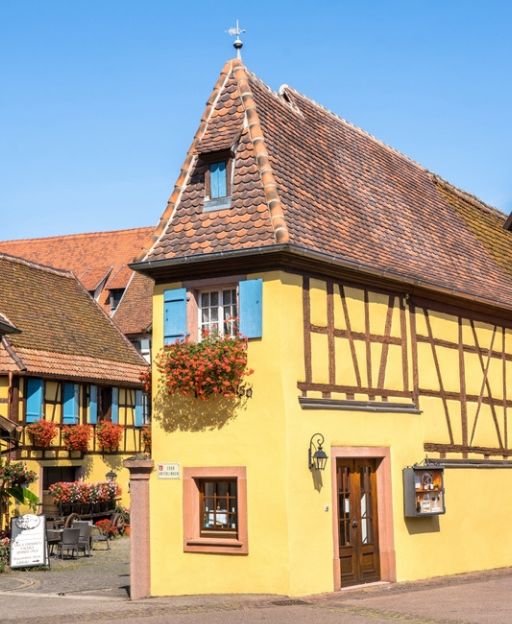
The half-timbered houses of Eguisheim, Riquewihr, and Kaysersberg look nothing like the rest of France. No Provençal stone farmhouses here. No Dordogne limestone walls. These buildings — painted pink and yellow and blue, their timber frames left bare — belong to a different world.
Until 1648, much of Alsace was part of the Holy Roman Empire. The German influence went deep: into the architecture, the wine grapes (Riesling, Gewurztraminer), the food (choucroute, baeckeoffe stew), and the Christmas market tradition.
When Alsace became French, it kept all of it. Not as a statement. Simply as common sense.
Enjoying this? 7,000 France lovers get stories like this every week.
Thinking about it seriously? If you’ve started actually planning a move, our complete our complete Moving to France guide walks through every step, every cost, and the paperwork that catches most people out.
The Christmas Market France Borrowed
Every December, the rest of France fills with Christmas markets. Mulled wine, gingerbread, twinkling lights over cobbled squares. The French adore them.
Almost none of it is originally French.
The Christmas market tradition came to France through Strasbourg, which has held one every year since 1570. It is one of the oldest in the world. When the rest of France fell in love with the idea, they were borrowing something that arrived with Alsace's German inheritance.
Alsace does not mind. It has always been generous with what it invented first.
The Food That Refuses to Choose Sides
The cuisine of Alsace will not be categorised. Choucroute garnie — slow-cooked sauerkraut with pork and sausages — is as German as it sounds. It is also the region's most celebrated dish, served in fine restaurants in Strasbourg without a trace of embarrassment.
Then there is tarte flambée: a thin, crisp base spread with crème fraîche, onions, and lardons. It looks like a pizza. It eats like comfort. It belongs to no one but Alsace.
The wines are the same. Riesling and Pinot Gris grown in French soil, labelled with German grape names, made by families who have been here for centuries and call themselves French without question.
When to Go and What to Expect
The Route des Vins runs for 170 kilometres through villages that barely look real. Start in Thann in the south and finish near Marlenheim in the north — and stop at every village in between. If you are planning your trip to France, Alsace deserves at least two or three days.
Late October is ideal. The vine leaves go gold, the harvest is in, and the summer crowds have gone. December turns Strasbourg into something from a snow globe. Spring brings blossom and quiet lanes between the vines.
Alsace is not the France you expect. That is entirely the point. It is a place that has been pulled in two directions for centuries and come out knowing exactly what it is. If you have read about why Bretons call themselves Breton before they call themselves French, you will understand something about Alsace too. France has never been one thing.
Alsace has been handed between two great nations like a piece of disputed land for centuries. What it chose to do with that — hold on to everything it was, in both languages, in every cobbled street and painted timber frame — is what makes it worth the journey. Some places know exactly who they are. Alsace is one of them.
Join 7,000+ France Lovers
Three times a week, get France's hidden gems, seasonal guides, local stories, and the art of la vie française — straight to your inbox.
Subscribe free — enter your email:
Love more? Join 65,000 Ireland lovers → · Join 43,000 Scotland lovers → · Join 30,000 Italy lovers →
Free forever · · Unsubscribe anytime
🇫🇷 You Might Also Love
Tours & experiences you might love


Powered by Viator. Some links are affiliate links — we may earn a small commission at no extra cost to you.

Leave a Reply