What’s your name in French? 🇫🇷
Your French Name — type any first name for the French equivalent, with meaning and regional notes.
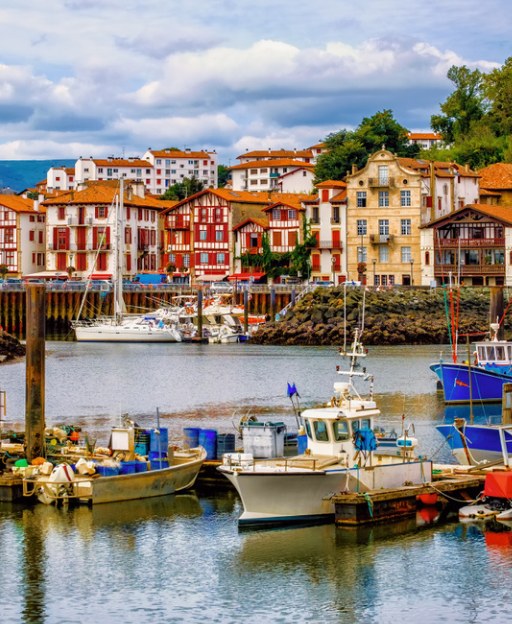
There is a moment, standing in the market square of Saint-Jean-de-Luz on a warm September morning, when you notice that the names on the shop fronts, the fishing boats, and the stone lintels of the old houses simply do not look like anything else in France. Etcheberry. Larralde. Irigoyen. Oxarango. They are not Gascon, not Latin, not Germanic — they are something older and stranger, and the first time I encountered them I felt the particular thrill of stumbling upon a language that refuses to explain itself. The French Basque Country, pressed between the Pyrenees and the Atlantic in the modern département of Pyrénées-Atlantiques, is home to one of Europe’s most extraordinary surname traditions, and for anyone tracing Basque ancestry — whether from a village in Labourd, Soule or Basse-Navarre, or from a sheep ranch in Nevada or a rancho in Argentina — understanding how these names work is the essential first key.
What Makes French Basque Surnames Unique
The answer begins with the language itself. Euskara, the tongue of the Basque people, is a language isolate: it has no known relatives anywhere on earth, and the Basque language stands entirely apart from French in structure, vocabulary, and sound. While French descends from Vulgar Latin and carries the deep imprint of Frankish, Norse, and Occitan influence, Euskara predates the Roman conquest of Gaul by an unknown span of centuries, possibly millennia. Linguists cannot connect it to any Indo-European family. This means that Basque surnames were formed according to entirely different principles from those governing French, Spanish, or any of the surrounding Romance traditions — and it shows.
Where French surnames frequently derive from Latin personal names (Martin, Laurent, Bernard) or from medieval occupational titles rooted in Old French, the great majority of Basque surnames are toponymic — that is, they describe a house, a farm, a hillside, a valley, or a physical feature of the land. This is not merely a curiosity. In traditional Basque society, the etxea — the ancestral house — was the fundamental unit of identity. A person did not simply belong to a family; they belonged to a place, and the name of the house became the name of the family. When the French state began requiring hereditary surnames in the early modern period, Basque communities had in many cases been using house-names as identifying markers for generations already. The administrative formalisation simply fixed what communities already knew.
This house-name origin produces surnames of a very particular character. They are often compound words built from recognisable Euskara roots, and once you learn a handful of those roots — etxe (house), mendi (mountain), borda (hut or outbuilding), iri (village or settlement), larre (pasture), harri (stone) — you begin to see how the landscape of the western Pyrenees is encoded in the surnames of its people. This is quite different from the experience I had researching surnames in, say, the Alsatian borderland where culture and identity blurred across centuries of French and German sovereignty — in Alsace the naming traditions are layered and contested, a palimpsest of competing influences. In the French Basque Country, by contrast, even after centuries of French administration and the slow erosion of everyday Euskara, the surname layer remains stubbornly, beautifully legible.
The Most Common French Basque Surname Patterns
The prefix Etche- or Etchea- (from etxe, house) is perhaps the single most productive root in the entire French Basque surname corpus. Etcheberry — from etxe berria, meaning “the new house” — is among the most frequently encountered Basque surnames on both sides of the Pyrenees. Etcheberry families can be traced in parish registers from Bayonne and Biarritz well back into the sixteenth century, and the name travelled to Louisiana, Quebec, and South America with emigrating Basque communities. Etchecopar combines etxe with kopar, a root variously interpreted as relating to a cup-shaped hollow in the terrain or to a copse of trees, giving something like “house by the hollow.” Etchegaray derives from etxe garai, the “high house” — a name that conjures immediately the habit of Basque hill-farmers of building their farmsteads on the upper slopes away from the valley floors.
The Iri- prefix, from iri or uri meaning a settlement or village nucleus, generates another significant cluster. Irigoyen — from iri goien, “upper village” or “upper settlement” — is one of the most widespread Basque surnames in the Americas and appears in records from Buenos Aires to Boise. The name carries a topographic clarity that any Basque-speaking ancestor would have recognised instantly: it told you where the family’s house stood relative to the main cluster of the village. Similarly, Irigoin and Iribehere (lower settlement) are variants that encode the same positional intelligence.
Beyond house and settlement names, occupational surnames do appear, though they are less dominant than in many other French regional traditions. Daguerre — carried to international fame by Louis Daguerre, the pioneer of photography, whose family was of Basque origin — is thought to derive from a topographic term related to wetlands or marshy ground, though some researchers connect it to an occupational tradition associated with farming on difficult terrain. Garat relates to a fortified gateway or the approach to a settlement, and families bearing the name were prominent in revolutionary-era France: Dominique Garat, born in Ustaritz in the Labourd region, served as Minister of Justice in 1792.
Salaberry combines sala (a hall or large room, possibly denoting a prosperous farmhouse) with the productive suffix -berria (new), giving “new hall” — a name that suggests a family whose house was notable enough in scale to be identified by its principal room. Larralde derives from larre (pasture or heath) combined with alde (side, vicinity), meaning roughly “by the pasture,” and reflects the pastoral economy that has shaped the Basque mountain country for thousands of years. Oxarango, one of the more phonetically striking names to French ears, appears to combine roots relating to a ravine with a locative suffix, suggesting a family whose farmstead overlooked a narrow gorge — exactly the kind of dramatic geography you find throughout the Soule and Basse-Navarre regions.
It is also worth noting the Borda- cluster, from the Basque borda meaning a hut, barn, or secondary outbuilding — the name given to the smaller agricultural structures on a Basque farm. Families named Bordaberry, Bordacahar, or simply Borda often descend from lines associated with such outbuildings, perhaps indicating cadet branches of a larger farmstead or families who settled land that had previously been worked from a main house elsewhere in the valley.
Basque Migration and the Spread of French Basque Surnames
One of the most remarkable chapters in the story of French Basque surnames is their extraordinary geographical dispersal. From the sixteenth century onwards, Basque fishermen and whalers from the French coast — particularly from Saint-Jean-de-Luz, Ciboure, and the Bay of Biscay ports — were ranging as far as Newfoundland and Labrador. Their surnames entered the record books of colonial administrators from Quebec to Louisiana, often mangled almost beyond recognition by French notaries unfamiliar with Euskara phonology, then mangled further by Spanish and later Anglo-American scribes. An Etcheberry might surface in a Louisiana census as Etcheberi, Echeberri, or Etcheverry; an Irigoyen might appear as Yrigoyen or Errigoyen depending on which side of the Pyrenean border the emigrant family had crossed and which administrative tradition they encountered.
The great wave of Basque emigration to the Americas in the nineteenth century brought French Basque surnames deep into South America, particularly to Argentina and Uruguay, where communities in Buenos Aires and Montevideo established social clubs, churches, and mutual aid societies that kept Basque identity alive across generations. The surname Irigoyen became embedded in Argentine political history through Hipólito Yrigoyen, twice president of the republic, whose family was of Basque descent. In this way, names that began as descriptions of a hill-farm above Saint-Palais or a pasture near Mauléon became woven into the national histories of countries the original name-givers could never have imagined.
In the United States, the Basque presence is perhaps most legible in the high desert sheep country of Nevada, Idaho, and California. French Basque shepherds — many of them from the Soule and Basse-Navarre regions — arrived from the 1850s onwards, following gold-rush trails and then staying to work the ranges. The Basque hotels of Reno and Elko, which served as community hubs for generations of shepherds, still bear Basque names above their doors, and local telephone directories in those states carry surnames that would not look out of place in a church register from Mauléon or Tardets. I have met descendants of French Basque shepherds in Nevada who cannot speak a word of Euskara but who carry Etcheberry or Larralde as their family name with a fierce and specific pride, knowing that it connects them to a particular kind of landscape and a particular kind of people.
The comparison with Norman heritage reshaped much of Western Europe is instructive: like the Normans, the Basques spread their cultural markers — including their surnames — across an astonishing range of territory, often in contexts very far removed from the original homeland. Unlike the Normans, however, the Basques did so not through conquest but through labour migration, trade, and the restless pursuit of fishing grounds and grazing land.
How to Trace Your French Basque Ancestry
For anyone beginning research into French Basque family history, the single most important resource is the Archives Départementales des Pyrénées-Atlantiques, based in Pau and Bayonne. This archive holds the civil registration records for the département from 1793 onwards, as well as the older parish registers (état civil ancien) that predate the Revolution. Many of these records are now digitised and accessible through the archive’s online portal, which is free to use. The parish registers of the Labourd, Soule, and Basse-Navarre regions extend in some cases back to the late sixteenth century and are an essential starting point for any serious genealogical investigation.
The Société Internationale de Généalogie Basque (SIGB) is the specialist organisation for Basque family history research and maintains databases, published indexes, and a network of researchers familiar with the particular challenges of Basque record-keeping — including the way house-names function alongside patronymics in the older records, creating a layer of complexity that can confuse researchers accustomed to straightforward European surname inheritance. The SIGB publishes Hizkuntza, a research journal, and maintains contacts with sister organisations in Spain, Argentina, and the United States.
When searching archival records, it is worth bearing in mind that the same family might appear under different surname spellings within a single generation, because notaries in the French administrative tradition often transcribed Euskara phonetically — and their phonetics varied. A family named Etcheberry in their village might appear as Echeberri, Etcheberi, or even Etchevary in successive documents. Searching for the core root (etxe, berri) rather than a fixed spelling will typically yield better results. Online resources including the Basque Country entries on FamilySearch (which has digitised significant quantities of French Basque civil and church records) and the Basque-specific databases maintained by the Nevada-based Basque Museum and Cultural Centre in Boise, Idaho, can be invaluable for tracing lines that crossed the Atlantic.
Frequently Asked Questions
Why do so many French Basque surnames begin with “Etche-“?
The prefix Etche- derives from the Euskara word etxe, meaning house or home. Because traditional Basque naming practice was built around the ancestral farmhouse rather than a personal patronymic, the name of the house became the name of the family — and houses were very commonly identified by their position, age, or distinctive feature, often with etxe as the anchoring element. This is why the prefix is so extraordinarily common: it reflects an entire social and cultural logic in which the house was the primary unit of identity.
Are French Basque surnames different from Spanish Basque surnames?
The same Euskara roots produce surnames on both sides of the Pyrenees, but the spellings and administrative forms frequently diverge because French and Spanish notaries transcribed Euskara sounds according to their own orthographic conventions. The French form Etcheberry corresponds to the Spanish form Echevarría or Echeberria; Irigoyen appears in both French and Spanish records but is more common in the Spanish Basque Country and in Argentina, where Spanish administrative traditions prevailed. Researchers tracing cross-border Basque families should search for both French and Spanish spelling variants of any given surname.
How can I find out what my French Basque surname means?
The most reliable approach is to identify the Euskara root elements within your surname — resources such as the Basque Vocabulary compiled by the Real Academia de la Lengua Vasca (Euskaltzaindia) and the etymological notes published by the Société Internationale de Généalogie Basque are good starting points. Many surnames can be analysed by breaking them into recognisable components: a topographic root (mendi, larre, harri, etxe) combined with a descriptor (berri = new, zahar = old, goien = upper, behe = lower) will often yield a clear meaning. If the analysis is uncertain, reaching out to a specialist at the SIGB or to Euskaltzaindia’s onomastics section can provide authoritative guidance.
What strikes me most, after spending time with these names and the records that contain them, is how much life they carry. A surname like Etcheberry is not merely a label: it is a small biography of a farmstead, a memory of a house that was new when the name was given — perhaps four hundred years ago, perhaps more — and that stood on a hillside above the Nive or the Saison while generations of the same family tended the same land. Whether your connection to that heritage comes through a grandparent who emigrated to Buenos Aires or a great-great-uncle who herded sheep on the Nevada high desert, the name is a thread that leads back to a very specific place in one of the most singular corners of France. Following that thread, through archives and databases and the patient work of genealogical research, is one of the most rewarding journeys a person with Basque roots can undertake — and at Love France, we think the French Basque Country deserves to be known not only for its pelota courts and its pintxos bars but for the extraordinary depth of heritage encoded in the names its people have carried across the world.
Join 7,000+ France Lovers
Every week, get France’s hidden gems, local recipes, and travel inspiration — the kind you won’t find in any guidebook.
Thinking about it for retirement?
If you’ve started thinking seriously about retiring there, our complete our full Retire in France guide covers the visa, healthcare, cost-of-living, and the regions worth shortlisting.
Free forever · One email per week · Unsubscribe anytime
Tours & experiences you might love


Powered by Viator. Some links are affiliate links — we may earn a small commission at no extra cost to you.

Leave a Reply