
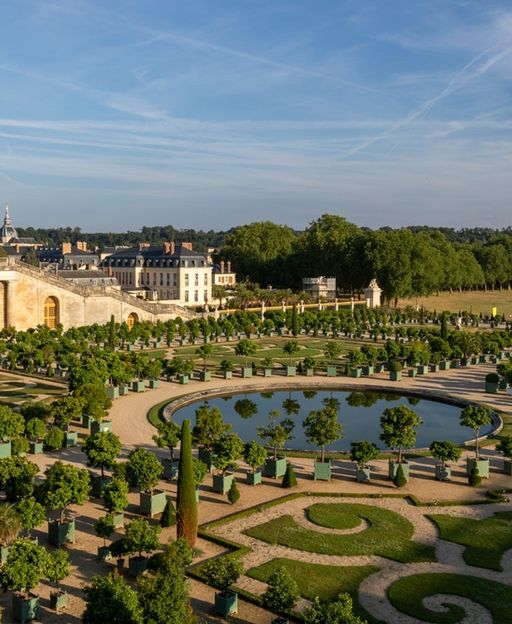
Most visitors to Versailles spend hours in the gardens without realising they are walking through a philosophical argument. Every straight path, every clipped hedge, every mirror-calm pond makes the same point. The French mind can improve on nature. And it has been saying so for 350 years.
The Man Who Changed How Europe Saw Gardens
André Le Nôtre was the son and grandson of royal gardeners, which might suggest a quiet life trimming hedges. Instead, he invented an entirely new idea: that a garden could be a demonstration of reason itself.
Before Le Nôtre, French gardens were formal but bounded — enclosed, geometric on a small scale, walled in on all sides. He threw out the walls. At Vaux-le-Vicomte, the private estate he designed for the finance minister Nicolas Fouquet in the 1650s, he built something France had never seen. Vast parterres of clipped box stretched to the horizon. Canals reflected the sky in perfect stillness. The landscape obeyed.
Louis XIV visited once. Then he had Fouquet arrested and hired Le Nôtre for himself.
What Le Nôtre Built at Versailles
The numbers at Versailles are almost impossible to grasp. More than 350 fountains. Thirty-five kilometres of trellised walkways. A Grand Canal 1.5 kilometres long, shaped like a cross. Eight hundred hectares of park, all of it precisely calculated.
But the scale is only part of the point. Le Nôtre designed the gardens so that every major axis aligns with the setting sun. Standing at the central windows of the château at dusk, the Grand Canal glows gold, perfectly framed. Nature did not arrange that. It was made to.
The Philosophy Hidden in the Hedges
The jardin à la française — the French formal garden — was not merely decoration. It was an argument.
French Enlightenment thinking held that reason could and should improve on raw nature. Wild forests and tangled undergrowth were not beautiful — they were disorder waiting to be solved. By clipping a hedge into a perfect green wall, by making water run in straight lines, by training a tree into a geometric cone, the French gardener was making a philosophical statement: human intelligence improves everything it touches.
The English had a different view. The English landscape garden — rolling lawns, serpentine lakes, trees positioned to look accidental — argued the opposite: that nature is most beautiful when it appears untouched. This was not merely a stylistic disagreement. It was a different way of seeing the world.
Enjoying this? 7,000 France lovers get stories like this every week. Subscribe free →
The Idea That Spread Across Europe
Louis XIV understood that gardens were power. When foreign dignitaries arrived at Versailles, they walked through a landscape that said, in stone and water and clipped lime trees: France is the most civilised place on earth.
The message worked. Within a generation, every royal court in Europe was planting à la française. Peter the Great commissioned Peterhof on the Gulf of Finland, designed by a pupil of Le Nôtre. The gardens of Het Loo in the Netherlands, La Granja de San Ildefonso in Spain, the Grosser Garten in Dresden — all carry the same idea, traced back to one French civil servant with an extraordinary eye for landscape and order.
Where to See It Today
Versailles is the obvious choice, but far from the only one. Vaux-le-Vicomte, an hour south-east of Paris, shows the garden that first caught the king’s eye — smaller than Versailles, but arguably more perfect. You can take in the entire design from the château steps without the crowds.
The Tuileries in Paris — the long garden running from the Louvre to the Place de la Concorde — is Le Nôtre’s work too, though remodelled over the centuries. Walk it on a weekday morning before the tourists arrive and you will understand something about Paris that no guidebook quite captures.
The Château de Chantilly, an hour north of Paris, has gardens Le Nôtre designed himself, with far smaller crowds than Versailles. If you are planning your trip to France, this is one worth adding to your list.
Every time you walk down a French allée — lime trees clipped to a perfect wall on either side, gravel crunching underfoot, the path running dead straight to the horizon — you are standing inside a 350-year-old argument. The French did not just build gardens. They built proof that beauty requires discipline. After all this time, it is very hard to disagree.
Join 7,000+ France Lovers
Three times a week, get France’s hidden gems, seasonal guides, local stories, and the art of la vie française — straight to your inbox.
Subscribe free — enter your email:
Free forever · Unsubscribe anytime
🇫🇷 You Might Also Love
Tours & experiences you might love


Powered by Viator. Some links are affiliate links — we may earn a small commission at no extra cost to you.

Leave a Reply