
The tour guide pauses at a section of carved oak panelling. She runs her finger along a gilded edge, presses once — and a small door springs open. Behind it, a dark compartment barely wider than a hand. There are 237 of these in this room alone. Every one was built for a queen who never stopped watching her back.
The Most Feared Woman in France
Catherine de Medici arrived in France at fourteen, married to the future King Henri II. She spoke with an Italian accent, came from a Florentine banking family, and was regarded as an outsider by the French court her entire life.
When her husband died — struck through the eye during a jousting tournament in 1559 — she became regent. Her three sons ruled in name. She governed in fact. Through their successive reigns she held France together during the Wars of Religion, the most violent period in the country’s history. Tens of thousands died. Noble families chose sides. The crown was constantly at risk. To survive that kind of politics, you needed more than intelligence. You needed secrets.
Château de Blois was where she kept them.
A Room Built for Suspicion
Her private study sits on the first floor of the François I wing. The room is small — barely larger than a generous bathroom. But the walls are something else entirely.
Floor to ceiling, they are covered in carved wooden panels. Elaborate, decorative, apparently innocent. Look closely and you will see the handles. Each panel conceals a hidden compartment, built into the wainscoting by craftsmen who were sworn to discretion. The joinery is immaculate — the seams nearly invisible even when you know what to look for.
What Catherine kept inside has been debated for five centuries.
The Poison Cabinet
The most dramatic theory — the one that guides love to tell, and that history has never fully shaken — is that this was her cabinet des poisons. Vials of arsenic, belladonna, and other compounds allegedly used to dispatch enemies who had outlived their usefulness.
The story stuck because the timing was often suspicious. Several rivals died unexpectedly during her years of power. She had a known interest in astrology and herbal medicine — fields barely separated from toxicology in the sixteenth century. Her Italian origins made her suspect to Protestant writers, who were happy to imagine the worst about a Catholic Italian queen.
What historians actually say is more measured. There is no direct evidence she poisoned anyone. What is beyond dispute is that she was secretive, politically calculating, and operating in an era when a carelessly worded letter could get you arrested. Whatever those compartments held — correspondence, valuables, medicines, personal documents — they were never meant to be seen.
Enjoying this? 7,000 France lovers get stories like this every week. Subscribe free →
Four Kings in One Courtyard
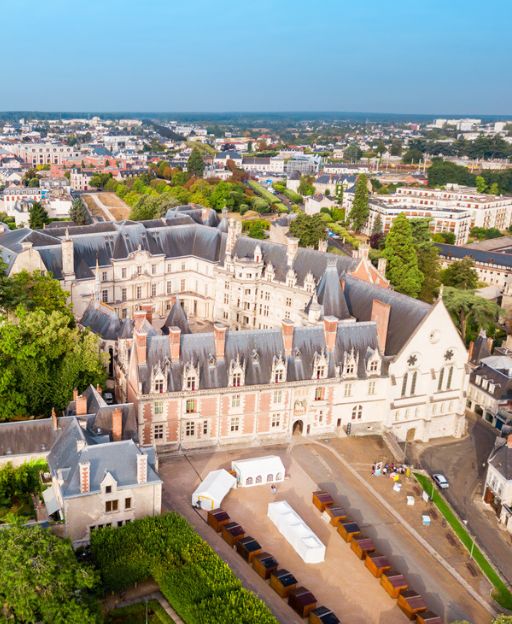
What makes Château de Blois extraordinary is not just Catherine’s legend. It is the building itself.
The main courtyard is bordered by four wings, each built by a different king in a different era. Walk fifty metres and you move from a medieval fortress corridor into a flamboyant Gothic staircase into a classical Renaissance arcade. Louis XII, François I, Gaston d’Orléans — every one of them left their mark on the same structure. No other château in France shows the evolution of royal architecture so completely in one place.
The town of Blois itself is underrated. It sits on the north bank of the Loire, a short train ride from Paris, and is compact enough to explore on foot. The old town rises steeply from the river, full of half-timbered houses and quiet squares. If you are planning a trip to the Loire Valley, Blois makes a far better base than the more crowded options further west.
Visiting Château de Blois
The château is open to visitors year-round. The Catherine de Medici study is part of the standard guided tour, and the moment when the guide opens the hidden panels is one of the more memorable things you will experience in any Loire Valley visit. It is not theatrics — the mechanism genuinely works, and has for five hundred years.
In summer evenings, the château stages a son et lumière — a sound-and-light show projected directly onto the stone façades after dark. It retells five centuries of royal drama in roughly forty-five minutes, using the actual building as the screen. It is theatrical, beautifully staged, and surprisingly moving.
A few kilometres away, the town of Amboise holds the château where Leonardo da Vinci spent the last three years of his life, and where he is buried. The Loire Valley, in other words, collects its extraordinary people and refuses to let go of them.
Stand in that small study and it is easy to understand what power looked like in the sixteenth century. Not armies and proclamations. Not ceremony. Just a small room, carved wood, and 237 locked doors. Some of those compartments are still sealed. Nobody knows what is inside.
Join 7,000+ France Lovers
Three times a week, get France’s hidden gems, seasonal guides, local stories, and the art of la vie française — straight to your inbox.
Subscribe free — enter your email:
🇫🇷 Discover the France Most Tourists Never Find
Get our free guide to 25 hidden villages of France — then join 7,000+ readers for weekly stories about places most guidebooks never mention.
Get Your Free Village Guide →Free forever · Unsubscribe anytime
🇫🇷 You Might Also Love
Tours & experiences you might love


Powered by Viator. Some links are affiliate links — we may earn a small commission at no extra cost to you.

Leave a Reply