
Most people know France has Roman history. Few realise that some of those Roman structures never stopped being used. Not preserved behind ropes. Not reconstructed for tourists. Actually used — for concerts, festivals, daily life — every single year for two thousand years.
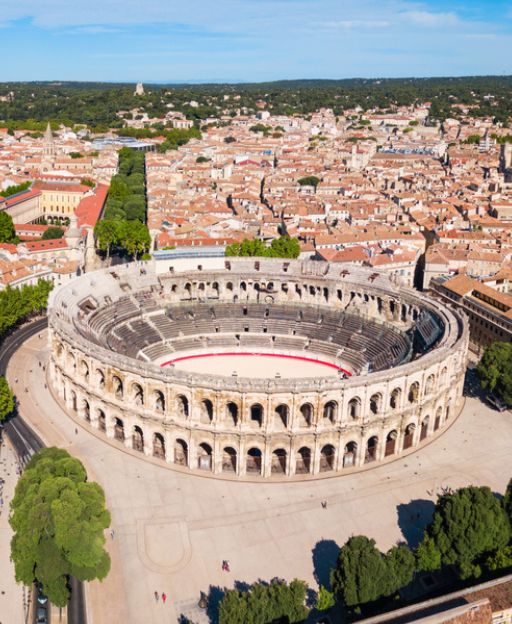
The Arena That Seats 24,000 — and Books Concerts
In the centre of Nîmes, in the south of France, sits a Roman amphitheatre built around 70 CE. It is one of the best-preserved in the world, and last summer it held rock concerts.
The Arènes de Nîmes was built to hold 24,000 spectators. Roman citizens watched gladiatorial fights here. Today, during the city’s famous férias — wild, week-long festivals — bullfights and flamenco nights fill the same stone tiers. The limestone seats are worn smooth by two millennia of use.
What makes Nîmes different from the Colosseum in Rome is this: it was never abandoned. In the Middle Ages, people moved inside it. Entire families lived within its walls. It became a small village of 700 people, complete with two chapels. The stones that Romans cut are the same stones you sit on today.
The Theatre That Still Hosts Opera
Fifty kilometres north-east of Nîmes, in the town of Orange, stands a Roman theatre built in the 1st century BCE. Its stage wall — 103 metres wide and 36 metres tall — is the best preserved in the world.
Every summer since 1869, the Théâtre Antique d’Orange hosts the Chorégies d’Orange, one of Europe’s oldest opera festivals. The acoustic design the Romans built into the stone is so precise that singers perform without microphones. The wall that once displayed a statue of Emperor Augustus still stands behind them.
UNESCO made it a World Heritage Site. The French just made it their summer plans.
Paris Has a Roman Amphitheatre Too
Most visitors to Paris never hear about the Arènes de Lutèce. Tucked behind quiet streets in the Latin Quarter, this Roman amphitheatre was built in the 1st century CE when Paris was still called Lutetia.
It was buried and forgotten for centuries, then rediscovered during construction works in 1869. Victor Hugo campaigned to save it. Today it is a public park — pensioners play pétanque on the old arena floor, children use the terraced seating as climbing steps, and locals eat their lunch on stones that once held 15,000 Romans.
There is no queue. No ticket. No audio guide. Just history, open to anyone who wanders through the gates.
Enjoying this? 7,000 France lovers get stories like this every week. Subscribe free →
Lyon: Where Rome Ran the Empire
Before Paris was the capital of France, Lyon was the capital of Roman Gaul. It was called Lugdunum, and it was one of the most important cities in the entire Roman Empire.
On the Fourvière hill above the city, two Roman theatres still stand. The Grand Théâtre seats 10,000 people. Every June, it hosts the Nuits de Fourvière festival — jazz, theatre, circus, and classical music performed in a space built by Roman engineers. The smaller Odéon beside it, with its geometric marble floor, was used for smaller performances in Roman times and still is today.
If you are planning a French heritage trip, Lyon rewards deep attention. Roman ruins sit a short walk from medieval traboules, Renaissance mansions, and some of France’s finest restaurants. Two thousand years of civilisation stacked on one hill.
The Bridge That Carried Water for 500 Years
The Pont du Gard is not a building you use. It is a building you stand beneath and feel small.
Built in the 1st century CE, this three-tiered aqueduct bridge carried fresh water 50 kilometres from a spring to the city of Nîmes. It is 49 metres tall. The Romans built it without mortar — each stone was cut so precisely that the structure held by weight alone. It kept carrying water until the 4th century CE.
You can swim in the Gardon river beneath it. Kayak past its arches. Eat lunch in its shadow. The area around it is part of a nature park, quiet and unhurried in the way that only the south of France manages. Start your trip to this region with our France travel planning guide — the south needs at least a week to do properly.
Why France Never Let These Places Decay
The Roman ruins of southern France survived because the people who came after never fully abandoned them. They were lived in, repurposed, fought over, built around. The Maison Carrée in Nîmes — a Roman temple so well preserved that Thomas Jefferson called it one of the most beautiful buildings he had ever seen — served as a church, a stable, a government archive, and a museum before becoming what it is today: a perfectly intact Roman temple in the middle of an ordinary French town.
That is the thing about Roman France. The ruins are not ruins. They are the walls of a civilisation that never quite finished.
The south of France — Provence, Occitanie, the Rhône valley — feels different to Paris. Older. Slower. More sure of itself. That confidence comes from knowing exactly where it stands in history: on the foundations Rome left behind. For more on what makes this region so special, read about the Provence town that shaped the world’s perfume industry — another piece of ancient heritage hiding in plain sight.
Sit in the Nîmes Arena on a warm evening, listening to music echo off the same stone walls that heard Roman crowds roar two millennia ago, and France stops feeling like a destination. It starts feeling like a memory you somehow already carry.
Join 7,000+ France Lovers
Three times a week, get France’s hidden gems, seasonal guides, local stories, and the art of la vie française — straight to your inbox.
Subscribe free — enter your email:
Free forever · Unsubscribe anytime
🇫🇷 You Might Also Love
Tours & experiences you might love


Powered by Viator. Some links are affiliate links — we may earn a small commission at no extra cost to you.

Leave a Reply