
Alsace Wine Route Travel Guide: What to See, Taste and Do
The Alsace Wine Route is one of France’s most rewarding road trips. Stretching roughly 170 kilometres through the foothills of the Vosges mountains in northeastern France, this route links dozens of villages that look as if they have been lifted from a fairy tale. Half-timbered houses painted in pastel shades, cobbled market squares, medieval fortifications perched on hilltops above the vines — and, at every turn, the promise of a glass of Riesling or Pinot Gris poured in a vine-draped courtyard. This guide tells you everything you need to plan your own journey along the Alsace Wine Route, from the best villages to the most memorable wine stops and the practical details that make the difference between a trip that works and one that doesn’t.
Love France? Join 7,000+ readers on our free newsletter → lovetovisitfrance.substack.com
What Is the Alsace Wine Route?
Known in French as the Route des Vins d’Alsace, this road was formally established in 1953, making it one of the oldest wine routes in France. It runs between Marlenheim in the north and Thann in the south, passing through around 70 wine-producing villages along the way. The scenery shifts gently as you travel — wide plains near the Rhine to the east, dense forest on the slopes of the Vosges to the west, and the vines themselves occupying the gentle mid-ground where the soil and climate conspire to produce some of France’s most distinctive whites.
Alsace occupies a unique position in French culture and history. The region changed hands between France and Germany four times between 1871 and 1945, and that turbulent past shows in everything from the architecture to the food to the dialect still spoken by older residents. The wines, too, are distinct: Alsace is the only region in France where wines are labelled by grape variety rather than by appellation, a tradition inherited from German wine culture. That makes choosing a bottle refreshingly straightforward.
The Best Villages on the Alsace Wine Route
Riquewihr
Consistently ranked among the most beautiful villages in France, Riquewihr has preserved its medieval core almost entirely intact. The village sits behind ramparts that date from the 13th century, and the main street — the Rue du Général de Gaulle — is lined with wine merchants, artisan shops and restaurants housed in buildings that have changed little since the 16th century. The village escaped serious damage in both world wars, which is partly why it feels so untouched. Riquewihr is the home village of Hugel, one of Alsace’s most celebrated wine houses, and their cellar has been in continuous operation since 1639.
Ribeauvillé
A short drive north of Riquewihr, Ribeauvillé is a working market town as well as a wine village, which gives it a more everyday feel than some of its more polished neighbours. The grand rue is lined with fountains and half-timbered houses, and above the town three medieval castles — the Girsberg, Saint-Ulrich and Haut-Ribeaupierre — crown successive ridges. The walk up to Saint-Ulrich, the best-preserved of the three, takes about 40 minutes from the town centre and offers sweeping views across the Rhine valley to the Black Forest.
Colmar
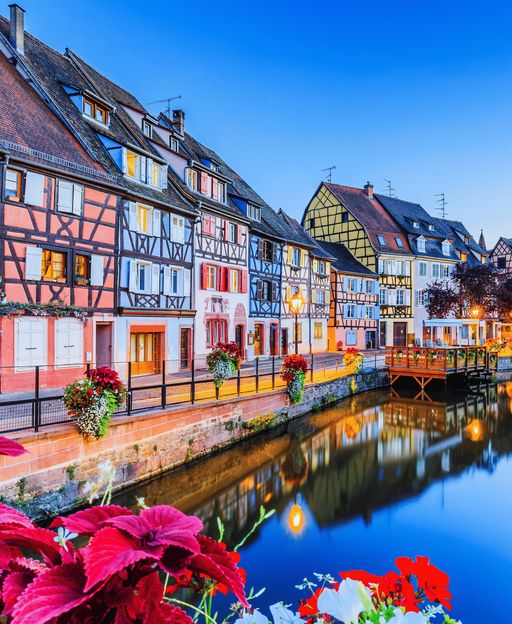
Colmar is the largest town on the route and the undisputed capital of Alsatian wine culture. Its historic quarter, known as Little Venice, is a network of canals lined with brightly painted merchants’ houses that once stored and shipped wine along the waterways. The Musée d’Unterlinden, housed in a 13th-century convent, holds the Isenheim Altarpiece — one of the most important works of German Renaissance art. Colmar makes an excellent base for exploring the route, with good train connections to Strasbourg and a wide choice of hotels and restaurants.
Kaysersberg
Kaysersberg sits at the opening of a narrow valley leading into the Vosges and has the feel of a village that knows it is special but hasn’t let that go to its head. The covered bridge over the Weiss river, the fortified keep above the town, and the streets of Renaissance-era houses make it one of the most photographed spots on the route. Kaysersberg is also the birthplace of Albert Schweitzer, and a small museum in his family home charts his life and work. The local wine — particularly the Riesling and Gewurztraminer from the grand cru vineyards above the valley — is outstanding.
Obernai
At the northern end of the route, Obernai is a larger town with a lively market square, the Place du Marché, that hosts one of Alsace’s most atmospheric Christmas markets in December. The town well, the corn market and the belfry of the old town hall are all medieval, and the surrounding vineyards produce good Pinot Blanc and Sylvaner. Obernai is only 30 kilometres from Strasbourg, making it a natural first or last stop on a route trip starting from the city.
The Wines of Alsace: What to Drink
Alsace produces almost exclusively white wine, with Pinot Noir as the only permitted red. The main varieties you’ll encounter are:
- Riesling — The region’s most celebrated variety. Alsace Riesling is dry (unlike many German versions), with high acidity, mineral depth and the ability to age for decades. Grand cru Rieslings from vineyards like Schlossberg above Kaysersberg are among France’s finest whites.
- Gewurztraminer — Immediately recognisable by its heady aroma of roses, lychee and spice. Rich and full-bodied, it pairs remarkably well with the local cuisine, particularly the cheese course and foie gras.
- Pinot Gris — Sometimes labelled Tokay d’Alsace on older bottles. Fuller than most whites, with notes of honey, smoke and ripe stone fruit. Excellent with pork dishes and choucroute.
- Pinot Blanc — A lighter, everyday wine. Often used as the base for Crémant d’Alsace, the region’s excellent sparkling wine.
- Muscat d’Alsace — Dry (unusually for Muscat anywhere else in the world), with an intensely floral, grapey character. Drink it young as an aperitif.
Look out for the designation Alsace Grand Cru on bottles — this applies to 51 named vineyard sites and represents the region’s finest terroir. Vendange Tardive (late harvest) and Sélection de Grains Nobles (noble rot) are the sweet wine categories, produced in small quantities and only in exceptional years.
For more on how French wine labelling works and the controversies it has sparked, see our piece on the wine scandal that changed how every bottle in the world is labelled. And if you’re curious about the natural wine movement that’s reshaping what France drinks, read about the French wine movement that has divided the country — and won.
Food Along the Alsace Wine Route
Alsatian food is hearty, generous and deeply influenced by German and Central European traditions. It makes perfect sense alongside the region’s wines, which were always designed to accompany food rather than be sipped in isolation.
Choucroute garnie is the dish most associated with Alsace — fermented cabbage (sauerkraut) served with a variety of pork cuts, sausages and potatoes, accompanied by a bottle of dry Riesling. It’s the kind of meal that requires no other plans for the afternoon. Tarte flambée (flammekueche in the local dialect) is thinner and lighter — a wood-fired flatbread topped with crème fraîche, onions and lardons that makes an ideal lunch. Baeckeoffe is a slow-cooked casserole of meat and root vegetables that was traditionally left with the village baker to cook in a sealed earthenware pot while families went to Sunday mass. Munster cheese, produced in the valley of the same name in the Vosges, is pungent and runny, best eaten with caraway seeds and a glass of Gewurztraminer.
The region also has a strong tradition of winstub — informal wine taverns, often family-run, that serve regional specialities in relaxed surroundings. These are where locals eat, and they are almost always better value than the tourist-facing restaurants in the main squares.
Practical Information: How to Drive the Route
How long does it take?
You can drive the full length of the route in a single day, but that would be to waste it entirely. Three to four days is a comfortable minimum if you want to visit a handful of villages, taste wines and eat properly. A week allows you to explore more deeply, including detours into the Vosges for walking, and side trips to Strasbourg.
When to go
The route is accessible year-round, but the most dramatic times to visit are late September to mid-October (harvest season, when the vineyards are at their most active), and December (Christmas markets in every village). Summer is busy but beautiful. Spring, particularly May and June, brings flowering vines and relatively few crowds. Avoid the August bank holiday weekends if you dislike queues.
How to get there
Strasbourg has a major international airport with direct flights from many European cities. From the UK, Eurostar connections via Paris take around five hours to Strasbourg. Car hire is available at Strasbourg airport and train station. The route itself is best done by car, though cycling is popular — a well-marked cycling path runs alongside much of the route on quieter roads through the vineyards.
Where to stay
Colmar has the widest choice of accommodation and the best transport links. For a more immersive experience, many of the smaller villages have chambres d’hôtes (bed and breakfast accommodation) and small hotels, often run by wine-producing families. Booking ahead is essential in summer and during the December market season.
Enjoying this? 7,000 France lovers get stories like this every week. Subscribe free →
Beyond the Wine: Other Things to See in Alsace
Strasbourg
The regional capital deserves at least a full day. The Gothic cathedral of Notre-Dame de Strasbourg dominates the skyline and took over 400 years to complete. The Petite France quarter, with its 16th-century tanner’s houses reflected in the canals of the Ill river, is one of the most beautiful urban landscapes in France. Strasbourg is also the seat of the European Parliament and the Council of Europe, giving it a distinctly international character quite unlike anywhere else in the region.
Château du Haut-Koenigsbourg
Perched on a rocky spur above Kintzheim, this vast medieval fortress was restored in the early 20th century for Kaiser Wilhelm II and offers extraordinary views across the Rhine plain toward the Black Forest. The restoration is thorough and sometimes theatrical, but the castle’s history — it was repeatedly destroyed and rebuilt over five centuries — is genuinely fascinating.
The Route des Crêtes
The ridge road running along the crest of the Vosges mountains, built during the First World War to keep troop movements out of sight of German observers, offers sweeping views over Alsace to the east and the Lorraine plateau to the west. Several peaks are accessible without four-wheel drive, and the high pastures are scattered with chaumes — traditional stone farmhouses serving local food, including the Munster cheese produced on site.
You Might Also Enjoy
- Burgundy Travel Guide: Wine, Châteaux and Medieval Villages
- The Loire Valley Château With 237 Secret Hiding Places — and Why They Were Built
- French Alps Travel Guide: Planning Your Visit
Plan Your France Trip
Ready to start planning your journey to Alsace or beyond? Our France trip planning hub brings together everything you need — from choosing the right regions and getting around to the best time of year to visit. It’s the best place to start building your itinerary.
Join 7,000+ France Lovers
Three times a week, get France’s hidden gems, local recipes, and travel inspiration — the kind you won’t find in any guidebook.
Subscribe free — enter your email:
Free forever · Unsubscribe anytime
🇫🇷 You Might Also Love
Tours & experiences you might love


Powered by Viator. Some links are affiliate links — we may earn a small commission at no extra cost to you.

Leave a Reply