
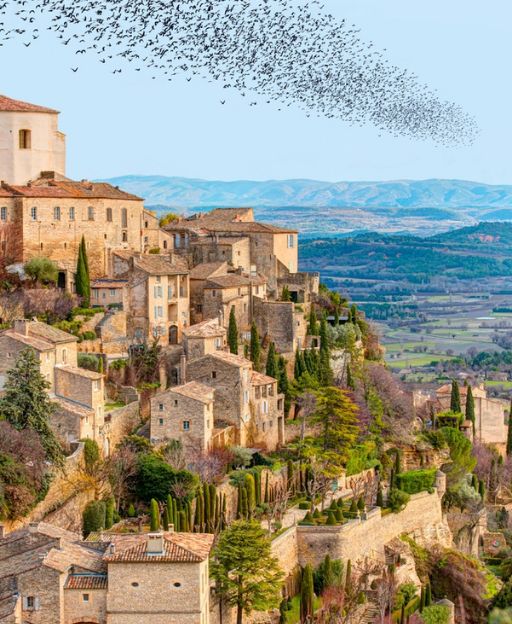
The first time you see Gordes, you almost stop the car. Stone towers rise straight from a cliff edge. Narrow streets disappear into shadows between ancient walls. The whole village seems to be growing out of the rock. And then it hits you — this was never built for beauty.
When the View Was a Warning Sign
Every hilltop village in Provence tells the same story. The position was chosen for one reason: you could see trouble coming.
From the ridge above Les Baux, you can see 30 kilometres in every direction. From Bonnieux, the valley below unfolds like a map. From Roussillon, the red ochre cliffs glow at sunset — but the real advantage was always the vantage point.
These villages were lookout posts long before they were homes.
What They Were Running From
The medieval centuries were brutal in Provence. Armies crossed this land constantly — Romans, Visigoths, Saracens, and later the armies of competing nobles who carved the region into warring territories.
Lowland settlements were raided and burned. Communities learned quickly. The higher you built, the harder you were to reach.
Some villages had a single entrance — a narrow gate that one man with a sword could hold. Others had walls four metres thick. Gordes sits on a limestone plateau with a sheer drop on three sides. It wasn’t picturesque. It was strategic.
Life Inside the Walls
Living on a clifftop in the Middle Ages was not comfortable. Water had to be carried up from springs in the valley. Crops grew on terraced fields carved into the hillside by hand. Every stone of every house was lifted up narrow, winding lanes.
Women made the climb daily to communal washing basins. Men descended before dawn to tend vines and olive groves below. Children grew up knowing the exact width of every alley in the village — because in an emergency, those alleys became escape routes.
The villages developed a shared architecture almost by necessity. Houses were built touching each other, sharing walls for warmth and defence. The church always stood highest — not just for spiritual reasons, but because the bell tower doubled as a watchtower.
🇫🇷 Discover the France Most Tourists Never Find
Get our free guide to 25 hidden villages of France — then join 7,000+ readers for weekly stories about places most guidebooks never mention.
Get Your Free Village Guide →The Villages That Still Stand
Provence has more villages perchés than almost anywhere in Europe. Some are well-known. Others barely appear on maps.
Gordes is the most photographed — golden limestone cascading down a clifftop above the Luberon valley. In summer it fills with tourists. In October, in the early morning, it is almost empty, and the light turns everything amber.
Les Baux-de-Provence sits on a ridge of white rock so dramatic it looks carved by hand. The ruined castle above the village was once home to one of the most powerful noble families in the south of France.
Bonnieux looks across the Luberon valley to its sister village Lacoste. On a clear morning, they can see each other through the mist — two stone crowns on opposite ridges, watching each other across five centuries.
Roussillon sits on cliffs of red ochre, the same pigment that painters have used for centuries. The village itself seems to glow from inside at golden hour.
Why People Keep Climbing
These villages could have been abandoned. Some in France were. Population drifted to the valleys when roads improved and the need for defence disappeared.
But in Provence, people stayed. Artists came first — drawn by the quality of light. Then writers, potters, photographers. They found something in the slowness of clifftop life, in the way sound travels differently at altitude, in the morning light against old stone.
Life found a new rhythm. The afternoon game that every Provençal village takes deadly seriously settled into the shaded squares below the church. Cafés opened in the old gatehouse arches. The defensive walls became the best seats in town.
If you’re planning a visit to Provence, the villages perchés deserve more than a quick stop and a photograph. Arrive before 9am. Walk slowly. Look at the doorways — many are five hundred years old and still in daily use. You can start with our guide to planning your trip to France to build your route.
These are not tourist constructions. They are places where people survived. And then chose to stay.
That’s the feeling no photograph quite captures. You’re not just visiting a picturesque village. You’re standing in a place that people held onto, generation after generation, because there was nowhere else they’d rather be. That’s worth the climb.
Join 7,000+ France Lovers
Three times a week, get France’s hidden gems, seasonal guides, local stories, and the art of la vie française — straight to your inbox.
Subscribe free — enter your email:
Free forever · · Unsubscribe anytime
🇫🇷 You Might Also Love
Tours & experiences you might love


Powered by Viator. Some links are affiliate links — we may earn a small commission at no extra cost to you.

Leave a Reply