The Hundred Years’ War shaped France more than almost any other event in its history. It lasted from 1337 to 1453 — a stretch of 116 years. England and France fought again and again across those long decades. Cities burned. Crops failed. Whole regions emptied out. But by the end, France stood as a united kingdom with a clear sense of who it was. The Hundred Years’ War, in short, made France French.
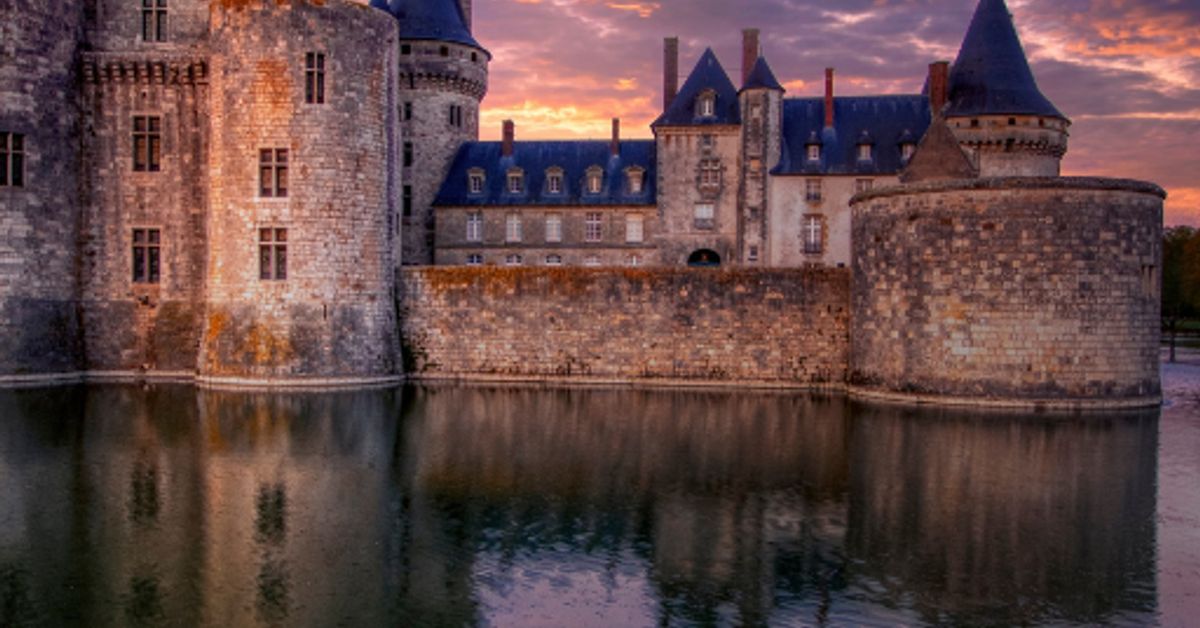
The Château de Sully-sur-Loire was built in the 1390s. It rose from the ground while the war was still raging. Joan of Arc visited in 1429. For many French people, these stones are as much about identity as they are about history.
If you have French roots, your ancestors lived through this war. It touched every corner of France.
It Wasn’t One War — It Was Many
The name is misleading. The Hundred Years’ War wasn’t a single non-stop conflict. It was a series of campaigns separated by long truces. Years of uneasy peace gave way to sudden violence. Plagues swept through both sides. The same cities changed hands several times over. Think of it less as one war and more as a century of struggle over a single question: who rules France?
That question had a very clear answer at the start. Then the ground shifted — and kept shifting — for more than a hundred years.
A Throne Without an Heir
The trouble began in 1328. France’s King Charles IV died without a son. Two men claimed the right to succeed him. One was Philip of Valois, a French noble and cousin to Charles. The other was Edward III of England. Edward’s mother was the daughter of a French king, and he believed this gave him a rightful claim to the throne.
French nobles disagreed. They chose Philip. Edward accepted this at first. But tensions rose over trade rights, territory in Gascony, and deeper questions of power. In 1337, Philip seized Gascony — a large and wealthy region in southwest France where the English had long held influence.
Edward responded by formally claiming the throne of France. The war had begun.
Early English Victories
The first decades of fighting went badly for France. At the Battle of Crécy in 1346 — fought on Norman soil — English longbowmen cut down the French cavalry. It was a crushing defeat.
Three years later, the Black Death arrived in France. It killed millions. Both sides buried their dead and tried to recover.
War resumed. In 1356, Edward the Black Prince captured the French king himself at the Battle of Poitiers. France paid a vast ransom. The English signed a treaty and took control of large parts of southwestern France.
For a time, it looked as though England might win outright. But France refused to accept defeat.
🇫🇷 Enjoying this? 7,000 France lovers get stories like this every week. Subscribe free →
The French Fight Back
Charles V of France turned things around in the 1360s and 1370s. He rebuilt his army and avoided big pitched battles. Instead, his general Bertrand du Guesclin harassed English troops, cut off their supplies, and retook town after town. By 1380, England held very little of France outside Bordeaux and Calais.
Then both kings died. Both countries fell into internal crises. The war paused — but did not end.
The Normans who had once conquered England from France now found themselves caught between two crowns. Normandy changed hands more than once. Its people paid the price.
Henry V and the Fall of France
In 1415, the English returned in force. Henry V led his army through Normandy. At Agincourt, he met a French force far larger than his own — and beat it. The defeat was devastating for France.
Henry pressed on. He conquered Normandy. In 1420, the Treaty of Troyes forced France to accept Henry as heir to the French throne. He married the French king’s daughter. France looked broken.
Then Henry V died suddenly in 1422. His infant son Henry VI inherited two kingdoms. But France wasn’t done.
Joan of Arc and the French Revival
In 1429, a teenage girl arrived at the court of the uncrowned French prince, Charles VII. She came from a village in Lorraine. Her name was Joan of Arc. She said God had told her to drive the English from France.
Charles gave her command of part of his army. Joan raised the English siege of Orléans in just nine days. She stood at Charles’s side when he was crowned king at Reims — the city where French kings had always been crowned.
Her victories changed everything. The French found belief again. Joan of Arc remains one of the most remarkable figures in French history — and one of the most studied.
Joan was captured by Burgundian allies of England in 1430. She was put on trial for heresy and burned at the stake in Rouen in 1431. She was nineteen years old.
But the cause she had reignited kept burning. France pushed on without her.
The End of the War
The French retook territory step by step. Normandy fell in 1450. Gascony followed in 1451. At the Battle of Castillon in 1453, French artillery destroyed the English army. It was the first major battle in European history decided mainly by cannons and gunpowder.
There was no formal peace treaty. The war simply stopped. England held only Calais, which it would lose a hundred years later. The long conflict was over.
What the War Left Behind
The Hundred Years’ War changed France in ways that still shape the country today.
A single national identity. Before the war, France was a loose collection of regions. Many people thought of themselves as Normans, Gascons, or Bretons first. A century of shared struggle — and shared loss — began to change that. Joan of Arc gave France a story to tell about itself. That story shaped a nation.
A professional army. Medieval French armies had depended on noble knights. The war proved that wasn’t enough. France built a standing royal army, equipped with artillery. That army secured France’s borders and ended the era of English occupation.
French as the language of the realm. During the war, the French crown used the French language to unite people behind the king. Latin gave way to French in official documents. National feeling born in the war drove this change forward.
A changed map of Europe. England lost almost all its territory on the Continent. Both countries pulled back within their own borders. France became more unified than it had been in centuries.
Where to See the Hundred Years’ War Today
Many of the war’s key sites survive and are easy to visit.
Château de Sully-sur-Loire, Loire Valley. Built in the 1390s, right in the thick of the conflict. The thick walls and wide moat tell you exactly what it was built for. Joan of Arc visited here after the coronation at Reims. The château stands remarkably intact.
Reims Cathedral, Champagne. This is where Charles VII was crowned king of France in 1429, with Joan of Arc beside him. It is one of the great Gothic cathedrals of Europe. Standing inside it today, the history is very close.
Place du Vieux-Marché, Rouen, Normandy. This square marks the spot where Joan of Arc was burned at the stake in 1431. A modern church stands there now. The combination of medieval history and quiet reflection makes it one of the most powerful places in France.
Château de Vincennes, near Paris. Henry V died here in 1422. The medieval keep — one of the tallest in France — still stands. It gives a real sense of the period.
Azincourt, Pas-de-Calais. The village of Azincourt has a small museum telling the story of the 1415 battle. It is a quiet and moving place, far from the tourist crowds.
If you have French ancestors from Normandy, Gascony, Champagne, or the Loire Valley, their lives were shaped by this war. Who they married, where they lived, which town they fled — all of it happened against this backdrop. Planning a heritage trip to France is one of the most powerful ways to connect with that story.
Want to trace your French family back through the records? Our complete guide to tracing your French ancestry is a good place to start.
Frequently Asked Questions
How long did the Hundred Years’ War actually last?
Despite its name, the Hundred Years’ War lasted 116 years — from 1337 to 1453. It wasn’t a continuous conflict. Long truces separated major campaigns, and both sides suffered from the Black Death, internal rebellions, and political crises in between the fighting.
Who won the Hundred Years’ War?
France won. By 1453, the English had been driven out of almost all their territory in France. England held only Calais on the French coast, and even that was lost in 1558. France emerged from the war as a unified kingdom, while England turned its attention back to its own affairs.
What role did Joan of Arc play in the war?
Joan of Arc turned the tide of the war in 1429. She led French forces to relieve the siege of Orléans. She helped Charles VII reclaim his throne — his coronation at Reims was the turning point. Her victories gave France renewed belief at a critical moment. She was captured and executed in 1431, but France kept winning after her death.
Where did the Hundred Years’ War take place?
Most of the fighting took place in France — particularly in Normandy, Gascony, the Loire Valley, and northern France. Key battles were fought at Crécy in Normandy (1346), Poitiers in western France (1356), and Agincourt in northern France (1415). The siege of Orléans (1428–1429) was one of the most important events of the war.
Why is the Hundred Years’ War important to French history?
The war turned France from a loosely connected collection of regions into a unified national kingdom. It created a shared French identity. It gave rise to a professional royal army. It promoted the French language across the whole kingdom. And it produced national heroes — above all Joan of Arc — whose stories France still tells about itself today.
You Might Also Enjoy
- Joan of Arc: Why France’s National Hero Still Matters — the full story of France’s most famous figure, from Lorraine to the stake at Rouen.
- The Normans Who Changed the World — how Viking settlers in northern France became the people who conquered England in 1066.
- The French Revolution: How France Changed the World Forever — the events of 1789 that ended the monarchy and sent shockwaves across Europe.
Plan Your France Trip
Ready to explore the châteaux, battlefields, and cathedrals of France? Our complete France trip planning guide covers everything from getting there to finding the best places off the beaten track.
Join 7,000+ France Lovers
Every week, get France’s hidden gems, seasonal guides, local stories, and the art of la vie française — straight to your inbox.
Subscribe free — enter your email:
Love more? Join 64,000 Ireland lovers → · Join 43,000 Scotland lovers → · Join 30,000 Italy lovers →
Free forever · One email per week · Unsubscribe anytime
Tours & experiences you might love


Powered by Viator. Some links are affiliate links — we may earn a small commission at no extra cost to you.

Leave a Reply