
In the summer of 1494, a young French king crossed the Alps with an army and returned home carrying something far more enduring than military glory. Charles VIII had gone to Italy to press a dynastic claim to Naples. What he brought back instead was a vision of a world remade — one of marble colonnades, painted ceilings, sculpted gardens, and a philosophy that placed human possibility at the centre of everything. The Italian Renaissance had come to France, and nothing would ever be quite the same again.
For those of us who carry French heritage in our blood — whether our ancestors were Acadian settlers, Huguenot refugees, or Québécois farmers who crossed the Atlantic in the seventeenth century — this moment in history is more than a footnote. The Renaissance did not merely redecorate French palaces. It reshaped the French language, the French table, French law, and French identity. It forged the very culture that our forebears brought with them across the ocean.
Charles VIII, Francis I, and the Italian Obsession
Charles VIII’s invasion of Italy in 1494 is often remembered as a military adventure that ended in strategic failure. But as a cultural catalyst, it was a triumph beyond measure. The young king was mesmerised by what he encountered: the palaces of Naples and Florence, the workshops of Florentine craftsmen, the intellectual fervour of humanist scholars. He returned to France with twenty-two Italian artists, craftsmen, and gardeners in his retinue. It was an act of cultural kidnapping that would flower into one of history’s great artistic revolutions.
Yet it was Charles’s successor, Francis I, who truly ignited the French Renaissance. Reigning from 1515 to 1547, Francis was one of the most culturally ambitious monarchs Europe had ever seen. A soldier-king of enormous physical presence, he was equally at home discussing Platonic philosophy as he was leading a cavalry charge. He corresponded with Erasmus, collected manuscripts from across the Mediterranean world, and poured the considerable wealth of the French crown into transforming the Loire Valley and the Île-de-France into a showcase of Renaissance magnificence.
Francis did not merely import Italian art — he imported Italian artists. Among them was a white-haired Florentine genius then in his sixties, who arrived at the French court in 1516 with three paintings rolled under his arm. One of them was a small portrait of a Florentine merchant’s wife, painted on poplar wood, which we now know as the Mona Lisa. Leonardo da Vinci had come to France, and he would never return to Italy.
Leonardo’s Last Chapter: Amboise and the Clos Lucé
The Château du Clos Lucé, a modest manor house connected to the royal Château d’Amboise by an underground tunnel, became Leonardo da Vinci’s home for the final three years of his life. Francis I gave him the title Premier Painter, Engineer and Architect to the King, along with a generous pension and the freedom to think, sketch, and dream without commercial pressure. Leonardo was sixty-four when he arrived and in declining health, his right hand weakened by what many historians believe was a stroke. He painted little. Instead, he filled his notebooks with designs for canal systems, festival decorations, urban planning schemes, and a proposed new palace at Romorantin.
When we visit the Clos Lucé today — and we would strongly urge any heritage traveller to make the short journey from Tours — there is something deeply moving about standing in those modest rooms. Here, in this quiet corner of the Loire Valley, one of the greatest minds in human history spent his last days in conversation with a French king who valued him not for what he could produce but for what he knew. Leonardo died at Amboise in May 1519, reportedly in the arms of Francis I, though historians treat that detail with scepticism. The emotional truth of it, however, seems entirely right.
The relationship between Leonardo and Francis captures something essential about the French Renaissance: it was not simply a borrowing of Italian forms, but a genuine intellectual encounter, a dialogue between two cultures that produced something new. France did not merely become a provincial copy of Italy. It developed its own Renaissance character — more formal, more architectural, more closely bound to royal power and national identity.
Chambord, Fontainebleau, and the Architecture of Ambition
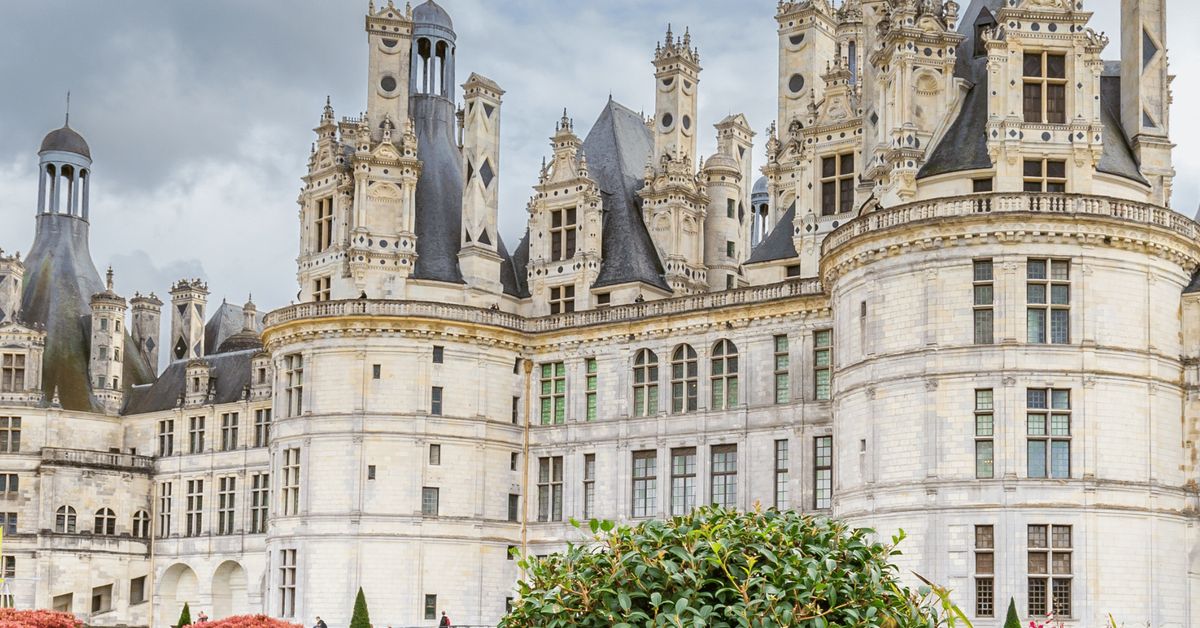
No building in France embodies this hybrid genius more perfectly than the Château de Chambord. Begun in 1519 — the same year Leonardo died — Chambord remains one of the most astonishing structures ever built. Its famous double-helix staircase, which allows two people to ascend and descend simultaneously without ever meeting, bears such a strong resemblance to Leonardo’s sketches that many art historians believe he contributed to the design before his death, or that his ideas were carried forward by his pupil Domenico da Cortona.
Chambord’s roofscape is unlike anything in Italy or anywhere else: a forest of chimneys, dormers, lanterns, and turrets that turns the French tradition of the turreted château into something hallucinatory and sublime. Francis never finished it and never lived there for long — it was a hunting lodge of almost insane grandeur, a statement of royal magnificence addressed to the entire world. Today it stands in its vast game forest as one of the great monuments of European civilisation, and for anyone tracing French heritage, a visit to Chambord is a pilgrimage to the moment France announced itself to the world.
At Fontainebleau, the influence was different but equally profound. Francis commissioned the Florentine painter Rosso Fiorentino and then Francesco Primaticcio to decorate his new palace south of Paris. What emerged from their workshops was the School of Fontainebleau — a distinctly French synthesis of Italian Mannerism, Flemish realism, and French decorative sensibility. The long gallery of Francis I at Fontainebleau, with its extraordinary combination of painted panels and high-relief stucco figures, set the template for French interior decoration for the next two centuries and can be traced in a direct line to the Hall of Mirrors at Versailles and, ultimately, to the revolutionary moment when all that royal splendour was called to account.
Beyond the Arts: How the Renaissance Reshaped French Life
The transformation Charles VIII and Francis I set in motion was not confined to painting and architecture. The Italian Renaissance carried with it a revolution in ideas that touched every corner of French life.
The French language itself was a casualty — and a beneficiary — of this encounter. The Ordinance of Villers-Cotterêts, signed by Francis I in 1539, established French (rather than Latin) as the language of law and administration throughout the kingdom. This was a Renaissance act: the humanists had argued that the vernacular languages were worthy vehicles for serious thought, and Francis’s ordinance put that principle into law. For Acadian and French-Canadian families whose ancestors preserved the French language across centuries of English colonial pressure, this royal decree is in many ways the founding document of their cultural identity.
French cuisine, too, was transformed by the Italian connection. Catherine de’ Medici, who married the future Henri II in 1533, is credited in French culinary mythology with introducing forks, refined table manners, and a host of Italian dishes to the French court. Historians now treat many of these claims sceptically — French cooking was already sophisticated, and the influence was more gradual and mutual than the legend suggests. But the broader point stands: the Renaissance brought to France a new culture of the table, a philosophy of pleasure and refinement in eating that would eventually produce the culinary tradition that French emigrants carried with them to Quebec, Acadia, and Louisiana.
In philosophy and law, the impact was equally lasting. The French Renaissance produced Michel de Montaigne, whose Essais — published in 1580 — invented a new form of literature and a new mode of self-examination. Montaigne’s willingness to use his own experience, his own doubts and contradictions, as the raw material of thought is a Renaissance inheritance that shaped French intellectual culture for centuries. The legal tradition, too, was deepened by humanist scholarship: jurists trained in the new methods of textual analysis brought greater rigour and sophistication to French law, laying groundwork that persisted through the revolutionary codes of the eighteenth century and into the legal frameworks of New France.
A Heritage That Crossed the Ocean
When the ancestors of today’s Acadian, Québécois, and Huguenot diaspora left France — whether by choice in the great migrations of the seventeenth century or by force in the Acadian deportations of the 1750s — they carried with them a culture already deeply shaped by the Renaissance encounter with Italy. The French language they spoke had been standardised and elevated by Francis I’s reforms. The Catholic faith they practised had been hardened and refined by the Counter-Reformation that the Protestant challenge (itself partly a product of Renaissance humanism) had provoked. The cooking traditions, the legal customs, the very way they organised community life — all bore the imprint of a transformation that had begun with a young king crossing the Alps more than a century before their departure.
For Huguenot descendants in particular, the story has an additional layer of complexity. The religious wars that tore France apart in the second half of the sixteenth century were in part a product of the Renaissance: the new humanist methods of Biblical scholarship had made possible the Reformation critiques of the Catholic Church, and France’s Huguenot communities were among the most intellectually vibrant products of that ferment. When the Edict of Nantes was revoked in 1685 and Huguenots fled to England, the Dutch Republic, Prussia, and South Africa, they scattered seeds of French Renaissance culture across the world.
We find, when we trace these threads, that the story of the French Renaissance is not a story about kings and artists alone. It is the story of a civilisation in transformation, a culture gathering the best of what it encountered and making it unmistakably its own. That capacity for assimilation and reinvention is itself a French inheritance — one that survived the Atlantic crossing and the hardships of the new world with remarkable tenacity. To plan your own journey through these remarkable sites and stories, our French heritage planning hub is the ideal starting point.
Frequently Asked Questions
When did the French Renaissance begin?
The French Renaissance is generally dated from Charles VIII’s Italian campaign of 1494, when the French king first encountered the culture of Renaissance Italy and began importing Italian artists and craftsmen. The movement reached its height under Francis I (reigned 1515–1547), who brought Leonardo da Vinci to France and commissioned the great Loire châteaux and the Fontainebleau palace. By the mid-sixteenth century, France had developed its own distinctive Renaissance character, blending Italian influence with deep French traditions in architecture, language, and the arts.
Did Leonardo da Vinci really live in France?
Yes — Leonardo da Vinci spent the last three years of his life in France, from 1516 until his death in May 1519. Invited by Francis I with the title of Premier Painter, Engineer and Architect to the King, Leonardo lived at the Château du Clos Lucé in Amboise, connected by an underground tunnel to the royal château. He brought with him several of his greatest paintings, including what is now the Mona Lisa. Though his health prevented much painting during these years, he continued to fill his notebooks with designs and ideas. He died at Amboise and was buried in the collegiate church of Saint-Florentin, though his remains were later moved and their final location remains uncertain.
What was the School of Fontainebleau?
The School of Fontainebleau refers to two distinct phases of artistic activity centred on the royal palace of Fontainebleau, south of Paris. The First School (roughly 1530–1570) was established by Francis I, who brought the Florentine Mannerist painters Rosso Fiorentino and Francesco Primaticcio to France to decorate his new palace. Their combination of elongated figures, complex allegory, and innovative stucco-and-fresco decorative schemes created a distinctly French form of Mannerism that influenced painting, printmaking, and decorative arts across northern Europe. The Second School (roughly 1594–1610) emerged under Henri IV and included both French and Flemish artists working in a slightly more naturalistic style. Together, the two schools represent France’s most original contribution to Renaissance visual culture.
How did the Renaissance affect the French language?
The Renaissance had a profound and lasting effect on the French language in several ways. Most significantly, Francis I’s Ordinance of Villers-Cotterêts (1539) established French rather than Latin as the official language of law and royal administration throughout France — a landmark moment in the history of the language. At the same time, humanist scholars were enriching and standardising written French: the poets of the Pléiade group, led by Pierre de Ronsard and Joachim du Bellay, published their Défense et Illustration de la Langue Française in 1549, arguing for the elevation of French to a literary language equal to Latin and Greek. Italian loanwords entered the language in large numbers — particularly in the fields of art, architecture, military affairs, and food. The French that Acadian and Québécois settlers carried to the New World in the seventeenth century bore the full imprint of these Renaissance reforms.
Where in France can I see the Renaissance legacy today?
The most concentrated surviving evidence of the French Renaissance lies in the Loire Valley, now a UNESCO World Heritage Site. The Château de Chambord, begun in 1519, is perhaps the most spectacular single monument — its extraordinary roofscape and famous double-helix staircase represent Renaissance architecture at its most inventive. The Château d’Amboise and the adjacent Clos Lucé (where Leonardo lived and died) offer an intimate connection to the personal history of the Renaissance. Azay-le-Rideau, Chenonceau, and Villandry each show different facets of the Loire Renaissance. Further afield, the Château de Fontainebleau preserves the galleries that defined the School of Fontainebleau, while in Paris the Square Court of the Louvre — begun under Francis I — remains one of the finest examples of French Renaissance architecture anywhere.
Image Credit: Shutterstock
Tours & experiences you might love


Powered by Viator. Some links are affiliate links — we may earn a small commission at no extra cost to you.

Leave a Reply