
Lyon France Travel Guide: What to See, Eat and Do in France’s Gastronomic Capital
Lyon is the kind of French city that rewards those who choose it over Paris. Sitting at the confluence of the Rhône and Saône rivers in east-central France, it has been quietly accumulating reasons to visit for over two thousand years — Roman ruins on a hilltop, a UNESCO-listed old town threaded with secret passageways, and a food scene that many chefs consider the finest in the country. If you are planning a trip to France from the US and want more than the Eiffel Tower, Lyon belongs at the top of your list.
Love France? Join 7,000+ readers on our free newsletter → lovetovisitfrance.substack.com
Why Lyon Deserves More Than a Day Trip
Most visitors passing through France give Lyon half a day on the way south. That is a mistake. The city has three distinct districts, each with its own personality, and the traboules — the hidden covered passageways that run through the old town — alone can fill an afternoon of quiet discovery. UNESCO added Vieux-Lyon to its World Heritage list in 1998, making it one of the largest Renaissance districts in Europe outside Italy.
Lyon also sits at a practical crossroads. It is two hours south of Paris by TGV, two hours north of Marseille, and an easy base for day trips into Burgundy to the north or the Rhône Valley vineyards to the south. If you are flying into Paris and travelling through France on a rail pass, Lyon is the natural first stop before heading into Provence.
Vieux-Lyon: The Renaissance Old Town
Start any visit to Lyon in Vieux-Lyon, the cobblestoned district on the west bank of the Saône. The streets here — Rue Saint-Jean being the main artery — are lined with pastel-coloured Renaissance buildings that predate most of Paris’s famous boulevards. The district dates primarily from the 15th and 16th centuries, when Lyon was one of the most important commercial centres in Europe, home to the Italian merchant families who financed the French silk trade.
The traboules are Vieux-Lyon’s most distinctive feature. These covered passageways, some of which date back to the 4th century, were built to allow silk workers to move fabric from workshop to workshop without exposing it to rain. During the Second World War, the French Resistance used them as escape routes. You can enter many of them freely — look for numbered plaques on the doorways along Rue Saint-Jean. The most impressive run from Rue Saint-Jean all the way through to Rue du Bœuf and beyond, connecting multiple courtyards along the way.
The Cathédrale Saint-Jean-Baptiste stands at the southern end of Vieux-Lyon and is worth a slow visit. The stained glass windows from the 12th to 14th centuries are remarkable, and the 16th-century astronomical clock in the north transept still chimes at noon, 2pm, 3pm, and 4pm, with automata figures marking the hours. The cathedral charges no admission fee.
Fourvière Hill: Roman Lyon Above the City
Take the funicular from the old town up to Fourvière Hill and you step into a different era entirely. The Romans founded Lyon — then called Lugdunum — in 43 BC, and for much of the 1st and 2nd centuries AD it served as the capital of Roman Gaul. The hilltop still holds two Roman theatres: the Grand Théâtre, which seated up to 10,000 spectators, and the smaller Odéon used for musical performances. The Romans built both around 15 BC, and Hadrian expanded them in the 2nd century. The archaeological site charges no entry fee, and in summer the theatres host the Nuits de Fourvière festival, with concerts and theatre performances running from June through August.
The Musée Gallo-Romain sits into the hillside beside the theatres and contains one of the finest collections of Roman artefacts in France. The Claudian Tablet — a bronze inscription of Emperor Claudius’s speech to the Roman Senate, discovered in Lyon in 1528 — takes centre stage. Allow 90 minutes.
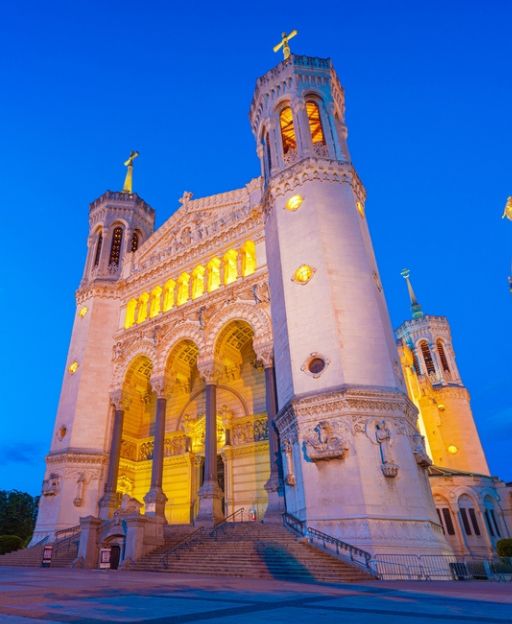
The Basilica of Notre-Dame de Fourvière, built in the late 19th century, is the dominant landmark you will see from anywhere in the city. The interior is lavish in a way that divides opinion — floor-to-ceiling mosaics, marble columns, and four stone towers — but the terrace outside offers one of the best panoramic views in France. On a clear day you can see the Alps to the east, with Mont Blanc visible in the distance.
Lyon’s Food Scene: Why It Earned the Title
Paul Bocuse, born in Collonges-au-Mont-d’Or just north of Lyon in 1926, helped establish the city’s reputation as the gastronomic capital of France in the 1960s and 1970s. His restaurant L’Auberge du Pont de Collonges held three Michelin stars for over 55 consecutive years — a record that still stands. Bocuse died in 2018, but the restaurant continues under his name and his philosophy: respect for seasonal ingredients, classical technique, and the primacy of flavour over theatre.
The bouchon is the institution that defines Lyon’s food culture. These are small, traditional restaurants — often family-run, usually with paper tablecloths and blackboards rather than printed menus — that specialise in the rich, offal-forward dishes of the region. Tablier de sapeur (battered tripe), quenelles de brochet (pike dumplings in crayfish sauce), salade lyonnaise (frisée with poached egg, lardons, and croutons), and andouillette sausage are all bouchon staples. The Café des Fédérations on Rue Major Martin and the Bouchon des Filles on Rue Sergent Blandan are both well-regarded and reliably good. Expect to spend around €25 to €40 per person for a two-course lunch with a carafe of Beaujolais.
Les Halles de Lyon Paul Bocuse, on Cours Lafayette, is the covered market where Lyon’s chefs shop. Over 50 producers sell cheese, charcuterie, wine, bread, and pastries. The quality is exceptional and the atmosphere is that of a working market, not a tourist attraction. Arrive before 10am on a Saturday to see it at its best. Richard Sève’s stall for chocolates and the Mère Richard counter for Saint-Marcellin cheese are both worth the queue.
La Presqu’île: Lyon’s Central Peninsula
La Presqu’île — literally “the almost-island” — sits between the Rhône and Saône, and contains Lyon’s most urban, commercial face. Place Bellecour, at 62,000 square metres, is one of the largest pedestrian squares in Europe, dominated by an equestrian statue of Louis XIV from 1828. The square is the main gathering point for the city and a useful landmark for orientation.
To the north of Bellecour, the streets tighten into the Presqu’île’s most interesting section. Rue de la République is the main shopping street, but the side streets around Rue Auguste Comte and Rue Victor Hugo have the independent boutiques, antique dealers, and wine shops that reward slower wandering. The Musée des Beaux-Arts on Place des Terreaux houses the second-largest fine art collection in France after the Louvre, with works by Rubens, Rembrandt, Monet, and Picasso. Admission is €8.
Place des Terreaux itself has a large 19th-century fountain by Frédéric Bartholdi — the sculptor better known for the Statue of Liberty — and is surrounded by the Hôtel de Ville and the Musée des Beaux-Arts. At night the square is beautifully lit and the surrounding brasseries fill quickly, making it a good base for an evening.
The Confluence District: Where Old and New Meet
At the southern tip of La Presqu’île, the Confluence district marks the point where the Rhône and Saône actually meet. Fifteen years ago this was an industrial wasteland of disused warehouses. Today it is one of France’s most ambitious urban regeneration projects, built around sustainable architecture and public green space. The Musée des Confluences opened here in 2014 in a building designed by the Vienna-based studio Coop Himmelblau — a dramatic structure of stainless steel and glass that looks like two giant crystal formations colliding above the riverbank. Inside, the permanent collections cover the sciences, human societies, and the natural world, all without the dusty taxonomic approach of older museums. Admission is €9.
The Confluence is also where you find the largest concentration of street food markets and weekend pop-ups in Lyon. The Marché de la Confluence on Saturday mornings draws producers from across the Auvergne-Rhône-Alpes region. It is worth the tram ride down from Bellecour.
La Croix-Rousse: The Silk Weavers’ District
North of La Presqu’île, the steep hill of La Croix-Rousse was home to Lyon’s silk-weaving industry from the 17th century until the early 20th. The canuts, as locals called the weavers, lived and worked in the same tall, narrow buildings, their looms requiring high ceilings and large windows to catch the light. The district still has the feel of a working-class neighbourhood that gentrified gradually rather than all at once: there are good independent cafés, a morning market on the Boulevard de la Croix-Rousse that runs Tuesday through Sunday, and a network of traboules distinct from those in Vieux-Lyon.
The Maison des Canuts on Rue d’Ivry gives a thorough introduction to the silk-weaving tradition, with demonstrations of a working Jacquard loom and displays of historical silk samples. Joseph-Marie Jacquard invented the loom in Lyon in 1804. It used a punched card mechanism to automate the weaving of complex patterns — historians regard it as a direct precursor to the modern computer. Admission is €7.
Practical Travel Information for US Visitors
Lyon is served by Lyon-Saint-Exupéry Airport (LYS), which has direct flights from several European hubs and seasonal services from New York JFK. Most US visitors fly into Paris Charles de Gaulle and take the TGV, which covers the 460km in approximately two hours and runs frequently throughout the day. The main station is Lyon Part-Dieu, with secondary service to Lyon Perrache. Both are central.
The city is very walkable within districts, but the hills between Vieux-Lyon and La Presqu’île are steep. The funicular from Vieux-Lyon to Fourvière costs €2.10 and is part of the TCL public transport network, meaning a standard day pass covers it. A TCL one-day pass is €6.20 and covers the metro, trams, buses, and funiculars.
The best times to visit Lyon for US visitors are April to June and September to October. July and August are hot (regularly 30°C+), and many restaurants close during the August holiday period, including some bouchons. The Fête des Lumières in December — when the whole city becomes a canvas for light installations for four nights — draws enormous crowds but is genuinely extraordinary if you can book accommodation in advance.
Budget two full days minimum. Three or four days allows you to cover the city properly and take a half-day trip to the Beaujolais vineyards 30km to the north or to Pérouges, a perfectly preserved medieval walled town 35km to the east.
You Might Also Enjoy
- Lyon France Travel Guide
- Provence Travel Guide: What to See in the South
- Burgundy Travel Guide: Wine Villages and What to See
- How to Travel France by Train
Plan Your France Trip
Ready to plan your journey to France? Our complete planning hub covers everything from budget and transport to the best regions for first-time visitors. Start planning your France trip here →
Frequently Asked Questions About Visiting Lyon
How many days do you need in Lyon, France?
Two full days are the minimum to cover Lyon’s main districts — Vieux-Lyon, Fourvière Hill, La Presqu’île, and La Croix-Rousse. Three or four days allows you to explore more thoroughly and make a half-day trip to nearby Beaujolais or the medieval town of Pérouges.
Is Lyon worth visiting over Paris for a first trip to France?
Lyon and Paris serve different travellers. Paris is essential for first-time visitors to France, but Lyon rewards those looking for a less crowded, more authentically French experience. If you have already been to Paris, Lyon should be your next destination — the food alone justifies the TGV ride south.
What is Lyon, France best known for?
Lyon is best known for three things: its food (it is widely regarded as the gastronomic capital of France), its UNESCO-listed Renaissance old town (Vieux-Lyon), and its hidden traboule passageways. The city also has exceptional Roman ruins from its time as the capital of Roman Gaul, and a rich silk-weaving heritage in the Croix-Rousse district.
What is the best time of year to visit Lyon?
April to June and September to October are ideal — the weather is comfortable, the bouchons are open, and the city is not at peak tourist capacity. The Fête des Lumières in December (four nights of city-wide light installations) is spectacular but requires booking accommodation well in advance.
How do you get from Paris to Lyon?
The TGV from Paris Gare de Lyon to Lyon Part-Dieu takes approximately two hours and departs frequently throughout the day. Tickets start at around €25 booked in advance and rise to €80 or more on the day. Driving takes around four hours on the A6 autoroute, but the TGV is faster and far more convenient for most visitors.
Join 7,000+ France Lovers
Every week, get France’s hidden gems, local recipes, and travel inspiration — the kind you won’t find in any guidebook.
Subscribe free — enter your email:
Love more? Join 64,000 Ireland lovers → · Join 43,000 Scotland lovers → · Join 30,000 Italy lovers →
Free forever · One email per week · Unsubscribe anytime
Tours & experiences you might love


Powered by Viator. Some links are affiliate links — we may earn a small commission at no extra cost to you.

Leave a Reply