
Burgundy France Travel Guide: Wine, Villages and What to See Beyond the Vineyards
The Burgundy France travel guide most visitors read barely scratches the surface. Yes, this region in central-eastern France produces some of the world’s most celebrated wines. But Burgundy — known in French as Bourgogne — is also a place of medieval hilltop villages, Romanesque abbeys, cycling trails through golden vineyards, and a food culture serious enough to rival Paris. If you are planning a trip and want to get beyond the obvious, this guide covers where to go, what to eat, when to visit, and how to make the most of two to five days in one of France’s most rewarding regions.
Love France? Join 7,000+ readers on our free newsletter → lovetovisitfrance.substack.com
Where Is Burgundy and How Do You Get There?
Burgundy sits roughly in the centre of France, south of Paris and north of Lyon. The region stretches from Auxerre in the north down through Dijon and Beaune to Mâcon in the south. It covers a long, thin corridor rather than a neat square, which is worth understanding before you plan your route.
Getting to Burgundy from Paris
The TGV from Paris Gare de Lyon reaches Dijon in around 1 hour 35 minutes, making it one of the easiest regional day trips from the capital — though staying overnight gives you a completely different experience. Beaune, the wine capital of the region, is a further 25 minutes south by train. If you are travelling France by train, Burgundy fits naturally into a longer journey between Paris and the south.
Getting There from Lyon
From Lyon, Beaune is about 45 minutes by fast train. This makes a southern approach equally practical, particularly if you are combining Burgundy with the Loire Valley to the west. Hiring a car from either Paris or Lyon gives you the flexibility to explore the smaller wine villages and hilltop towns at your own pace.
The Best Towns to Visit in Burgundy
Burgundy has no shortage of places worth stopping. The challenge is choosing between them when time is limited. Here are the towns most visitors find most rewarding.
Dijon
Dijon is Burgundy’s capital and the most obvious starting point. The old centre is compact, walkable, and genuinely beautiful. The Palais des Ducs dominates the main square, the covered market is one of the best in France, and there are enough excellent restaurants within a short walk of each other to fill an entire week. Dijon is also where the famous mustard originates — not a cliché, since the local versions sold in market stalls bear no resemblance to the supermarket variety.
Beaune
Beaune draws more visitors than any other Burgundy town outside Dijon, and for good reason. The Hôtel-Dieu, a medieval hospice with a dazzling polychrome tile roof, stands as the single most photographed building in Burgundy. The Côte d’Or surrounds the town — a thin strip of vineyards that produces some of the world’s most expensive Pinot Noir and Chardonnay. Walking between the villages of Aloxe-Corton, Pommard, and Volnay takes only a few hours, though stopping to taste at each domaine will slow your progress considerably.
Vézelay
Vézelay sits in the northern part of the region and is one of those places that stops you in your tracks. The Basilica of Sainte-Marie-Madeleine crowns a long ridge, visible for miles in every direction. Inside, the Romanesque nave stops you still — the light falls differently at different times of day, and art historians rank the carved column capitals among the finest in French medieval art. The village below the basilica has retained its medieval character almost intact.
Semur-en-Auxois and Châteauneuf-en-Auxois
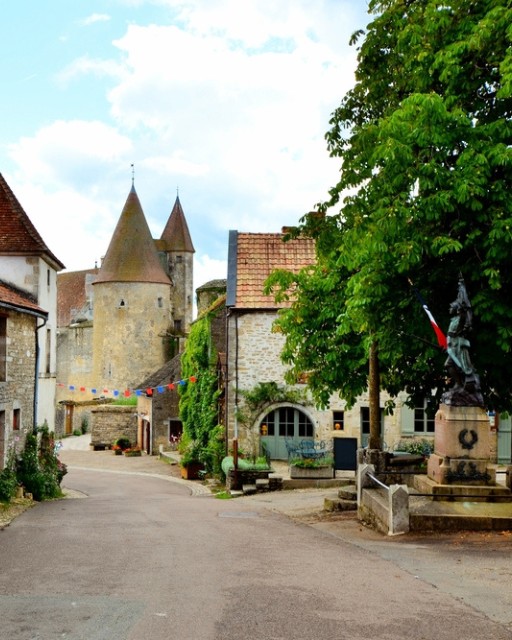
These two towns in northern Burgundy are often overlooked by visitors racing south to the wine villages, which is exactly why they are worth a detour. Semur-en-Auxois is a pink granite town rising above a tight loop of the Armançon river, with four medieval towers still standing above the old walls. Châteauneuf-en-Auxois, a short drive away, is a perfectly preserved feudal village on a hilltop overlooking the Canal de Bourgogne. Both reward an afternoon’s wandering.
Explore France with 7,000+ readers
Get weekly France travel inspiration, hidden gems, and local tips — completely free.
Subscribe Free →Burgundy Wine: What You Actually Need to Know
Understanding Burgundy wine at even a basic level changes the experience entirely. The region has four main wine areas from north to south: Chablis, the Côte de Nuits, the Côte de Beaune, and the Mâconnais. Each produces wines with a distinct character, and prices vary enormously between them.
Chablis
Chablis sits to the northwest of the main Burgundy corridor, closer to Auxerre than to Dijon. Chablis producers work exclusively with the Chardonnay grape, and the style here runs famously lean and mineral — quite different from the richer Chardonnays the Côte de Beaune turns out further south. If you enjoy white wine, a visit to one of the small family producers in the village itself is straightforward to arrange and illuminating.
Côte de Nuits
The Côte de Nuits runs south from Dijon through villages whose names read like a wine list: Gevrey-Chambertin, Morey-Saint-Denis, Chambolle-Musigny, Vosne-Romanée, Nuits-Saint-Georges. The great domaines of Burgundy produce their finest red wines here. Grand Cru bottles can cost several hundred pounds each, but village-level wines from the same communes offer a genuine introduction at a fraction of the price. The Route des Grands Crus cycling path connects these villages along quiet back lanes — a genuinely lovely way to spend a morning. For broader context on French wine, the French wine beginner’s guide covers the main regions side by side.
Côte de Beaune
The southern stretch of the Côte d’Or produces both red and white wines of exceptional quality. The village of Meursault makes some of France’s finest Chardonnay. Pommard and Volnay produce elegant, approachable Pinot Noir with a devoted following among wine drinkers. Many of the wine estates here welcome visitors without appointments, particularly outside the harvest period in September and October. Beaune itself has a cluster of wine merchants on the main street who offer guided tastings — a useful introduction if you are new to Burgundy’s complicated appellation system.
What to Eat in Burgundy
Burgundy has one of the strongest food identities of any French region. Burgundy’s cooks build their cuisine around a handful of core ingredients — beef, mustard, snails, and the wines themselves — and use each with genuine skill.
Boeuf Bourguignon
No dish defines Burgundy more completely than this one. Slow-braised beef, red wine, lardons, pearl onions, and mushrooms — the versions that the better Dijon and Beaune restaurants put out are dramatically better than any home cookbook version. Order it for lunch rather than dinner if you want the best result, since most kitchens prepare it fresh each morning.
Escargots de Bourgogne
Cooks across France serve snails in garlic, butter, and parsley, but Burgundy has a particular claim on the dish. The large Helix pomatia snail has a centuries-long history here, with local families collecting and preparing them from the surrounding countryside. If you have never tried them, the flavour is essentially garlic butter with a very mild, slightly earthy background — approachable rather than challenging. Most brasseries in Dijon serve them as a starter.
Époisses Cheese
Cheesemakers in the village of Époisses, about 40 kilometres west of Dijon, produce this remarkable washed-rind cheese. It has a powerful smell but a surprisingly creamy, mild flavour — much gentler than the aroma suggests. You will find it in any decent fromagerie in the region. It pairs well with Pinot Noir. Those curious about France’s wider cheese culture will find the guide to France’s best cheese caves a useful companion read.
When to Visit Burgundy
Burgundy has a continental climate, which means cold winters and warm summers with a sharp difference between the seasons.
Spring and Early Summer
May and June are excellent months to visit. The vineyards are bright green, the villages are not yet busy, and the weather is reliably warm without being oppressive. Hotel prices are lower than in high summer, and it is easier to get tables at the better restaurants without booking weeks ahead.
Harvest Season
September and October bring the vendanges — the grape harvest. This is the most atmospheric time to visit the wine villages. The pace quickens in the vineyards, the light turns golden, and the scent of fermenting grapes drifts through the streets of Beaune. It is also the busiest and most expensive time to visit, particularly around the third weekend of November when the Hospices de Beaune wine auction takes place. The guide to September in French wine country gives a feel for what this period is actually like.
Winter
December and January are quiet. Most visitor attractions remain open, prices are low, and Dijon’s Christmas market is one of the better ones in France. The cold can be sharp, but the empty streets and the chance to sit in a warm restaurant without a reservation have their own appeal.
How to Plan Your Burgundy Itinerary
Two Days
With two days, base yourself in Beaune and do not try to cover too much. Day one: walk the old town, visit the Hôtel-Dieu, and take a cycling loop through the nearest wine villages. Day two: drive or cycle north to the Côte de Nuits villages, stopping at one or two domaines for a tasting.
Three to Four Days
Add Dijon at the start — a full day in the capital is well spent. Then spend two nights in Beaune before heading north to Vézelay for a final afternoon. This covers the main highlights without feeling rushed. Those interested in road trips through France can find inspiration in the Loire Valley road trip guide for a natural extension to the west.
Five Days or More
With five days, add a day in the Chablis area to the north, or head south to Mâcon and the rolling hills of the Mâconnais. The villages of Cluny (home to the ruins of a once-vast medieval abbey) and Tournus (with its impressive Romanesque church) are easy additions to a southward route and reward the detour.
You Might Also Enjoy
- Bordeaux Wine Region Guide: Everything You Need to Know Before You Visit
- The Alsace Wine Route: A Complete Guide for First-Time Visitors
- What September Feels Like in French Wine Country
Plan Your France Trip
Ready to start planning? Our France Trip Planning Hub has everything you need — from choosing which region to visit first to practical advice on getting around, where to stay, and what to budget.
Frequently Asked Questions
How many days do you need in Burgundy?
Two to three days covers the main highlights in Dijon and Beaune, including time for wine tasting and a few of the surrounding villages. Four to five days allows for a more relaxed pace and the chance to explore the northern part of the region around Vézelay and Chablis.
Is Burgundy worth visiting if you don’t drink wine?
Yes — the medieval villages, Romanesque architecture, cycling routes, and food culture stand entirely on their own. Towns like Vézelay, Semur-en-Auxois, and Flavigny-sur-Ozerain have nothing to do with wine and are among the most beautiful in France.
What is the best base for exploring Burgundy?
Beaune gives you the most practical base for wine country — good train connections and a compact centre that you can explore on foot. Dijon suits those more interested in culture and gastronomy and has a wider choice of hotels and restaurants. For northern Burgundy and Vézelay, Auxerre is a quieter and underrated option.
Can you visit Burgundy as a day trip from Paris?
Technically yes — the TGV makes Dijon reachable in under two hours from Paris Gare de Lyon. In practise, a single day does not do justice to the region. An overnight stay in Beaune or Dijon transforms the trip entirely.
Join 7,000+ France Lovers
Every week, get France’s hidden gems, local recipes, and travel inspiration — the kind you won’t find in any guidebook.
Subscribe free — enter your email:
Love more? Join 64,000 Ireland lovers → · Join 43,000 Scotland lovers → · Join 30,000 Italy lovers →
Free forever · One email per week · Unsubscribe anytime
Tours & experiences you might love


Powered by Viator. Some links are affiliate links — we may earn a small commission at no extra cost to you.

Leave a Reply