
Stand in the centre of Château de Chambord and look up. Two staircases spiral around each other without ever meeting. You can watch someone walk down as you walk up, but you will never share the same step. This has baffled visitors for 500 years.
A Castle Built for a King Who Loved the Impossible
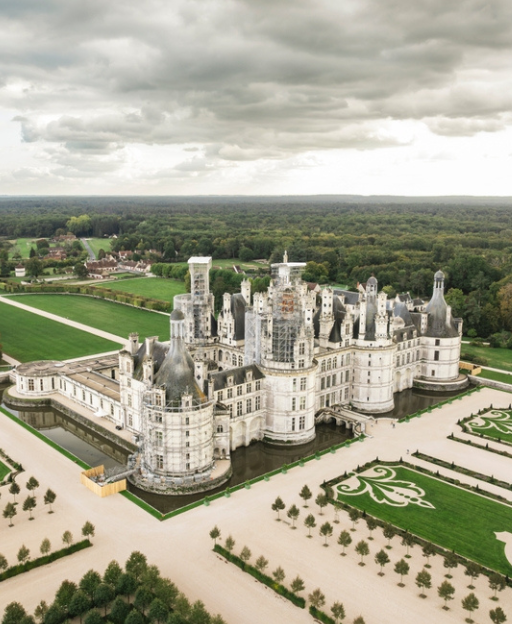
François I was 21 years old when he ordered Chambord. He wanted the largest castle in France — towers visible for miles and a scale no one had attempted before.
Construction began in 1519. Over 1,800 workers spent 28 years on the site. The finished château holds 440 rooms, 365 chimneys, and a roofline so complex it looks like a city landed on top of a palace.
But nothing at Chambord is stranger than the staircase at the heart of it all. If you are planning a wider trip through the region, our France travel planning guide covers everything you need before you go.
The Double Helix That Stops You Cold
Walk into the central keep and you find it immediately. Two stone staircases wind around a shared axis, rising from the ground floor to the roof terrace. They form a double helix — centuries before anyone knew what DNA was.
Each staircase stays open on the inside. You can see the other spiral through the gaps. You can call across the void. But the two staircases never cross.
Someone descending on one side and someone climbing on the other will spiral around each other from bottom to top without ever meeting. It is one of the most extraordinary pieces of engineering in France.
The Leonardo da Vinci Question
Here is where the story gets complicated.
François I invited Leonardo da Vinci to France in 1516 — three years before Chambord’s construction started. Leonardo spent his final years at Château du Clos Lucé, just 60 kilometres from the Chambord site.
Leonardo sketched double helix staircases in his notebooks. His architectural drawings include interlocking spiral structures that match what you see at Chambord today.
Enjoying this? 7,000 France lovers get stories like this every week. Subscribe free →
Some historians believe François I shared the plans with his master engineer. Others think Leonardo influenced the design more directly. The records from that period are incomplete, and no document names a single architect for the staircase.
What we know is this: the king’s favourite genius was nearby when the drawings were made. No one has fully explained that away.
What the Original Builders Left Behind
The central keep follows a Greek cross layout — four wings radiating from the staircase in the middle. This pattern came from Italian Renaissance architecture, not French tradition.
French medieval castles faced inward and hid behind walls. Chambord faced outward. Every room had windows. The towers served no defensive purpose. Builders made a statement of peacetime power, not a fortress.
The roofline alone took decades to finish. It holds chimneys, turrets, dormers, and lanterns in a pattern that looks chaotic from the ground but follows a precise geometric order from above.
Several architects worked on Chambord across different phases. But the double helix staircase belongs to the original design — and that design reflects a mind trained in Italian Renaissance geometry. If château history fascinates you, read about another Loire château with a remarkable architectural story.
Planning Your Visit to Chambord
Chambord sits within a 5,500-hectare estate — the largest walled forest in Europe. The château opens daily except Christmas and New Year. Pair it with Cheverny (12 kilometres away) for an easy and rewarding day in the Loire Valley. For a full two-week trip that takes in Chambord alongside the best of France, our two-week France itinerary is the place to start.
What is the best time to visit Château de Chambord?
September and October offer mild weather, smaller crowds, and the famous deer rut in the surrounding forest. Spring (April to June) also works well, with long days and green grounds throughout the estate.
How do I get to Chambord from Paris?
Take the train from Paris Austerlitz to Blois (around 90 minutes), then a taxi or seasonal shuttle to Chambord. Hiring a car lets you visit multiple Loire Valley châteaux in a single day.
How long should I spend at Château de Chambord?
Allow two to three hours to explore the château properly. The rooftop terrace is not to be missed — on clear days, you can see across the Sologne plain for miles in every direction.
Is Chambord near other Loire Valley châteaux?
Chambord sits 14 kilometres east of Blois and around 45 kilometres from Amboise. Cheverny is just 12 kilometres away, making a combined visit an easy and satisfying day trip.
The staircase was built to impress a king. Five centuries later, it still does.
Join 7,000+ France Lovers
Three times a week, get France’s hidden gems, seasonal guides, local stories, and the art of la vie française — straight to your inbox.
Subscribe free — enter your email:
Free forever · Unsubscribe anytime
🇫🇷 You Might Also Love
Tours & experiences you might love


Powered by Viator. Some links are affiliate links — we may earn a small commission at no extra cost to you.

Leave a Reply