
In 1755, British soldiers loaded French families onto ships at bayonet point. They burned the farms. They separated husbands from wives, parents from children. They called it a necessary military operation. The Acadians called it Le Grand Dérangement — the Great Upheaval.
Those families had lived in Acadia for five generations. They had drained tidal marshes, built churches, and raised children who spoke French, prayed in French, and dreamed in French. They were, in every way that mattered, as French as the villages their grandparents had left behind in Poitou and Saintonge.
The British expelled them. But they could not make them stop being French.
This is the story of the Acadians — who they were, how they survived, and why three million of their descendants still carry France in their bones.
Who Were the Acadians?
Acadia was France’s first permanent colony in North America. Samuel de Champlain and Pierre Dugua de Mons established Port-Royal in 1605 on the shores of what is now Nova Scotia. The settlers who followed came mostly from western France — from Poitou, Saintonge, Anjou, Normandy, and Touraine.
They were farmers and fishermen. They were not wealthy. They did not come from Paris or the great cities of France. They came from the Atlantic coast — from towns like Surgères, Fontenay-le-Comte, Saint-Maixent, and Saumur. Many of their family names still appear in modern-day Nova Scotia and New Brunswick: Thibodeau, Leblanc, Hébert, Richard, Gaudet, Cormier, Boudrot.
If your family name appears in our guide to French Surnames of Normandy or French Surnames of Brittany, there is a good chance your ancestors shared a coastline with the first Acadians.
Building a New France in the New World
The land the Acadians inherited was not easy. The Bay of Fundy has the highest tides in the world — walls of water that flood the marshes twice each day. The Acadians did not retreat from the tides. They mastered them.
They built a system of dykes called aboiteaux — earthen walls fitted with wooden sluice valves. The valves let fresh water drain out at low tide but snapped shut against the salt water at high tide. Over generations, the Acadians drained vast tracts of marshland and turned them into some of the most fertile farmland in North America.
This was not a colony of soldiers or administrators. It was a community of farming families. They grew wheat, raised cattle, tended orchards. They built stone churches and wooden homes. They formed alliances with the Mi’kmaq people, learning their language and trading freely. By 1750, around 13,000 Acadians lived in the region.
They had been French settlers. By this point, they were something new: Acadians. A people shaped by the Atlantic marshes, by the tides, by the cold winters, and by a language that had slowly drifted from the French of Paris while keeping its deep roots.
🇫🇷 Enjoying this? 7,000 France lovers get stories like this every week. Subscribe free →
Le Grand Dérangement: The Great Upheaval of 1755
Britain and France had fought over Acadia for decades. Britain seized control in 1713 under the Treaty of Utrecht, but most Acadians refused to sign an oath of unconditional allegiance to the British Crown. They wanted to remain neutral — subjects of Britain, perhaps, but not soldiers against France or their Mi’kmaq neighbours.
The British authorities grew impatient. In 1755, Lieutenant Governor Charles Lawrence ordered the deportation of the entire Acadian population. The order came without warning.
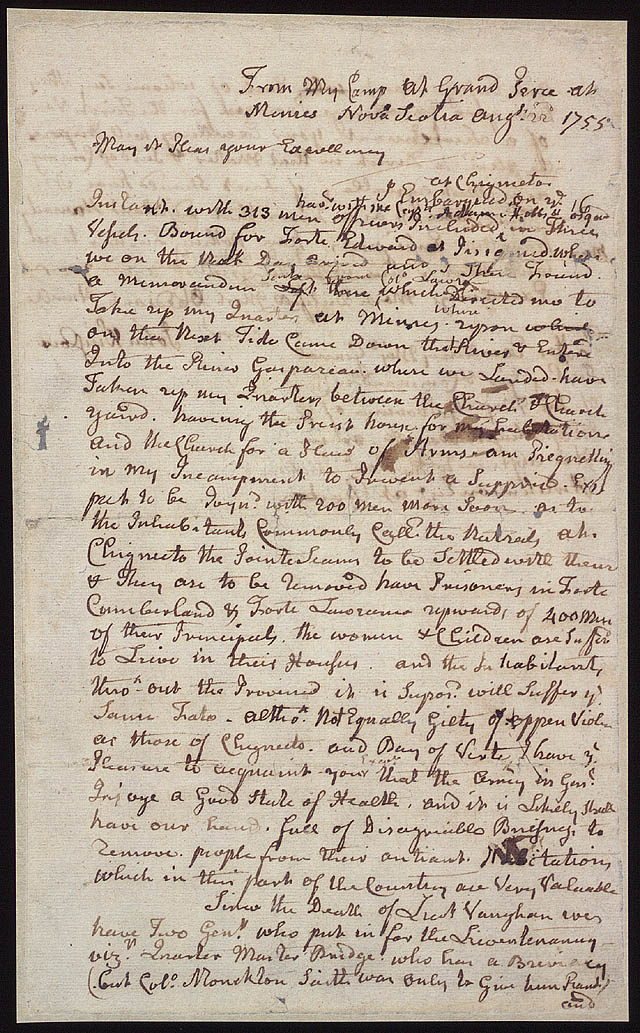
On 5 September 1755, Acadian men and boys gathered at the church in Grand-Pré, expecting a routine meeting. British soldiers locked the doors and read the order aloud. The men would be deported. Their lands, livestock, and homes were forfeit to the Crown.
What followed was brutal. Soldiers herded families onto ships. Fathers were separated from sons. Wives watched their husbands sail away on different vessels. Children lost parents on the docks. The soldiers burned the farms and the churches to prevent any return.
Between 1755 and 1763, the British deported between 10,000 and 14,000 Acadians. Many died at sea. Ships overcrowded with deportees carried disease through their holds. Bodies went overboard in the Atlantic. Families that survived the crossing arrived in ports across the British colonies, France, and the Caribbean — strangers in places that did not want them.
Where the Acadians Were Scattered
The deportation scattered Acadians across three continents. Some went to the British colonies along the American coast — Massachusetts, Virginia, Maryland, Georgia. Many were rejected and left stranded at sea. Some ended up in England. Others reached the Caribbean islands of Martinique and Saint-Domingue.
A significant number reached France itself. Ships landed in the ports of La Rochelle, Rochefort, Saint-Malo, and Cherbourg. The French government struggled to settle them — these people were French by ancestry and language, but strangers to modern France. Many Acadians settled on the island of Belle-Île-en-Mer off the Brittany coast. Others settled around Poitiers, in the region their grandparents had originally left.
Then there was Louisiana. Spain controlled Louisiana at the time, but it was a French-speaking territory. Between 1765 and 1785, thousands of Acadians made their way there — some overland through the colonies, some directly from France. In the bayous and wetlands of southern Louisiana, they rebuilt. They farmed, fished, and kept their language. The word “Acadian” became “Cajun” — and a new culture was born.
Quebec took in thousands more. Some Acadians had escaped into the forests during the deportation and made their way north. Others arrived after the war ended. Their descendants fill the Francophone communities of Quebec and the Maritime provinces today.
The French islands of Saint-Pierre and Miquelon, just off the coast of Newfoundland, became a refuge for some Acadian families. Those islands remain French territory to this day — the last remnant of French colonial North America.
Keeping the Flame: How Acadian Identity Survived
The Acadians had lost everything material. They kept everything that mattered.
They kept their language. Acadian French is an older form of the language — closer to the 17th-century French of Poitou and Saintonge than to modern Parisian French. Linguists travel to New Brunswick and Louisiana specifically to hear words and constructions that disappeared from France centuries ago. The Acadians did not update their French. They preserved it.
They kept their Catholic faith. The church was the centre of Acadian life before the deportation, and it remained so in exile. Priests who survived the deportation became community anchors. The feast of the Assumption of Mary — 15 August — became Acadian National Day, chosen at the first Acadian National Convention in 1881.
They kept their music. Acadian fiddle music carries the traditions of western France — the same rhythms that once filled the dance halls of Poitou. In Louisiana, that music blended with African and Caribbean influences to create Cajun and zydeco. The string is different, but the French soul runs through it.
In 1884, at the second Acadian National Convention, delegates chose a flag. They took the French tricolour — blue, white, and red — and added a single golden star in the blue stripe. The star is the Stella Maris, Star of the Sea, patroness of sailors and of all people who cross dangerous waters. It is a perfect symbol for a people who survived the Atlantic.
Acadian Descendants Today
Today, approximately three million people claim Acadian descent. They live across a wide arc of the world.
New Brunswick is the heartland. The province is officially bilingual — English and French — and the Acadian community forms a third of its population. Moncton, the city of Dieppe, and the Acadian Peninsula in the north are deeply Acadian in culture, language, and identity. The Centre d’Études Acadiennes at the Université de Moncton holds the largest Acadian genealogical archive in the world.
Nova Scotia and Prince Edward Island have strong Acadian communities. The village of Grand-Pré — where the deportation order was read in 1755 — is now a UNESCO World Heritage Site and a place of pilgrimage for Acadian descendants.
Louisiana’s Cajun Country stretches across the southern bayous — Lafayette, Breaux Bridge, Opelousas, Houma. Here, Acadian French survived in a distinct creole form. Cajun culture gave the world Cajun cuisine (jambalaya, crawfish étouffée, boudin), zydeco music, and a particular way of living that owes everything to France but belongs entirely to Louisiana.
In France itself, communities of Acadian descent persist around Poitiers and on Belle-Île-en-Mer, where the descendants of deportees who returned to France still celebrate their heritage each summer.
Tracing Your Acadian Roots
Acadian genealogy is among the most thoroughly documented in North America. The population was small and Catholic — every birth, marriage, and death went into a parish register. Those records survived, and many are now online.
Start with the Centre d’Études Acadiennes (CEA) at the Université de Moncton. Their database, Inventaire général des sources documentaires sur les Acadiens, covers hundreds of thousands of Acadian individuals from the 1600s onwards. Access is available online.
FamilySearch has digitised many Acadian parish records — search under “Nova Scotia” and “New Brunswick” for early registers. Ancestry.ca holds large collections of Acadian and French-Canadian records, including deportation ship lists and post-1763 census returns.
For French origins, start with the Archives de la Charente-Maritime in La Rochelle — this archive holds records for Saintonge and Aunis, the primary source regions. The Archives de la Vienne in Poitiers covers Poitou. Both archives have online portals with increasing digital access.
Common Acadian surnames with confirmed French regional origins include: LeBlanc (from Saintonge), Thibodeau (from Poitou), Hébert (from Saintonge), Landry (from Saintonge and Anjou), Arseneau (from Poitou), Cormier (from Saintonge), and Gaudet (from Saintonge).
Our complete guide to tracing French ancestry walks you through the full process — from French archives to heritage travel planning.
The France Your Ancestors Left Behind
If you have Acadian roots, the France your ancestors came from is not Normandy or Brittany (though some came from there). The heartland is further south — the western Atlantic coast, a region of flat marshes, salt flats, and old market towns that sent more people to Acadia than anywhere else in France.
Poitiers and the Vienne department sit at the centre. This was the administrative capital of Poitou — the region that gave Acadia many of its founding families. Walk the old town, visit the Baptistère Saint-Jean (one of the oldest Christian buildings in France), and understand the world that produced the first Acadians.
La Rochelle was the great port of embarkation. Ships left La Rochelle’s harbour for Acadia throughout the 1600s and early 1700s. After the deportation, ships carrying Acadian refugees also arrived here. The city’s old harbour — the towers of Saint-Nicolas and La Chaîne — stood as the last sight of France for thousands of departing settlers. La Rochelle also connects to our earlier piece on the Huguenots, another group expelled from France in the same era.
Surgères, a market town in Charente-Maritime south of La Rochelle, is often called the “capital of Acadian ancestry.” More founding Acadian families traced their roots to the communes around Surgères than to any other single area in France.
Belle-Île-en-Mer, an island off the southern coast of Brittany, became home to Acadian deportees who eventually reached France. The island community still honours its Acadian heritage with an annual festival. Their descendants farm the same island fields today.
If you plan to visit these regions, our guide to planning a French heritage trip to your ancestral village will help you make the most of the journey.
Frequently Asked Questions
What is the difference between Acadian and Cajun?
“Cajun” is a corruption of “Acadien” (the French word for Acadian). When Acadian exiles settled in Louisiana from the 1760s onwards, their name evolved in the local dialect to “Cajun.” Cajuns are Acadians who settled in Louisiana and whose culture blended with African, Spanish, and Caribbean influences. All Cajuns have Acadian roots, but not all Acadians became Cajuns.
Where did most Acadians originally come from in France?
The majority of Acadian founding families came from the western French provinces of Poitou, Saintonge, and Anjou — roughly the area of modern Charente-Maritime, Vienne, and Maine-et-Loire. Smaller numbers came from Normandy, Brittany, and other regions. The area around Surgères in Charente-Maritime is considered the epicentre of Acadian ancestral territory in France.
When is Acadian National Day?
Acadian National Day falls on 15 August — the Feast of the Assumption of Mary. Acadians chose this date at their first National Convention in 1881 as a celebration that united their Catholic faith with their distinctive identity. The day is celebrated across New Brunswick, Nova Scotia, PEI, and by Acadian communities worldwide.
How can I find out if I have Acadian ancestry?
Start with the Centre d’Études Acadiennes database at the Université de Moncton — it is the most comprehensive Acadian genealogical resource in the world. FamilySearch and Ancestry.ca also hold large collections of Acadian records. If your surname is LeBlanc, Thibodeau, Hébert, Landry, Arseneau, Cormier, Gaudet, Richard, Boudrot, or Melanson, you may well have Acadian roots.
Did Britain ever apologise for the Acadian deportation?
In 2003, the Governor General of Canada, on behalf of the Crown, signed a Royal Proclamation acknowledging Le Grand Dérangement and expressing profound regret for the deportation and its consequences. The proclamation designated 28 July as a Day of Commemoration for the Great Upheaval. It was not a formal apology, but it was the first official recognition of the deportation by the British Crown.
You Might Also Enjoy
- The Huguenots: France’s Great Exodus and Its Global Legacy — another story of a French people scattered across the world by persecution
- French Surnames of Normandy: Origins, Meanings and Family Heritage — trace your Norman roots
- How to Trace Your French Ancestry — the complete step-by-step guide
Plan Your France Trip
Ready to walk the streets your ancestors walked? Our France travel planning hub covers everything from getting to Charente-Maritime to finding accommodation near the ancestral villages of Poitou. Start there and build your heritage journey from the ground up.
Join 7,000+ France Lovers
Three times a week, get France’s hidden gems, seasonal guides, local stories, and the art of la vie française — straight to your inbox.
Subscribe free — enter your email:
Free forever · Unsubscribe anytime
🇫🇷 You Might Also Love
Tours & experiences you might love


Powered by Viator. Some links are affiliate links — we may earn a small commission at no extra cost to you.

Leave a Reply