
Stand at any corner in Aix-en-Provence and you hear it before you see it. Water. Running somewhere. Around a corner, down a mossy channel, over a carved stone basin. There are more than 100 fountains in this city — and every one of them connects, somehow, to the Romans.
Romans Built This City Around a Spring
In 122 BC, Roman general Gaius Sextius Calvinus defeated the local Celto-Ligurian tribes near a thermal spring in Provence. He named the settlement Aquae Sextiae — the Waters of Sextius. He wasn’t being poetic. The spring was the point.
Romans built cities around water for a reason. Thermal springs meant baths, sanitation, and a steady supply that didn’t depend on rainfall. Sextius planted the first Roman city in Gaul right here, on this hill above the plain, because the ground gave water freely.
The Roman baths vanished centuries ago. But the water didn’t stop. Medieval builders tapped the same underground channels. The 17th century brought grand stone fountains to the squares. By the time architects built the Cours Mirabeau, Aix already had more fountains than any city of its size in Europe. Some locals claim the number reached a thousand. History puts the actual count closer to 110 — but nobody wants to correct a good story.
The Cours Mirabeau and the Life It Holds
No single street in Provence does more work than the Cours Mirabeau. This broad, plane-tree-lined boulevard stretches half a kilometre through the heart of Aix. The trees grow so wide and dense that they form a complete canopy in summer — a long green tunnel of shade in a city that reaches 35°C by July.
Café terraces line the south side. Old noble townhouses — hôtels particuliers built by the 17th-century legal elite — line the north. Three fountains anchor the boulevard at different points. The Fontaine de la Rotonde at the western end shoots water 12 metres into the air from a baroque stone base. Local children treat the whole street as a living room.
On market days, vendors push in from the surrounding countryside. You’ll find calissons — the almond and candied melon sweets that Aix has produced since the 15th century — stacked in paper cones at every turn. The Cours fills, empties, and fills again. Nobody rushes.
Cézanne Painted the Mountain 80 Times
Paul Cézanne grew up in Aix. He left for Paris, struggled, and returned. He spent the last years of his life painting Mont Sainte-Victoire — the flat-topped limestone ridge that dominates the eastern horizon — from multiple angles, in different lights, across different seasons.
He painted it more than 80 times. He wasn’t being repetitive. He chased something about the way southern light dissolves a solid object into colour and geometry. He died in 1906 after collapsing in a rainstorm while painting outside.
His studio on the hill above the city, the Atelier Cézanne, still stands. His coat hangs on the same peg. His palette sits on the same shelf. The bowl of artificial fruit he used — he couldn’t afford to let real apples rot while he worked — still occupies the corner table. Walking through it, you understand why he never left.
If you’re planning a trip across the region, the Provence Travel Guide covers villages, coastline, and what to eat from east to west. For everything before you travel, start with the France planning guide — it’ll save you hours.
Enjoying this? 7,000 France lovers get stories like this every week. Subscribe free →
The Saturday Market and the Old Quarter
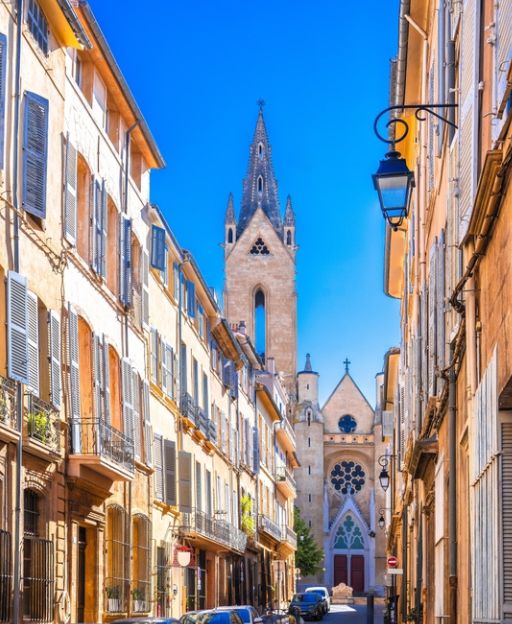
The old quarter of Aix sits above the Cours. Streets here run too narrow for cars and too beautiful to widen. On Saturday mornings, the Place des Prêcheurs and the surrounding squares fill with one of the best food markets in Provence.
Farmers drive in from the Luberon. Others come from the Alpilles and the Var. You’ll find tomatoes with real smell, cheese wrapped in chestnut leaves, bundles of dried thyme, and honey from lavender, chestnut, and pine in separate jars. The market runs from dawn to noon and demands nothing of you.
Afterwards, find a café table on a side street. Order a glass of Coteaux d’Aix-en-Provence rosé — the vineyards around the city produce wine that tastes of hot stone and dry earth. Watch the fountain in the nearest square. The water has been running long enough; it can wait a little longer for you to catch up.
Aix pairs naturally with a day trip south. The Calanques coastline sits 30 kilometres away — white limestone cliffs dropping into turquoise water, most of it accessible on foot.
Frequently Asked Questions About Aix-en-Provence
When is the best time to visit Aix-en-Provence?
May, June, and September offer the best conditions. Summer temperatures regularly exceed 35°C, which makes July and August uncomfortably hot for walking the old quarter. Spring brings cooler air and the markets at their most abundant. September adds grape harvest activity in the surrounding vineyards.
How far is Aix-en-Provence from Marseille and the coast?
Aix sits 30 kilometres north of Marseille — about 30 minutes by motorway. TGV trains connect Aix’s out-of-town station to Paris in under three hours. The Calanques coastline south of Marseille takes around 45 minutes by car from Aix town centre.
What is Aix-en-Provence most famous for?
Aix earns its reputation on three things: its fountains (over 100, fed by ancient Roman spring systems), its connection to painter Paul Cézanne (who lived and worked here his entire life), and calissons — the soft almond and candied melon sweets the city has produced since the 15th century.
Is Aix-en-Provence worth visiting for a day trip from Nice or Marseille?
Yes — a full day covers the Cours Mirabeau, the Atelier Cézanne, the old quarter, and the Saturday market if your timing lines up. Aix works better as a base for two or three nights if you want to reach the Luberon villages and the local vineyards too.
Aix-en-Provence doesn’t ask you to hurry. The fountains have run for two millennia. The plane trees have shaded the Cours for centuries. The city has had a very long time to get comfortable — and it shows in every quiet square and every unhurried afternoon. Come ready to slow down.
Join 7,000+ France Lovers
Three times a week, get France’s hidden gems, seasonal guides, local stories, and the art of la vie française — straight to your inbox.
Subscribe free — enter your email:
Free forever · Unsubscribe anytime
🇫🇷 You Might Also Love
Tours & experiences you might love


Powered by Viator. Some links are affiliate links — we may earn a small commission at no extra cost to you.

Leave a Reply