
No one knows where the Basque people came from. Their language — Euskara — shares no roots with any other language on Earth. They arrived here before the Romans, before France, before Spain. And they are still here.
A Language with No Family
Linguists call Euskara a “language isolate.” It has no known relatives and no ancestral tongue. Scientists have studied it for centuries without finding a match. The Basques spoke it long before written history began.
In towns like Bayonne and Saint-Jean-de-Luz, street signs appear in both French and Euskara. Shopkeepers greet you in both. Children learn it at school alongside French. The language did not survive by luck — Basques fought hard to keep it alive.
This sense of distinct identity runs through everything — the food, the festivals, the architecture. The Basque Country occupies the southwest corner of France, wedged between the Pyrenees and the Atlantic. It looks like France. It feels like somewhere else entirely.
The Food That Defines a People
Basque food plays by its own rules. Pintxos — small bites of bread topped with seafood, cured meat, or local cheese — line the counters of every bar in Bayonne. They are not tapas. Basques will correct you on this point, firmly and with good humour.
The region produces txakoli, a sharp, slightly fizzy white wine. Bartenders pour it from height, raising the bottle well above the glass to aerate it. The effect is theatrical and very good.
The Espelette pepper grows only here. French law grants it a protected designation of origin (AOP). Locals add it to sausages, stews, and even chocolate.
Bayonne also claims the invention of chocolate in France. Spanish Sephardic Jews brought cacao here in the 17th century. The city’s chocolatiers have kept that tradition alive ever since.
Saint-Jean-de-Luz: Where the King Married
Enjoying this? 7,000 France lovers get stories like this every week.
Thinking about it seriously? If you’ve started actually planning a move, our complete our complete Moving to France guide walks through every step, every cost, and the paperwork that catches most people out.
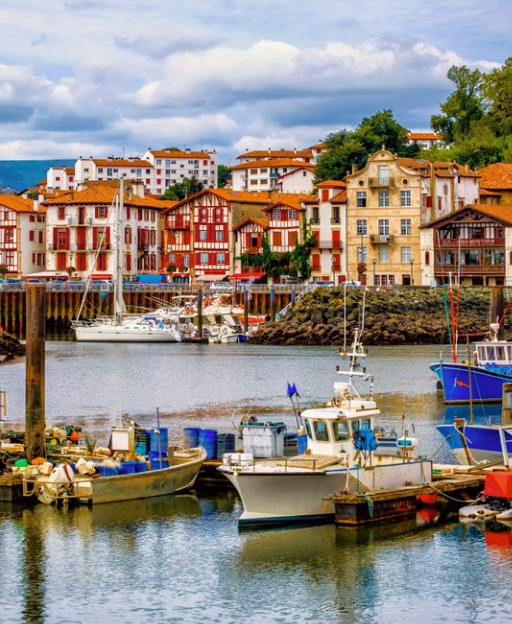
Saint-Jean-de-Luz sits on a curved bay between the Pyrenees and the Atlantic. Fishing boats fill the harbour at dawn. Red and green shutters line the whitewashed houses. This is the most photographed town in the French Basque Country — and you will see why immediately.
In 1660, Louis XIV married Marie-Thérèse of Spain here. After the ceremony, workers sealed the church door shut. Nobody has opened it since. It stands there today, bricked up, marking the spot where two kingdoms briefly became one.
Bayonne sits 20 minutes north, where two rivers — the Nive and the Adour — meet. Its Gothic cathedral dates to the 13th century. Narrow streets fill with bars and chocolate shops. The city runs on chocolate, cured ham, and rugby, not necessarily in that order.
A Culture That Refuses to Disappear
Basques play pelota — a fast, physical ball game with roots older than tennis. Every village has a fronton, the open-walled court where players compete. On summer evenings, crowds gather to watch.
The Fêtes de Bayonne each August draws over a million visitors to a city of 50,000. Everyone wears white and red. Music plays day and night for five days straight. Sleep is optional.
The old Pyrenean passes link directly to the pilgrim route heading south. These historic mountain paths remain open to walkers today. The Armagnac country of Gascony begins just to the east — another corner of southwest France worth exploring. Our France travel planning guide covers the whole country if you want to build a longer itinerary.
Frequently Asked Questions
What is the best time to visit the French Basque Country?
May, June, September, and October offer warm, sunny weather without August crowds. The Fêtes de Bayonne run in late July and early August — book accommodation months ahead if you want to attend.
Where should I stay in the French Basque Country?
Saint-Jean-de-Luz suits visitors who want a scenic seaside base with easy beach access. Bayonne works better for food, culture, and rail connections. Biarritz, ten minutes from both, adds surf beaches and a grand casino.
Is the French Basque Country easy to reach?
Biarritz airport has direct flights from Paris and several European cities. Bayonne sits on the main Paris–Madrid rail line. Both destinations are under three hours from Paris by TGV.
What should I eat and drink in the Basque Country?
Start with pintxos and txakoli at a Bayonne bar. Try jambon de Bayonne, aged for at least seven months. Ask for ttoro — the local fishermen’s stew. Finish with gâteau basque filled with black cherry jam or pastry cream.
The Basque Country does not ask whether it belongs to France or Spain. It belongs to itself. That certainty wraps around you as you walk through Saint-Jean-de-Luz at dusk — the Pyrenees behind you, the Atlantic ahead, and pintxos waiting on the bar.
Join 7,000+ France Lovers
Three times a week, get France’s hidden gems, seasonal guides, local stories, and the art of la vie française — straight to your inbox.
Subscribe free — enter your email:
📲 Know someone who’d love this? Share on WhatsApp →
Love more? Join 65,000 Ireland lovers → · Join 43,000 Scotland lovers → · Join 29,000+ Italy lovers →
Free forever · · Unsubscribe anytime
🇫🇷 You Might Also Love
Tours & experiences you might love


Powered by Viator. Some links are affiliate links — we may earn a small commission at no extra cost to you.

Leave a Reply