
Dordogne Travel Guide: The Best of South-West France for First-Time Visitors
The Dordogne is one of France’s most rewarding regions for visitors who want something beyond the crowds of Paris or the beaches of the Riviera. It has prehistoric cave art, golden medieval towns perched above river valleys, and farmhouse cooking that puts most city restaurants to shame. Few places in France offer this combination, and fewer still feel this unhurried. If you are planning a first visit to the Dordogne, this guide covers everything you need to know — where to go, what to eat, when to visit, and how to make the most of your time here.
Love France? Join 7,000+ readers on our free newsletter → lovetovisitfrance.substack.com
What Is the Dordogne — and Why Should You Visit?
The Dordogne is a département in the Nouvelle-Aquitaine region of south-west France. The name also refers to the river that winds through it — a broad, gentle waterway that has shaped this landscape for millennia. The region sits roughly two hours east of Bordeaux and three hours south of the Loire Valley.
What sets the Dordogne apart is its density of things to see. Within a two-hour drive, you can visit Lascaux’s prehistoric cave art, the cliff-top village of Les Eyzies (the capital of prehistory), the bastide town of Sarlat-la-Canéda, the castle of Beynac, and the limestone cliffs of La Roque-Gageac. This is not a region where you travel far between highlights. You meander.
The local name for the most popular part of the region is Périgord Noir — the Black Périgord — named for the dense oak forests that cover the hills. It is the heartland of Dordogne tourism, and it earns every visitor it gets.
The Top Places to Visit in the Dordogne
Sarlat-la-Canéda
Sarlat is the Dordogne’s most visited town, and for good reason. Its medieval centre is almost completely intact — golden limestone streets, turret-topped houses, and a cathedral that has stood since the twelfth century. The Saturday market is one of the finest in France, filling the main squares with foie gras, truffles, walnuts, and local cheeses from dawn until early afternoon.
Stay at least one night in Sarlat rather than visiting on a day trip. The town changes completely once the coaches leave in the late afternoon. The old streets grow quiet and golden in the last light, and that is when you understand why so many visitors return year after year.
Lascaux and the Prehistoric Caves
The Dordogne valley contains the greatest concentration of prehistoric art in the world. Lascaux Cave, discovered in 1940, holds paintings of horses, bulls, and deer that are over seventeen thousand years old. Authorities closed the original cave to protect the paintings, but Lascaux IV — an extraordinary full-scale replica that opened in 2016 — gives visitors an experience as close to the real thing as possible.
Les Eyzies-de-Tayac is the village at the centre of the prehistoric zone, with the National Museum of Prehistory built directly into a limestone cliff. From here, you can reach the Font-de-Gaume cave (which still shows original paintings — one of the last in France open to the public), and the Grotte de Rouffignac, where an electric train takes visitors through a kilometre of mammoth engravings.
The Bastide Towns
Bastides are planned medieval towns, built in a grid pattern around a central market square. The Dordogne and neighbouring Lot-et-Garonne have dozens of them. Many experts regard Monpazier as the most perfectly preserved in France — its arcaded market square has barely changed since 1284. Domme sits on a cliff above the river and offers views that stretch for miles across the valley.
The Châteaux of the Dordogne
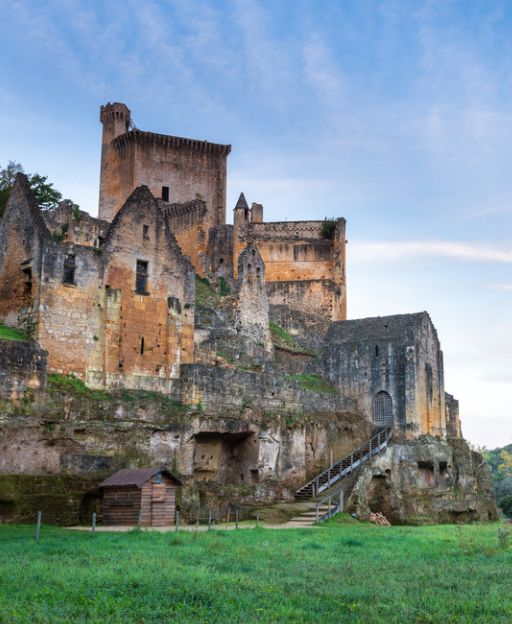
Castles line the river valleys here. Château de Beynac and Château de Castelnaud face each other across the Dordogne River — English and French strongholds during the Hundred Years’ War. Both now operate as museums and welcome visitors. Château des Milandes, once home to entertainer Joséphine Baker, tells a different kind of history. And Château de Commarque, buried in woodland near Les Eyzies, is one of the finest ruined castles in France — dramatically overgrown and rarely crowded.
The Food of the Dordogne: What to Eat
The Dordogne sits at the heart of Périgord gastronomy — a cuisine built around foie gras, duck confit, truffles, and walnuts. These are not tourist-trail additions. They are genuinely central to how people eat here.
Foie gras appears on almost every restaurant menu. The local version uses duck rather than goose, and producers make it throughout the region. You can visit farms that raise ducks using traditional methods. Whether you eat it or not, understanding the role of foie gras in the local economy and culture is part of understanding the Dordogne.
Confit de canard — duck leg slow-cooked in its own fat — is the region’s everyday staple. Order it at a village bistro and it will arrive dark-skinned, falling off the bone, served with potatoes cooked in the same fat. There is little more satisfying.
Truffles from Périgord are among the most prized in France. The black truffle season runs from December to February. If you visit at this time, look for menus featuring truffle omelettes, truffle risottos, and whole truffles sold at market. Sorges, north of Périgueux, even has a truffle museum.
Walnuts appear everywhere — in salads, in cakes, and pressed into oil that producers drizzle over goat’s cheese. Périgord walnut oil has protected designation of origin status and is worth bringing home.
For a broader picture of French regional food and drink traditions, our guide to the French Vendange explores how the seasons shape what ends up on French tables.
When Is the Best Time to Visit the Dordogne?
Late spring (May to early June) is arguably the finest time to visit. The crowds have not yet arrived in force, the weather is warm, the countryside glows green, and markets run at full swing. Accommodation is easier to book and noticeably cheaper than in high summer.
Summer (July and August) is the most popular period, particularly with French and British families. Sarlat and the major cave sites get crowded. Book accommodation and cave tickets — especially for Font-de-Gaume — well in advance. The long evenings make up for the daytime crush.
Autumn (September and October) is becoming increasingly popular with travellers who have discovered what the locals have always known. Walnut harvests begin, the forests turn copper and gold, and the truffle season is just around the corner. Restaurants are still open, prices drop, and the light in the valley is extraordinary.
Winter (November to February) is quiet. Many restaurants and some accommodation close. But the truffle markets are at their peak, and visitors who make the trip find a France they rarely see — unhurried, local, and very much still alive.
For a full breakdown by region and month, our guide to the best time to visit France covers everything you need to plan your trip around the seasons.
How to Get to the Dordogne
The closest major airport is Bordeaux-Mérignac (BOD), which is well-served by flights from the US, UK, and across Europe. From Bordeaux, the drive to Sarlat takes about two hours on the A89 motorway. Bergerac Airport (EGC) is smaller but closer — about an hour from Sarlat — and has seasonal flights from several British airports.
You need a car to explore the Dordogne properly. Public transport connects the main towns but covers almost none of the villages and cave sites. Hire a car at the airport and plan to cover distances slowly. The minor roads are part of the experience — narrow, winding, and frequently more beautiful than anything marked on the map.
Where to Stay in the Dordogne
The Dordogne has an excellent range of accommodation, from farmhouses and chambres d’hôtes (bed and breakfasts) to châteaux hotels and well-placed campsites. Staying in and around Sarlat gives you access to most of the major sites. The village of La Roque-Gageac — regularly listed among France’s most beautiful villages — has a few excellent hotels directly on the riverbank.
For the prehistoric sites, staying near Les Eyzies makes early visits easier. Font-de-Gaume sells out fast; staying nearby means you can arrive before the queues form.
If you are planning to combine the Dordogne with other parts of south-west France, our Loire Valley road trip guide offers a useful comparison for planning a longer French itinerary.
Practical Tips for Visiting the Dordogne
- Book Font-de-Gaume in advance. This is the only decorated prehistoric cave in France still open to original visitors. You must reserve tickets online, and the site caps visitor numbers strictly.
- Arrive early at Sarlat market. The Saturday market runs from 08:00. By 10:00 it is packed. The best foie gras producers and truffle sellers are there from the start.
- Learn a little French. English is understood in most tourist areas, but in smaller villages and at farm gates, a few words of French open doors. Our guide to French etiquette covers the basics every visitor should know.
- Fill the tank before you need to. In rural Périgord, petrol stations are not always where you expect them. In smaller villages, stations are sometimes unmanned and require a French bank card.
- Give yourself more time than you think you need. A week is the minimum for doing the Dordogne justice. Most visitors who come for five days wish they had stayed for ten.
Frequently Asked Questions About the Dordogne
How many days do you need in the Dordogne?
Most visitors find that five to seven days is the right amount of time to cover the key sites without rushing. A long weekend works if you focus on a single area, such as Sarlat and the river villages, but you will leave wanting more.
Is the Dordogne worth visiting in autumn?
Autumn is one of the best times to visit. The summer crowds have gone, prices are lower, and the walnut harvest and changing foliage make the landscape particularly beautiful from mid-September through October.
What language do people speak in the Dordogne?
French is the main language throughout the Dordogne. In tourist areas, restaurant staff and hotel receptions often speak English. Away from the main sites, English is less common, and a basic knowledge of French will serve you well.
Can you visit the Dordogne without a car?
It is very difficult. Public transport connects the larger towns, but the prehistoric caves, river châteaux, and bastide villages are spread across a rural area with limited bus services. Hiring a car is strongly recommended for any itinerary beyond Sarlat itself.
What is the Dordogne known for?
The Dordogne is known for three things above all: prehistoric cave art (particularly Lascaux), medieval villages and châteaux along the river valleys, and the rich local cuisine built around duck, foie gras, truffles, and walnuts.
You Might Also Enjoy
- Provence Travel Guide: What to See, Do and Eat in France’s Sunniest Region
- Burgundy France Travel Guide: Wine, Villages and What to See Beyond the Vineyards
- France Travel Budget: How Much Does a Trip to France Actually Cost?
Plan Your France Trip
Ready to start planning? Visit our complete France travel planning hub for everything you need to organise your trip — from visas and transport to the best regions for your travel style.
Join 7,000+ France Lovers
Every week, get France’s hidden gems, local recipes, and travel inspiration — the kind you won’t find in any guidebook.
Subscribe free — enter your email:
Love more? Join 64,000 Ireland lovers → · Join 43,000 Scotland lovers → · Join 30,000 Italy lovers →
Free forever · One email per week · Unsubscribe anytime
Tours & experiences you might love


Powered by Viator. Some links are affiliate links — we may earn a small commission at no extra cost to you.

Leave a Reply